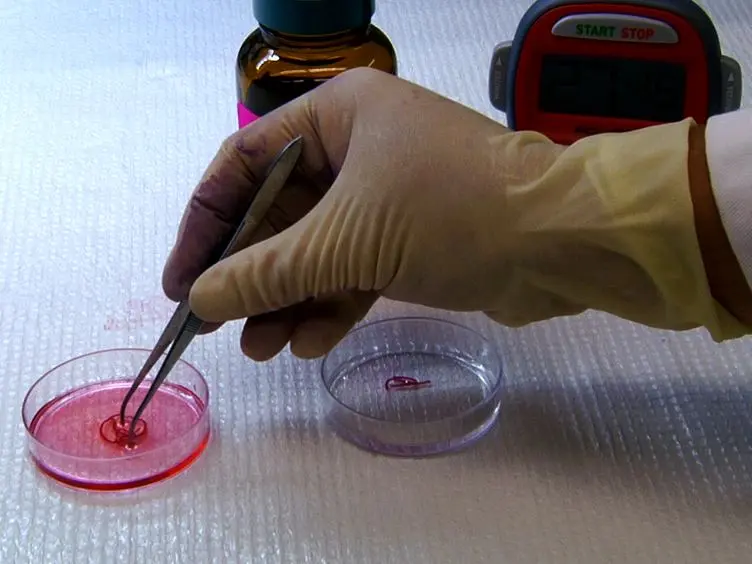
Wild animals are commonly parasitized by a wide range of helminths. The four major types of helminths are “roundworms” (nematodes), “thorny-headed worms” (acanthocephalans), “flukes” (trematodes), and “tapeworms” (cestodes). Here we describe how helminths are collected from a vertebrate animal and how they are preserved and taxonomically identified.
A subscription to JoVE is required to view this content. Sign in or start your free trial.
Method Article
Helminth Collection and Identification from Wildlife
In This Article
Summary
Abstract
Wild animals are commonly parasitized by a wide range of helminths. The four major types of helminths are "roundworms" (nematodes), "thorny-headed worms" (acanthocephalans), "flukes" (trematodes), and "tapeworms" (cestodes). The optimum method for collecting helminths is to examine a host that has been dead less than 4-6 hr since most helminths will still be alive. A thorough necropsy should be conducted and all major organs examined. Organs are washed over a 106 μm sieve under running water and contents examined under a stereo microscope. All helminths are counted and a representative number are fixed (either in 70% ethanol, 10% buffered formalin, or alcohol-formalin-acetic acid). For species identification, helminths are either cleared in lactophenol (nematodes and small acanthocephalans) or stained (trematodes, cestodes, and large acanthocephalans) using Harris' hematoxylin or Semichon's carmine. Helminths are keyed to species by examining different structures (e.g. male spicules in nematodes or the rostellum in cestodes). The protocols outlined here can be applied to any vertebrate animal. They require some expertise on recognizing the different organs and being able to differentiate helminths from other tissue debris or gut contents. Collection, preservation, and staining are straightforward techniques that require minimal equipment and reagents. Taxonomic identification, especially to species, can be very time consuming and might require the submission of specimens to an expert or DNA analysis.
Introduction
Vertebrates are parasitized by four major groups of helminths (worms). Two of the groups, trematodes, or flukes, and cestodes, or tapeworms, fall within the Phylum Platyhelminthes. The other two groups are the nematodes, or roundworms, (Nematoda) and the acanthocephalans, or thorny-headed worms (Acanthocephala). Many of these parasites have been documented as causes of morbidity and mortality in wild birds and mammals1,2.
Most helminths have complex life cycles involving more than one host1,2 . For instance, trematodes have one or two intermediate hosts (usually invertebrates) and a final host. All hosts need to be ava....
Access restricted. Please log in or start a trial to view this content.
Protocol
Animals used in the following experiments were found dead as road kills.
1. Animal Necropsy and Screening of Major Organs for Helminth Collection
- Position the animal on a flat surface and examine all external openings including ears, oral cavity and eyes with a magnifying glass for the presence of nematodes (round) and trematodes (flat and not-segmented) (see Figure 1).
- If working with birds, wash with tap water to dampen the feathers prior to dissecting.
- Using a sharp blade or knife and with the aid of a pair of dissecting forceps, make an incision over the abdominal cavity being carefu....
Access restricted. Please log in or start a trial to view this content.
Results
Using the methods outlined above, a survey of the helminths of the masked shrew, Sorex cinereus, was conducted in Missoula County, Montana between 2007-2011. A total of 56 shrews were collected from pitfall traps and examined within 2 hr after death. Overall prevalence of infection was 96%; only 2 shrews were free of parasites. Fifteen species of helminths were identified, including 9 species of cestodes and 6 species of nematodes. One species of the cestode genus Staphylocystoides was previously undesc.......
Access restricted. Please log in or start a trial to view this content.
Discussion
It is extremely difficult to identify helminth parasites, even to genus, based on poor material. Cestodes and trematodes, in particular, tend to die and deteriorate fairly rapidly after the death of the host. The taxonomy of cestodes depends greatly on the number, size, and shape of rostellar hooks, which are often lost in frozen material. The same applies to certain trematodes with spines around the oral sucker such as echinostomes and heterophyids, which are also frequently lost. Because of their thick cuticles, nemato.......
Access restricted. Please log in or start a trial to view this content.
Disclosures
We have nothing to disclose
Acknowledgements
The authors would like to thank Dr. Joe N. Caudell, Disease Biologist for the Indiana USDA APHIS Wildlife Services Program at Purdue University, for providing specimens used for the collection of helminths for the production of this video. Jennifer Serafin prepared all of the chemical solutions.
....Access restricted. Please log in or start a trial to view this content.
Materials
| Name | Company | Catalog Number | Comments |
|---|---|---|---|
| Fixing | |||
| Alcohol-Formalin-Acetic Acid (AFA) | Fisher Scientific | A407-1 (ethanol) F75F-1GAL (formaldehyde) BP2401500 (glacial acetic acid) | Ethanol 85% (85 ml) + formaldehyde 37% (10 ml) + glacial acetic acid (5 ml) |
| Ethanol for killing and long-term preservation | Fisher Scientific | A407-1 | Ethanol 100% (70 ml) + distilled water (30 ml) |
| Ethanol for fixing and DNA studies | Fisher Scientific | AC61511-0010 | Ethanol 80-90% (80-90 ml) + distilled water (20-10 ml), respectively |
| Formalin Buffered | Fisher Scientific | SF100-4 | Formalin 10% (10 ml) + distilled water (90 ml) |
| Glycerine-alcohol | Fisher Scientific | A407-1 (ethanol) AC15365-1000 (glycerine) | Ethanol 70% (95 ml) + glycerine (5 ml) |
| Clearing, staining and mounting | |||
| Ethanol for dehydrating during staining | Fisher Scientific | A407-1 | Ethanol 80%, 95%, 100% (80 ml, 95 ml, 100 ml) + distilled water (20 ml, 5 ml, 0 ml) |
| Lactophenol | Fisher Scientific | R400-27 | - |
| Phenol | Fisher Scientific | A931I-1 (phenol) A407-1 (ethanol) | Phenol 100% (80 ml) + ethanol 100% (20 ml) |
| Harris’ Hematoxylin | Fisher Scientific | S25347 (hematoxylin) A407-1 (ethanol) A567-500 (ammonium aluminum sulfate) S25553 (sodium iodate) | Hematoxylin (5 g) + ethanol 100% (50 ml) + ammonium aluminum sulfate (100 g) + sodium iodate (0.37 g) + distilled water (1,000 ml) |
| Semichon’s acetic carmine | Fisher Scientific | BP2401500 (glacial acetic acid) S25236 (carmine) A407-1 (ethanol) | Glacial acetic acid (100 ml) + carmine (1.5 g) + distilled water (100 ml). Heat in a boiling water bath for 15 min and cool. Filter to make stock solution. Mix 1:2 with 70% alcohol for staining. |
| Xylene | Fisher Scientific | X4-4 | Use only under a chemical fume hood. |
| Methyl salicylate | Fisher Scientific | S25437 | - |
| Ethanol basic | Fisher Scientific | A407-1 (ethanol) S25159A (concentrated ammonium hydroxide) | Ethanol 70% (100 ml) + ammonium hydroxide (0.1 ml) |
| Ethanol acid | Fisher Scientific | A407-1 (ethanol) SA9233-100 (hydrochloric acid) | Ethanol 70% (99.5 ml) + hydrochloric acid (0.5 ml) |
| Canada balsam | Fisher Scientific | B10-100 | - |
References
- Atkinson, C. T., Thomas, N. J. Parasitic Diseases of Wild Birds. Hunter, D. B. , John Wiley & Sons, Blackwell Press. Hoboken, New Jersey, USA. (2009).
- Parasitic Diseases of Wild Mammals. Samuel, W. M., Pybus, M. J., Kocan, A. A. , Second Edition, Iowa State University Press. Ames, Iowa, USA. (2001).
- Yamaguti, S. Parts 1 and 2. The Digenetic Trematodes of Vertebrates.
Access restricted. Please log in or start a trial to view this content.
Reprints and Permissions