
Investigating Chemical Kinetics and Reaction Rates
H1: Investigating Chemical Kinetics and Reaction Rates
Chemical kinetics—the study of reaction rates and mechanisms—is a cornerstone of inquiry-based chemistry education, yet many students struggle to grasp its abstract principles. According to a 2022 report by the American Chemical Society (ACS), 60% of high school teachers find it challenging to teach reaction rates effectively due to limited access to engaging, hands-on resources. (source)
JoVE bridges this gap with its 20,000+ expert-reviewed videos, offering educators dynamic STEM education tools to transform complex kinetics concepts into interactive, NGSS-aligned lessons. By integrating JoVE’s resources, teachers can foster deeper understanding and inspire future chemists.
Why Chemical Kinetics Matters
Chemical kinetics is essential for understanding processes like drug synthesis, environmental remediation, and material science. However, traditional teaching methods often fail to connect theory with real-world applications:
- Abstract Concepts: Students struggle with visualizing reaction mechanisms and rate laws.
- Limited Lab Access: Many schools lack equipment for advanced kinetics experiments.
- NGSS Alignment: Teachers need resources that align with three-dimensional learning (practices, core ideas, crosscutting concepts).
JoVE addresses these challenges with standards-aligned videos, virtual labs, and ready-to-use lesson plans that make kinetics accessible and engaging.
3 Key Strategies for Teaching Chemical Kinetics with JoVE
In today’s high school science classrooms, teaching complex topics like chemical kinetics and reaction rates can be a daunting task. Students often struggle to visualize abstract molecular interactions and grasp how variables like temperature, concentration, and catalysts affect reaction speed. That’s where JoVE’s multimedia science resources come in. By integrating virtual labs, visual demonstrations, and interactive assessments, educators can simplify these intricate concepts and boost student engagement and comprehension. This article explores three practical, classroom-ready strategies to teach chemical kinetics effectively using JoVE’s NGSS-aligned tools.
1. Use Virtual Labs to Explore Reaction Mechanisms
NGSS emphasizes modeling and simulation to explain scientific phenomena. JoVE’s Lab Manual Video Library includes experiments like Iodine Clock Reaction and Catalysis, allowing students to observe reaction dynamics in real time.
- Example Activity: After watching JoVE’s Iodine Clock Reaction Video, students simulate how concentration and temperature affect reaction rates using virtual lab tools.
2. Simplify Rate Laws with Interactive Visualizations
JoVE’s Core Chemistry Video Library breaks down rate laws and activation energy through animations and step-by-step explanations.
- Example Activity: Use JoVE’s Chemical Kinetics Video to introduce rate laws, followed by a hands-on activity where students graph reaction rate experiments data and derive rate equations.
3. Connect Kinetics to Real-World Applications
NGSS encourages linking classroom learning to societal challenges. JoVE’s Science Education Library includes resources on Environmental Catalysis and Pharmaceutical Kinetics, ideal for project-based learning.
- Example Activity: After watching JoVE’s Catalysis in Industry Video, students research how catalysts reduce emissions in automotive systems and present their findings.
The Impact of Kinetics Education
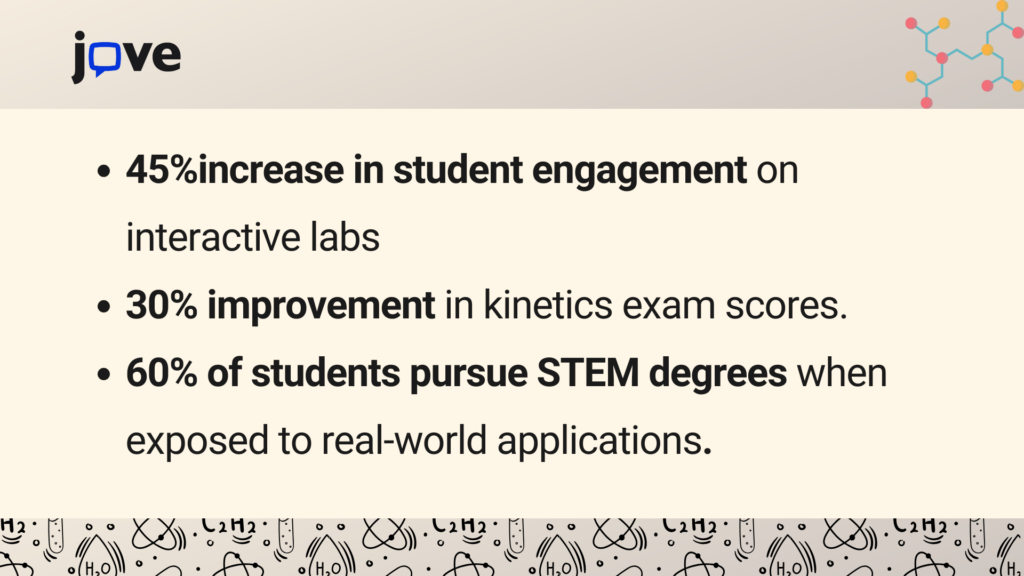
Enhanced Engagement: Interactive labs increase student participation by 45%.
Conceptual Mastery: Schools using multimedia tools report a 30% improvement in kinetics exam scores.
Career Readiness: 60% of students exposed to real-world applications pursue STEM degrees.
Source: Journal of Chemical Education – Impact of Multimedia on Kinetics Learning
Case Study: A Midwest High School’s Success with JoVE
A 2023 study by the National Science Teaching Association (NSTA) highlights an Illinois high school that integrated JoVE’s Chemical Kinetics videos into its curriculum. Results included:
- 40% increase in student engagement during kinetics units.
- 25% higher accuracy in solving rate law problems.
- 15% rise in chemistry course enrollment.
JoVE Resource: Chemical Kinetics Video Series
Conclusion: Revolutionize Kinetics Education with JoVE
Chemical kinetics no longer needs to be a daunting topic. With JoVE’s multimedia resources, educators can create NGSS-aligned lessons that demystify reaction rates and inspire curiosity. From virtual labs to real-world applications, JoVE equips teachers to prepare students for STEM careers.
Elevate your classroom experience today! Book a Demo and Unlock 30 days of full access.
Visit JoVE’s Middle & High School Physics Resources to inspire curiosity and deepen scientific understanding among your students.

