
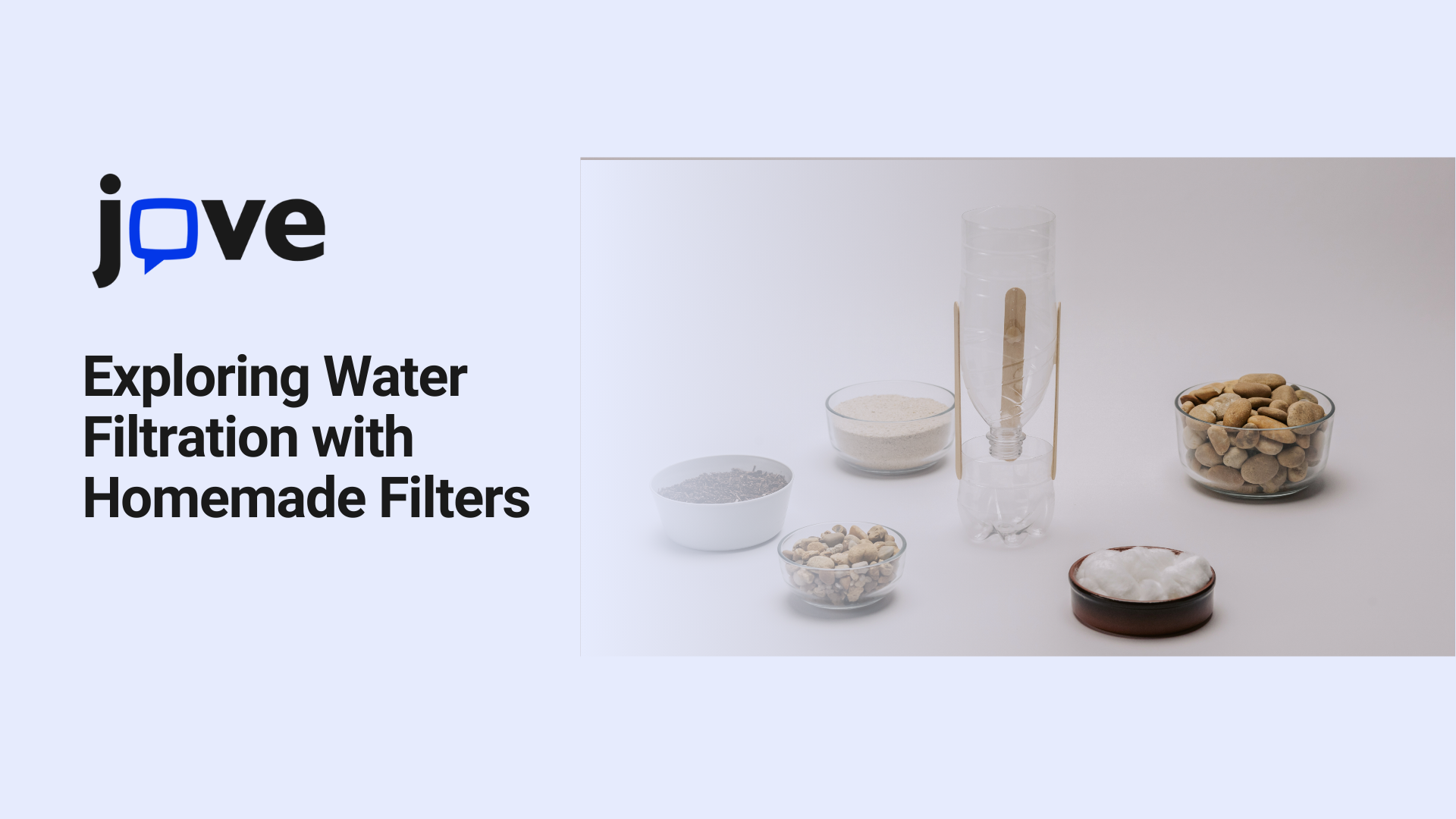
Exploring Water Filtration with Homemade Filters
Introduction: Turning Dirty Water into a Learning Opportunity
“What if you had to clean your own water in the wild?” asked Mr. Chang as he poured muddy water into a beaker. His students were immediately intrigued—and ready to engineer their own homemade filters for exploring environmental science. Through water filtration experiments, students investigated how physical and chemical processes help purify water, why access to clean water matters globally, and how science can solve real-world sustainability problems.
JoVE’s environmental science videos and NGSS-aligned lab experiments empower students to explore water quality, build working filtration systems, and test their effectiveness—while fostering problem-solving, inquiry, and systems thinking.
Why Water Filtration Education Matters
Access to clean drinking water is a global concern. According to UNICEF and WHO, 1 in 4 people worldwide lack access to safely managed drinking water. In the U.S., water quality remains a major topic in both science and civic education—especially as climate change and industrial pollution challenge local water systems. (source)
NGSS standard HS-ESS3-1 requires students to “construct an explanation based on evidence for how the availability of natural resources affects human activity.” Water filtration experiments give students the tools to examine filtration processes, test water purity, and explore how engineering designs can improve lives.
Engaging Water Filtration Experiments for the Classroom
Explore five NGSS-aligned activities to teach water quality and treatment filtration experiments using household or lab-grade materials to help students grasp core concepts of environmental science and engineering.
1. Build a Homemade Water Filter
Objective: Test different materials for filtering suspended particles
✅ Use plastic bottles, sand, gravel, cotton, and charcoal
✅ Have students test muddy water and record clarity, color, and smell before and after
🎥 Pair with JoVE’s Water Pollution and Filtration to explain filtration layers and contaminants
2. Analyze Water Quality Before and After Filtration
Objective: Use chemical indicators to measure filtration success
✅ Test pH, turbidity, and dissolved solids before and after filtration
✅ Compare results between filter designs
🎥 Use JoVE’s Water Quality Testing to teach protocols for environmental sampling
3. Compare Natural and Industrial Filtration Methods
Objective: Explore limitations and advantages of DIY vs. municipal systems
✅ Research and diagram how cities purify water
✅ Compare with students’ homemade designs
🎥 Use JoVE’s Sustainable Water Management to introduce resource conservation and system planning
4. Simulate Contamination and Chemical Adsorption
Objective: Model how charcoal and sand remove invisible pollutants
✅ Add diluted food coloring or iodine to simulate chemical contamination
✅ Test how activated charcoal adsorbs particles
🎥 Use JoVE’s Ecological Disturbance to link pollution with ecosystem impacts
5. Host a Classroom “Clean Water Challenge”
Objective: Encourage problem-solving and creativity in a real-world context
✅ Task students with filtering a liter of dirty water using only pre-assigned materials
✅ Score teams based on clarity, filtration time, and reuse potential
🎥 Reinforce with JoVE’s Nutrients in Aquatic Ecosystems to connect student inquiry to NGSS practice
Real-World Example: Global STEM Environmental Lessons Project on Water Quality
At North High School in Maryland, students partnered with a global non-profit to build and test low-cost filtration kits for a clean water initiative in Kenya. Using gravel, activated carbon, and DIY testing strips, students modeled contamination risks, tested turbidity, and shared their results during Earth Day.
This real-world application of hands-on water filtration experiments for middle & high school deepened students’ understanding of environmental justice, sustainability, and the intersection of science and global development. 🔗(source)
Conclusion — Clean Water Starts with Classroom Innovation
Water filtration is more than a science experiment—it’s a life skill rooted in global urgency. JoVE’s NGSS-aligned water filtration experiments help students understand how natural and engineered systems clean water, protect ecosystems, and save lives.
By combining JoVE videos with inquiry-based filtration labs, educators empower students to engage with climate resilience, environmental engineering, and civic responsibility.
💧 Ready to inspire curiosity and creativity through clean water science?
👉 Book a FREE Demo today and get full access to JoVE’s animated videos, interactive resources, and solar science experiments!

