
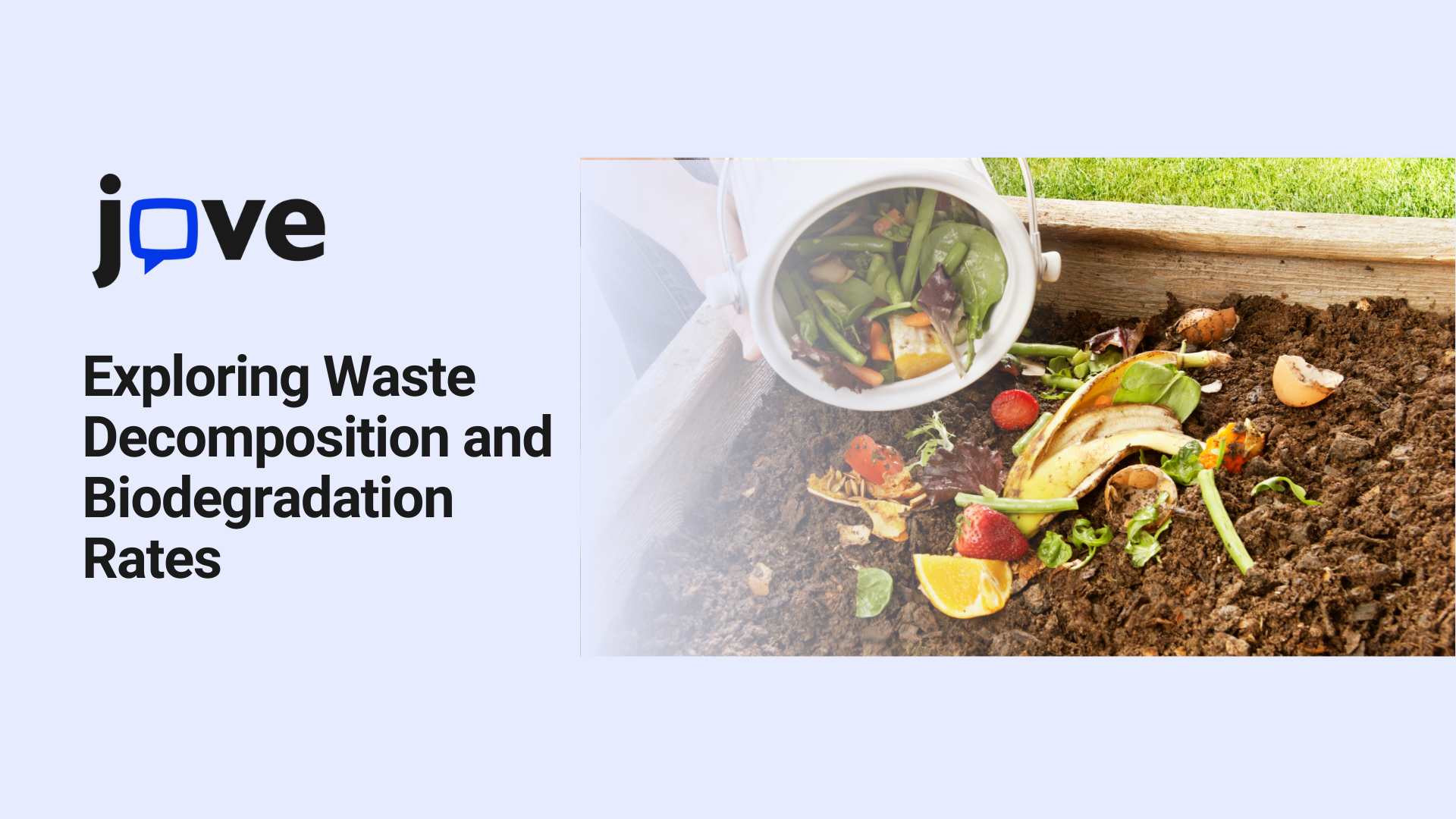
Exploring Waste Decomposition and Biodegradation Rates
Introduction: What Happens to Trash After We Toss It?
When Ms. Davis opened her biology class with the question, “How long do you think this plastic wrapper stays in the soil?” her students guessed everything from one month to 100 years. Their curiosity kicked off a series of biodegradation experiments comparing how quickly different materials decompose—and what factors influence the rate.
With JoVE’s NGSS-aligned environmental science videos and lab activities, students can monitor waste breakdown over time, explore the role of microbes and environmental conditions, and critically examine the real impact of everyday waste on ecosystems.
Why Biodegradation Education Matters
The average American produces over 4.5 pounds of trash per day, much of which ends up in landfills or the ocean. Understanding how waste breaks down—and why some materials persist—is essential for building sustainable habits and informed citizens. 🔗(source)
NGSS performance expectation HS-ESS3-3 challenges students to “create a computational simulation to illustrate the relationships among the management of natural resources, the sustainability lessons of human populations, and biodiversity.” Biodegradation experiments directly support this by showing students how variables like moisture, light, and material type affect decomposition, helping them apply science to real-world environmental challenges.
Engaging Biodegradation Experiments for High School Science
These five NGSS-aligned activities combine observation, data tracking, and JoVE video resources to explore the breakdown of waste in natural and artificial settings.
1. Compare Biodegradation of Organic vs. Synthetic Materials
Objective: Observe how material type affects decomposition
✅ Bury banana peels, paper, cotton, and plastic in separate soil containers
✅ Observe changes over 2–4 weeks and record visual, mass, and moisture differences
🎥 Pair with JoVE’s Composting and Microbial Action to explain microbial decomposition processes
2. Analyze Environmental Conditions and Decomposition Rate
Objective: Measure how light, temperature, and moisture influence breakdown
✅ Place identical waste samples in sun vs. shade, dry vs. moist soil
✅ Compare decay using smell, color, weight, and visual cues
🎥 Use JoVE’s Environmental Factors and Ecosystems to introduce variables affecting microbial activity
3. Use Transparent Decomposition Chambers
Objective: Monitor microbial action and gas release
✅ Create sealed observation chambers with plastic or glass sides
✅ Add soil, food waste, and organic matter; monitor gas bubbles, mold, and breakdown
🎥 Use JoVE’s Microorganisms activity in Environmental Science to explore bacteria and fungal roles
4. Test “Compostable” Product Claims
Objective: Decomposition Investigation real vs. marketed biodegradability
✅ Collect certified compostable utensils, bags, or packaging
✅ Bury alongside regular plastic and test breakdown over time
🎥 Pair with JoVE’s Sustainable Bioremediation to challenge product sustainability claims
5. Conduct a Decomposition Timeline Challenge
Objective: Engage students in research and presentation
✅ Have groups research and predict decomposition timelines for various materials
✅ Track changes and present results alongside photos and analysis
🎥 Use JoVE’s Biochemical cycles to reinforce inquiry-based lab procedures
Real-World Example: High School Students Audit Campus Waste
At Summit High School in Oregon, science students conducted a year-long biodegradation lab project. They buried a variety of school-lunch packaging—including biodegradable trays, paper bags, and single-use plastics—and tracked changes in weight, color, and microbial activity every week.
The results informed a school-wide campaign that replaced polystyrene trays with compostable alternatives and partnered with local farms to redirect food waste for composting. Their biodegradation experiments helped spark policy change and inspired students to pursue careers in environmental science.🔗 (source)
Conclusion — Decomposition Lessons That Stick
Biodegradation experiments show students that what we throw away doesn’t just disappear—it impacts ecosystems for decades. By measuring decomposition rates of natural and synthetic materials, students explore core biological processes, environmental systems, and real-world waste management.
With JoVE’s NGSS-aligned environmental science videos and inquiry-based labs, educators can turn trash into transformative lessons on sustainability, decomposition, and environmental action.
🌱 Ready to empower students through hands-on biodegradation experiments?
👉 Book a FREE Demo today and get full access to JoVE’s animated videos, interactive resources, and solar science experiments!

