
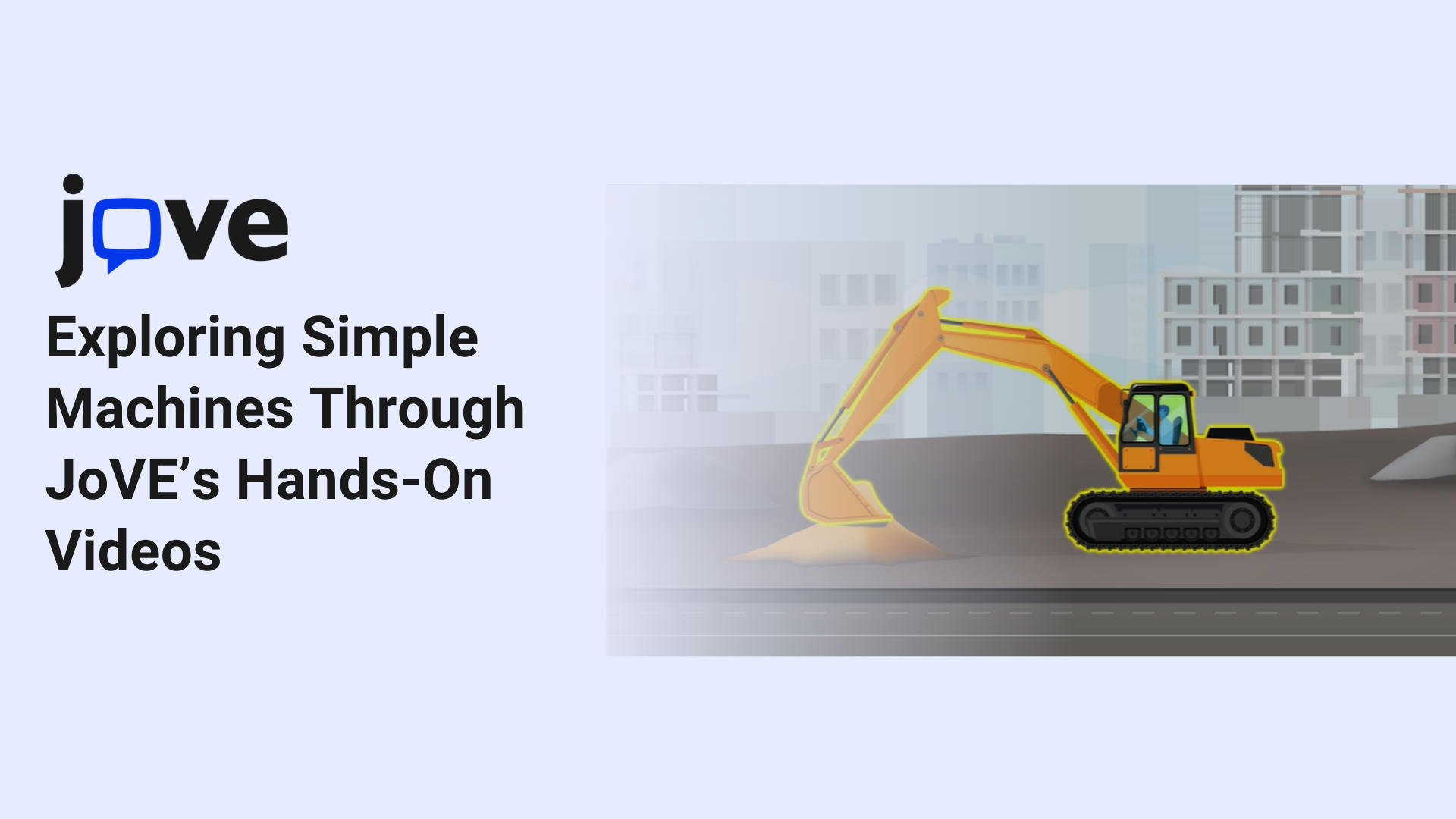
Exploring Simple Machines Through JoVE’s Hands-On Videos
Bringing Motion to Life
From lifting boxes with ramps to opening doors, simple machines make everyday actions easier. Yet, middle school students often struggle to understand exactly how levers, pulleys, and inclined planes actually work—unless they clearly see these machines in action.
Here, JoVE provides the solution. Through detailed animations, real-life demonstrations, and standards-aligned videos, JoVE helps teachers transform mechanical concepts into clear, engaging, hands-on lessons.
📺 Browse JoVE’s Simple Machines Science Video for Middle and High Schools
What Are Simple Machines and Why Teach Them Early?
Simple machines form the foundation of physics and engineering. They reduce the force needed to move objects, demonstrating essential scientific principles like force, motion, and energy transfer.
The six classic simple machines are:
- Lever
- Pulley
- Wheel and axle
- Inclined plane
- Wedge
- Screw
Clearly understanding these concepts helps students to:
- Grasp mechanical advantage
- Predict force requirements
- Develop early engineering skills
🎥 Use JoVE’s science video on Frames to visually demonstrate these tools with real-world examples and slow-motion breakdowns.
Activity 1 – Lever Lab: Find the Balance Point
Activity 1 – Lever Lab: Find the Balance Point
Objective: Help students clearly see how lever arm length affects mechanical advantage.
Materials:
- Meter stick
- Fulcrum (block or eraser)
- Weights or washers
- JoVE demonstration video
Instructions:
- Watch a JoVE video that introduces the concept clearly.
- Set up a basic lever and adjust the positions of the weights.
- Record observations and determine the lever’s balance point.
- Discuss clearly how load placement affects required effort.
📚 Connect this clearly to NGSS MS-PS3-1: “Construct and interpret graphical displays of data to describe relationships of kinetic energy to mass and speed.”
Activity 2 – Build Your Own Pulley System
Objective: Clearly explore how pulleys reduce the force required to lift weights.
Materials:
- String
- Pulleys (or spools)
- Small weights
- Hook or hanger
Instructions:
- Have students build both pulley types and compare effort.
- Clearly calculate how much less force is needed when adding more pulleys.
👩🔬 Reinforce learning with clear data charts and visual reflections.
How JoVE Videos Support Simple Machines Instruction
JoVE enhances teaching simple machines by providing:
✅ Clear visual learning through detailed animations
✅ NGSS-aligned video lessons and activities
✅ Hands-on experiments that students can replicate easily
✅ Auto-graded quizzes for immediate assessment feedback
📈 Studies show students using JoVE videos improved pre/post-lab performance by up to 100%, especially on topics like levers, pulleys, and force applications.
Common Misconceptions – Cleared with JoVE
❌ Misconception: “Pulleys always reduce effort.”
✅ JoVE clarifies clearly: Only movable pulleys reduce effort; fixed pulleys change direction only.
❌ Misconception: “All levers work the same way.”
✅ JoVE demonstrates Class 1, 2, and 3 levers, clearly comparing placement of force, load, and fulcrum.
JoVE’s videos allow students to pause, replay, and rewind, unlike single, one-time demonstrations.
Crosscutting Concept – Cause and Effect in Simple Machines
Simple machines provide a clear way to explore the NGSS crosscutting concept of Cause & Effect.
|
Cause |
Effect |
|
Adding more pulleys |
Reduces the force needed to lift an object |
|
Increasing lever arm length |
Reduces required effort force |
|
Using an inclined plane |
Spreads effort over a longer distance |
Encourage students to clearly predict and explain outcomes before and after conducting hands-on activities for simple machines.
Conclusion – Empower Problem-Solving Through Hands-On Physics
By pairing JoVE’s simple machines experiments with engaging classroom activities, educators empower students to:
- Clearly visualize how forces operate
- Understand math and mechanics behind machines
- Solve real-world engineering challenges confidently
🔍 Ready to simplify physics instruction with clear visuals?
👉 Book a Free Demo to Access JoVE’s Full Video Library on Simple Machines and Physical Science
No complicated setups—just clear visuals, interactive lessons, and NGSS-aligned excellence.

