
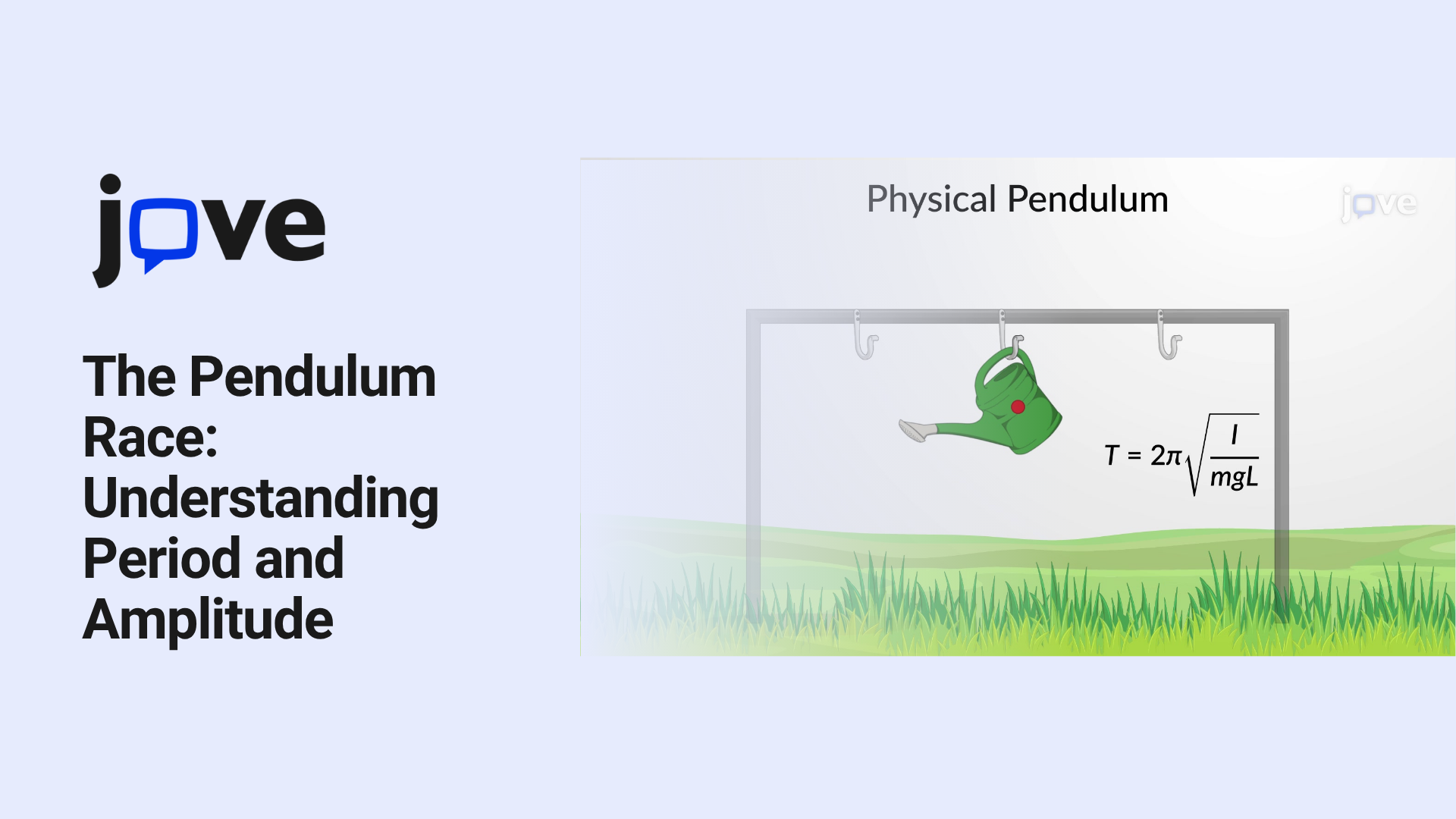
The Pendulum Race: Understanding Period and Amplitude
From Swinging to Solving
When students observe a swinging pendulum—on a playground, a grandfather clock, or in a lab—they’re seeing science in motion. For both middle school and high school students, pendulums offer a concrete way to explore patterns, predictability, and physical forces.
This article presents a flexible, NGSS-aligned activity that helps students understand how gravitational acceleration, period, and amplitude affect a pendulum’s motion. Whether you’re introducing energy transfer in middle school or analyzing time periods in high school, these concepts scale to meet student readiness.
🎥 Start by watching JoVE’s Pendulum Motion Video, designed to support visual learning at both middle and high school levels.
Why Pendulum Motion Still Matters in Physics Education
Pendulum motion offers an engaging, low-cost way to introduce core physics principles that apply to real-world systems—from seismographs to timekeeping. For middle school classrooms, it provides hands-on opportunities to explore cause and effect, forces, and energy transfer. In high school, the pendulum becomes a model for analyzing motion using quantitative data and mathematical relationships.
This versatility makes pendulums ideal for teaching NGSS-aligned physical science standards. For example:
- MS-PS2-2: Students can plan and carry out an investigation to provide evidence that the change in an object’s motion depends on the sum of the forces on the object.
- HS-PS2-1: Students can analyze data to support the claim that gravitational force affects the motion of objects.
Whether you’re introducing basic vocabulary or diving into trigonometric motion, pendulum experiments can meet your classroom needs while promoting visual, measurable, and repeatable scientific thinking.
Core Concepts Students Should Master
As you introduce pendulum motion, ensure students clearly understand:
- What period and amplitude mean
- How string length affects swing time
- The difference between mass and length effects
- How gravity influences acceleration
🧠 Tip: Use the NGSS crosscutting concept of “Pendulum” to help students identify consistent trends in pendulum data.
Classroom Activity – The Pendulum Race
Objective:
Explore how changing a pendulum’s length and amplitude affects its swing period.
Materials:
- String or fishing line (varying lengths)
- Washers or small weights
- Stopwatch or timer
- Ruler or meter stick
- JoVE pendulum motion video
Instructions:
- Watch JoVE’s pendulum video together as a class.
- Divide students into small lab teams.
- Each group creates pendulums of different lengths but consistent weights.
- Students record time for 10 swings (one full period = forward + return).
- Graph swing time vs. string length to analyze relationships.
- Repeat with different amplitudes to compare effects.
📈 JoVE’s Velocity and Position by Graphical Method Video helps students connect physical results to mathematical models.
Common Misconceptions – Cleared with JoVE
❌ Misconception: “Heavier pendulums swing faster.”
✅ JoVE clarifies: Mass doesn’t affect swing time, only length does.
❌ Misconception: “A bigger swing (amplitude) increases speed.”
✅ JoVE videos help show that amplitude changes have minimal impact on period unless extremely large.
🎥 Use JoVE’s Acceleration Due to Gravity to reinforce how pendulums demonstrate gravity’s effects consistently.
Real-World Application – A Clock That Teaches Time and Motion
At High School, a physics class turned a pendulum experiment into a timekeeping project. Students designed a functional pendulum clock using weights and string, experimenting with length to synchronize the ticks to seconds.
By pairing this project with JoVE’s videos on motion and measurement, students applied classroom concepts to build a working mechanical system—blending engineering, physics, and creativity.
Crosscutting Concept – Patterns in Pendulum Behavior
|
Cause and Effect Relationship |
Observed Pattern |
|
Shorter length |
Faster period |
|
Longer string |
Slower swing |
|
Greater amplitude |
Slight increase in period (minimal in small angles) |
Encourage students to identify and explain these trends based on collected data.
Conclusion – Make Motion Memorable
By using a pendulum experiment for students, you provide more than just swinging weights—you deliver measurable results, rich discussions, and a visual model for understanding motion.
JoVE’s NGSS-aligned physics videos support you every step of the way, offering clarity, animation, and reinforcement through expertly crafted lessons.
🎓 Want to make pendulum physics unforgettable?
👉 Book a FREE Demo today and get full access to JoVE’s animated videos, interactive resources, and solar science experiments!
JoVE access starts at just $2 per student.*
*Pricing based on 1,500 students.

