
Bridging the Gap: From Standards to Practice in Science Education
Bridging the gap between educational standards and classroom practice is essential for effective science education. The Next Generation Science Standards (NGSS) aim to transform science teaching strategies by integrating scientific practices, core ideas, and crosscutting concepts. However, educators often encounter challenges in implementing these standards effectively. This article explores strategies to align lesson plans with NGSS, leveraging multimedia science education resources to enhance science education.
The adoption of the Next Generation Science Standards (NGSS) signifies a commitment to providing high-quality science education. (source) However, educators often face challenges in translating these standards into effective classroom practices. A significant number of teachers report limited understanding of disciplinary concepts and experience with reform-based instructional approaches, hindering effective NGSS classroom implementation.
Why Bridging Standards to Practice Matters
Aligning classroom practices with NGSS challenges is crucial for fostering scientific literacy and critical thinking skills.(source) However, the transition from traditional teaching methods to NGSS-aligned instruction presents challenges, including limited instructional time for science and ineffective curricular resources. Addressing these challenges is essential to ensure that students receive a comprehensive science education that prepares them for future academic and career pursuits.
Key Strategies for Bridging NGSS to Classroom Practice
NGSS emphasizes phenomena-based instruction, hands-on experiments, and real-world problem-solving. Traditional textbooks often fall short in fully engaging students in scientific inquiry, making multimedia tools indispensable for standards-based science teaching.
Key Benefits of Using Multimedia in NGSS-Aligned Lessons
- Enhances Engagement: Visual and interactive content captures students’ attention, making complex concepts more accessible.
- Improves Comprehension: Multimedia allows students to observe and analyze real-world phenomena, deepening their understanding.
- Facilitates Hands-On Learning: Interactive virtual labs and simulations provide experiential learning opportunities, especially when physical resources are limited.
1. Embed Phenomena-Based Inquiry Activities
Phenomena-based instruction engages students by connecting scientific concepts to real-world scenarios. For example, using JoVE’s Evolutionary Relationships video, educators can anchor inquiry-based science activities, guiding students to explore patterns and analyze data practically.
2. Use Multimedia for Conceptual Clarity
Multimedia resources can enhance understanding of complex scientific ideas. JoVE’s Cell Division video visually breaks down intricate biological processes, aiding comprehension and retention. Studies have shown that multimedia tools can improve student engagement and learning outcomes in science education.
3. Employ Structured Collaboration
Collaborative activities promote scientific reasoning and interpersonal skills. JoVE’s Animal Behavior video models group investigations, facilitating discussions that deepen engagement with NGSS practices, such as data analysis and evidence-based arguments. Research indicates that structured collaboration enhances students’ problem-solving abilities and understanding of scientific concepts.
4. Implement Performance-Based Assessments
Performance-based tasks authentically assess students’ NGSS-aligned learning. Utilizing JoVE’s Energy Dynamics video, teachers can design assessments requiring students to plan investigations or interpret results, directly evaluating their proficiency in NGSS practices. Such assessments provide a comprehensive understanding of student learning and identify areas needing improvement.
Statistics on Bridging Standards to Practice
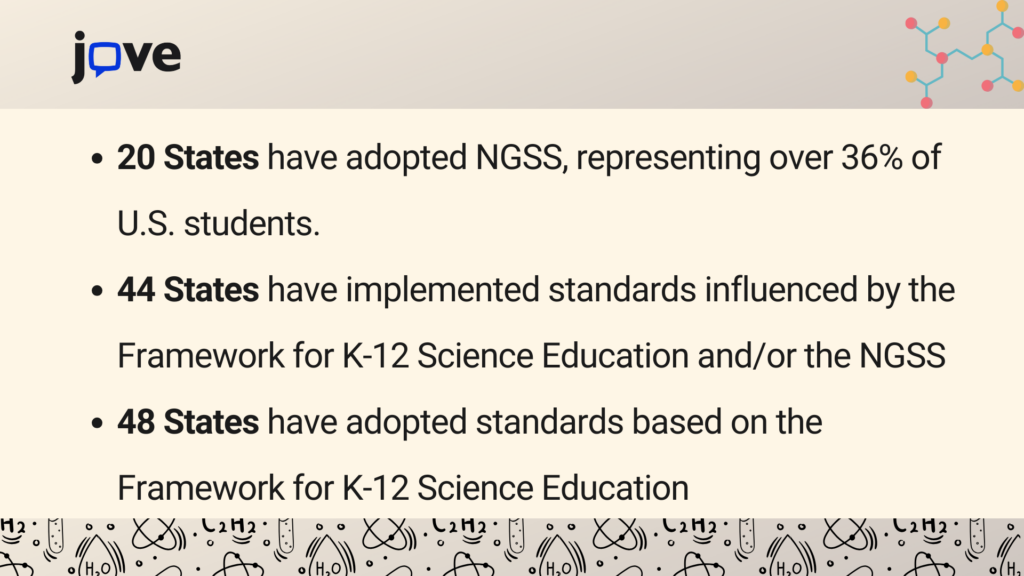
Implementing NGSS in classrooms requires addressing significant challenges to ensure effective science education. The infographic above highlights crucial data illustrating the importance and impact of aligning standards with classroom practice.
(Sources: School, District, and State Implementation of the Next Generation Science Standards, Ten Years of NGSS: Where Are We Now?, The Next Generation Science Standards and High School Chemistry🙂
Case Study: Bridging the Gap with Multimedia Learning
The measurable outcomes – higher engagement and learning gains – show the power of aligning teaching methods with NGSS. In practical terms, what made this NGSS implementation successful was a combination of visual learning (through JoVE’s videos), adherence to NGSS’s three-dimensional approach, and teacher enthusiasm in trying new methods. As one educator noted, the videos were “easy to use and teach the materials in depth,” helping even visual learners grasp challenging topics. This real-world example underscores that when teachers have the right resources and support, NGSS isn’t just an ideal on paper – it becomes a transformative force in the classroom, leading to deeper understanding and a 40%+ boost in student engagement in some cases (as the majority of teachers observed). By drawing on such successful models, other schools and districts can replicate these outcomes, tailoring the approach to their own context but keeping the core principle the same: connect the standards to engaging, evidence-based classroom practices.
Conclusion
Bridging the gap between standards and practice is essential for successful NGSS implementation. By integrating phenomena-based inquiry, multimedia resources, collaborative investigations, and performance-based assessments, educators can overcome implementation challenges. Crucially, you don’t have to do it alone. Modern educational resources like JoVE are designed to support teachers every step of the way. JoVE’s Middle & High School platform provides a wealth of NGSS-aligned videos, lab modules, and lesson guides that can save planning time and enrich your curriculum. JoVE’s resources make it easier to demonstrate complex phenomena, integrate science practices, and keep students hooked on learning science. As you plan your next unit, consider exploring what JoVE’s library has to offer – from physics simulations to biology lab techniques – all tailored for secondary education and mapped to standards.
Start effectively bridging standards to classroom practice today by booking a demo with us.

