
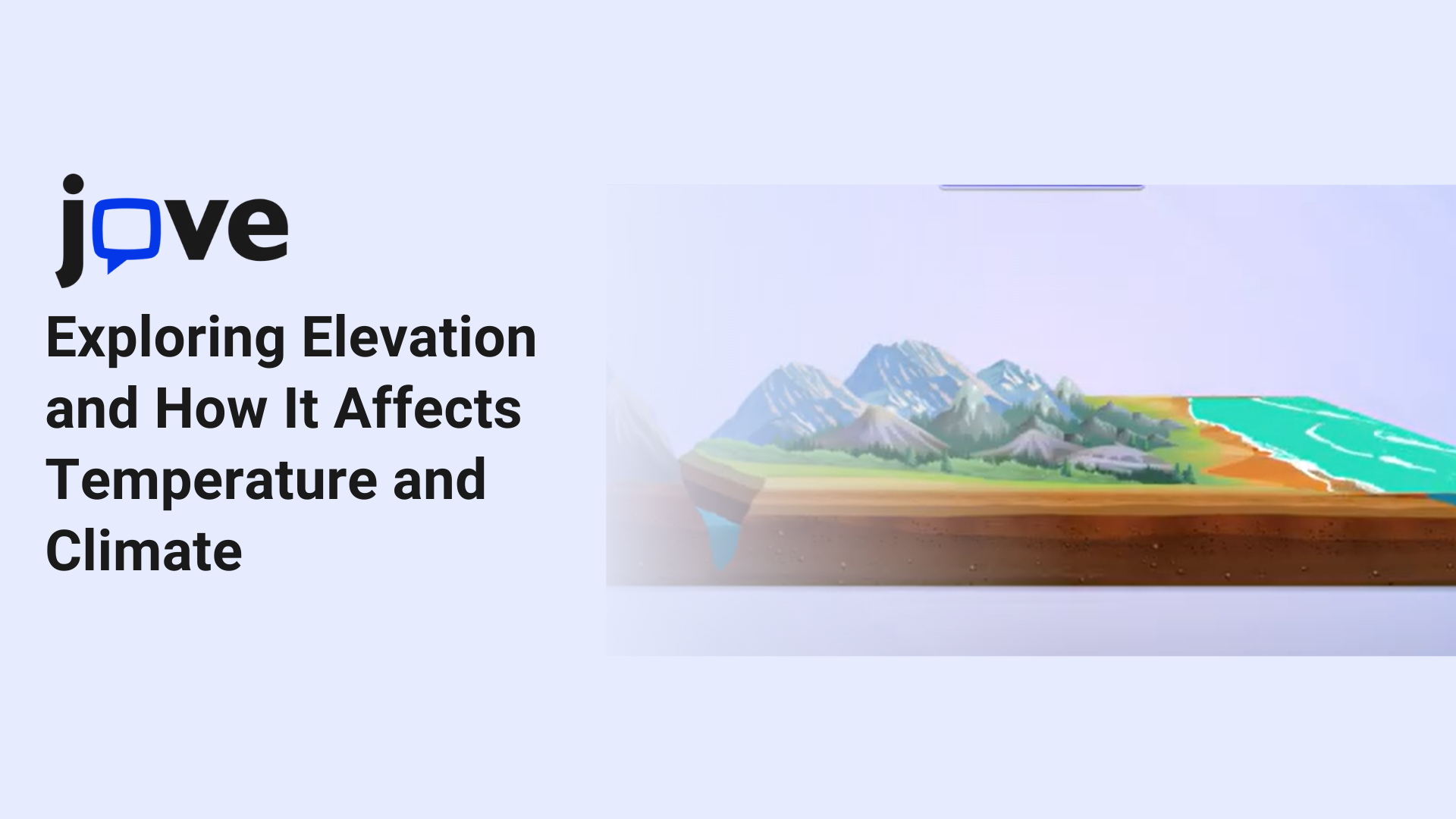
Exploring Elevation and How It Affects Temperature and Climate
Introduction: Why Does It Get Colder at the Top?
During a field trip to a nearby hiking trail, Mr. Davis’ 7th-grade students noticed something unexpected — the higher they climbed, the colder it got. It sparked a great classroom question: How does elevation affect temperature and climate?
To explain this relationship, Mr. Davis introduced a hands-on activity that made the science behind elevation and climate come to life. With a little help from JoVE’s science videos, students could both see and feel how altitude influences weather patterns.
What Is Elevation?
Elevation is the height of a point or location above sea level. It’s an important factor in geography and environmental science, and it directly affects air pressure, temperature, and climate conditions.
Teaching students about elevation helps them better understand how landscapes influence weather patterns and ecosystems.
What’s the Connection Between Elevation and Climate?
To make this concept hands-on, Mr. Davis set up an activity using thermometers and simple props to simulate temperature differences at varying elevations.
Materials Needed
✅ 2 identical thermometers
✅ 2 boxes or stands at different heights
✅ Ice packs or a fan (optional, for added effect)
✅ Timer or stopwatch
✅ Notebook for student observations
Step-by-Step Process
1️⃣ Set Up: Place one thermometer on a low table and another on a tall box or shelf.
2️⃣ Measure Starting Temps: Record the initial temperature of each.
3️⃣ Simulate Cooling: Use a fan or ice pack nearby to simulate thinner, cooler air at higher elevation.
4️⃣ Record Changes: After 10 minutes, compare and discuss the results.
This elevation and temperature science activity gave students a visual and physical understanding of how elevation impacts climate.
Real-World Examples Students Can Relate
To make the learning stick, Mr. Davis shared real-world connections:
🌄 Mount Everest: Despite being near the equator, its summit is freezing due to extreme elevation.
🏙️ Denver vs. Miami: Higher elevation in Denver makes it cooler on average than sea-level cities like Miami.
🌲 Mountain Forests: Tree lines change with elevation due to shifting temperatures and climates.
These examples helped students understand how elevation and climate are connected not just in textbooks, but across the globe.
Try This in Your Classroom!
✅ Have students record temperatures on different floors of the school building.
✅ Challenge them to research the elevation of their city and compare it to others across the country.
✅ Ask them to predict how temperature and weather might change during a mountain hike.
Want more ready-to-use activities? Explore JoVE’s Science Resources for middle school educators.
Conclusion — Elevate Learning with JoVE
Elevation isn’t just about how high you go — it’s about how the environment changes with every step. By combining easy experiments with visual learning, you can help students truly understand the link between elevation and climate.
Explore more engaging, curriculum-aligned science resources at JoVE and bring learning to life in your classroom.
Ready to make science unforgettable?
Book a FREE Demo Today to unlock JoVE’s full library of engaging, standards-aligned science videos built for middle school learners!

