
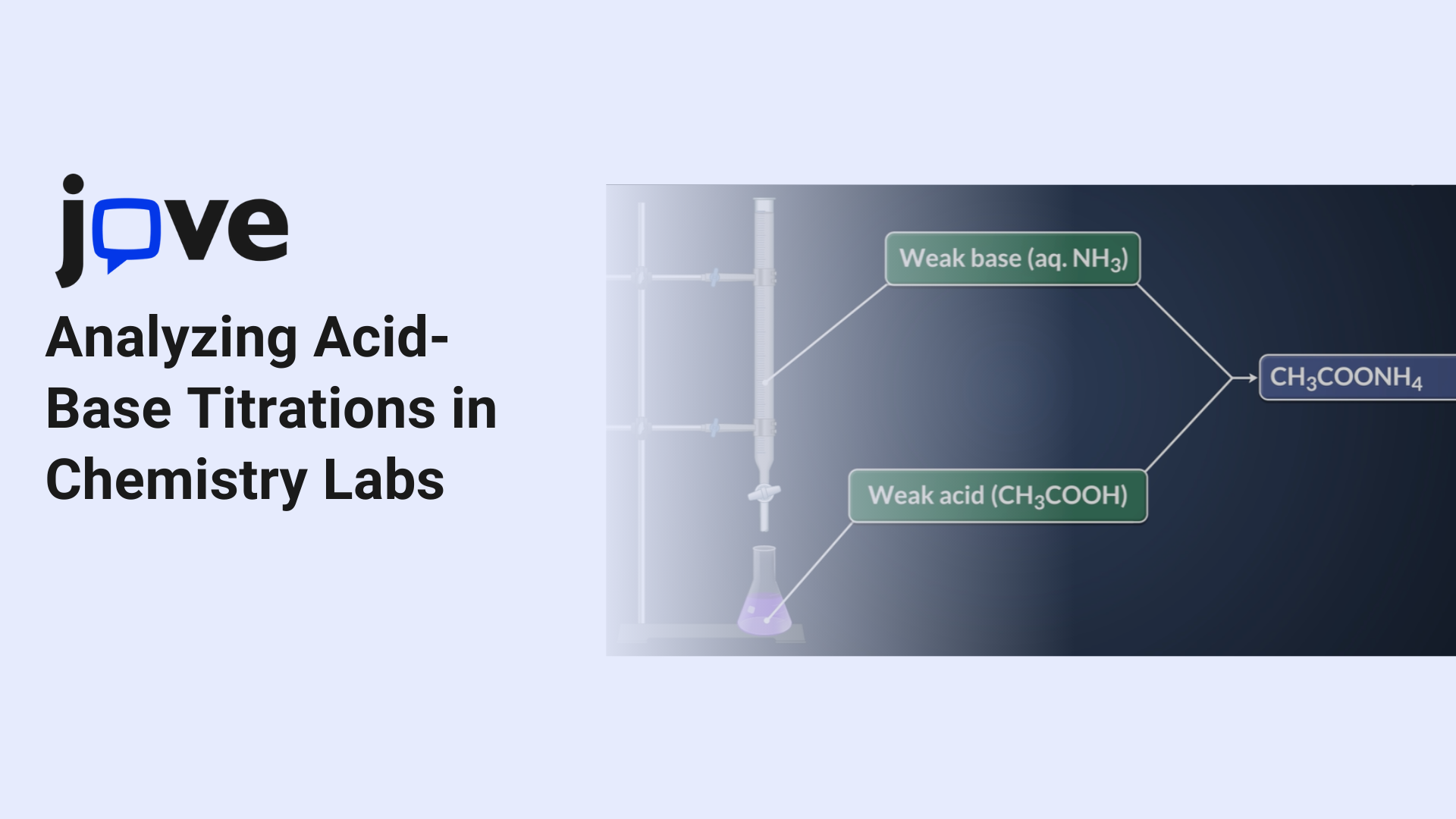
Analyzing Acid-Base Titrations in Chemistry Labs
Introduction: Bringing Chemistry to Life—One Drop at a Time
Mrs. Lane’s 10th-grade chemistry students were tired of dry textbook equations—until she handed them a burette and a beaker. With just a few drops of acid and base, the lesson transformed from passive learning to an exciting visual experiment.
Acid-base titration experiments not only demonstrate essential chemical reactions but also teach critical lab skills like measurement, observation, and data analysis. According to a 2023 study published in the African Journal of Educational Studies in Mathematics and Sciences, students who engaged in hands-on practical chemistry activities showed significantly higher understanding and interest in chemistry compared to those in lecture-based settings (AJESMS, 2023).
JoVE’s interactive videos give educators the tools to bring this concept alive in middle and high school settings, helping students visualize each step before they ever pick up a pipette.
Why Acid-Base Titration Experiments Matter in High School Chemistry
Acid-base titration is a foundational topic that introduces students to:
- The pH scale and neutralization reactions
- Analytical techniques used in labs and industry
- Real-world applications in medicine, agriculture, and environmental science
JoVE addresses this need by providing short, engaging visual demonstrations that show students the “why” behind every step.
How to Set Up a Successful Acid-Base Titration Lab
Setting up a titration lab correctly ensures students can focus on mastering the experiment while building essential lab skills safely and accurately.
Materials Needed
- Standard acid (e.g., HCl)
- Standard base (e.g., NaOH)
- Burette and pipette
- Erlenmeyer flask
- Phenolphthalein indicator
- Safety goggles and gloves
- Notebook for results
Step-by-Step Lab Guide
1️⃣ Start with the acid in a flask and add the base from the burette drop by drop.
2️⃣ Observe the color change once the acid is neutralized.
3️⃣ Record the volume of the base used.
4️⃣ Calculate the concentration using molarity formulas.
🎥 JoVE Resource: Titration Techniques: Measuring pH and Endpoint – Students can preview proper technique and practice analysis before lab time.
Tips for Making Titration Student-Centered
- Flip the Classroom: Assign JoVE videos before lab day to free up time for application and discussion.
- Real-World Scenarios: Link the titration to blood pH regulation or acid rain effects for greater relevance.
- Collaborative Experiments: Pair students to analyze errors and refine results.
Explore JoVE’s blog on Flipping the Chemistry Classroom with Educational Videos for more strategies.
How to Teach Acid-Base Titration to High Schoolers
To make acid-base titration accessible and engaging for students:
- Use analogies, like balancing a recipe, to simplify the process.
- Relate it to real-life problems, such as analyzing sports drinks or checking for acid rain damage.
- Pair JoVE’s animated titration videos with scaffolded worksheets.
- Conduct hands-on chemistry experiments for acid-base reactions in groups for peer learning.
This approach helps students better understand neutralization and molarity, while reinforcing key principles through active participation.
Conclusion — Turn Chemistry Concepts into Memorable Experiences
Acid-base titration experiments are an ideal way to merge theory with practice in high school chemistry. With JoVE’s high-quality video library and hands-on resources, teachers can foster student confidence, lab proficiency, and a genuine interest in chemistry.

