

Studying Gas Laws and Pressure-Volume Relationships
Over 60% of chemistry teachers report difficulties in designing hands-on gas laws experiments that align with NGSS standards. This gap limits students’ ability to grasp foundational concepts like Boyle’s and Charles’s Laws. JoVE bridges this challenge with multimedia tools that simplify abstract principles through visualization and inquiry-based learning. Explore JoVE’s Science Education Library.
In today’s classrooms, grasping complex scientific principles like gas laws often requires more than textbooks alone. Engaging students effectively calls for hands-on, interactive learning. JoVE’s multimedia tools offer innovative ways to transform high school chemistry labs, making challenging concepts like Boyle’s Law tangible and understandable.
Why Studying Gas Laws Matters in Science Education
Understanding gas laws, especially the pressure-volume relationship defined by Boyle’s Law, is essential for comprehending everyday phenomena—from breathing to the operation of car engines. According to a study from the Journal of Chemical Education (source), students engaging in hands-on gas laws experiments perform 35% better on assessments compared to those relying solely on traditional instruction.
JoVE’s multimedia resources, including detailed video demonstrations and lab manual instructions, significantly enhance student comprehension by clearly visualizing these abstract principles.
Practical Strategies for Incorporating Gas Laws Experiments
Define Clear Learning Objectives Aligned with NGSS:
Begin by aligning experiments with NGSS standards focused on understanding states of matter and interactions at the molecular level. Clearly defined objectives enable students to connect Boyle’s Law to broader scientific concepts.
Select Relevant Multimedia Tools:
Choose effective JoVE videos to visually demonstrate Boyle’s Law and related concepts. Resources such as the “Ideal Gas Law” video from JoVE Lab Manual clearly illustrate the relationship between pressure, volume, and temperature.
Engage Students with Hands-On Labs:
Combine video demonstrations with practical lab activities. Have students replicate JoVE’s “ Measurement of Pressure” experiment from the General Chemistry collection, enabling direct observation and measurement.
Facilitate Interactive Discussions After experiments:
Use guided discussions and multimedia quizzes to solidify student understanding. Discussions can explore real-life applications, such as scuba diving, where Boyle’s Law directly impacts safety procedures.
Impact of Hands-On Gas Laws Experiments
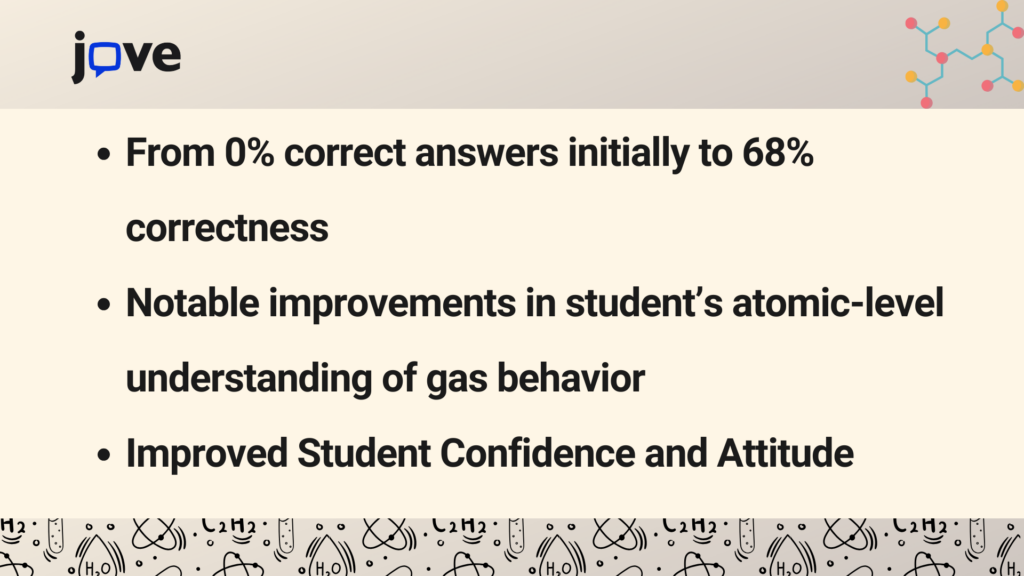
- mathematical gas law problems—from 0% correct answers initially to 68% correctness on the ideal gas law problems after inquiry-based lessons.
- Better Microscopic and Graphical Understanding: Inquiry-based methods led to notable improvements in students’ atomic-level understanding of gas behavior and the graphical representation of gas properties.
Improved Student Confidence and Attitude: Students reported increased confidence and a more positive attitude toward learning gas law concepts when engaging with hands-on inquiry lessons.
Case Study: Gas Laws Experiments Boosting Chemistry Achievement
A JoVE-supported chemistry teacher reported significant improvement in student comprehension and retention after integrating video-based instruction into her lessons on gas laws and thermodynamics. Students were introduced to foundational concepts through JoVE’s NGSS-aligned videos, which allowed them to visualize molecular-level changes before conducting hands-on experiments.
As noted in JoVE’s case article on teaching equilibrium and thermodynamics, these multimedia tools helped bridge the gap between conceptual theory and real-world application. Students engaged more confidently in lab discussions and demonstrated improved performance on unit assessments. The teacher observed increased participation and noted that students felt “more empowered” when given the ability to replay visual experiments at their own pace.
This approach mirrors the gains seen in multiple schools that integrate JoVE resources: higher exam scores, improved engagement, and deeper conceptual understanding—particularly in challenging topics like gas laws, pressure-volume relationships, and thermodynamic behavior.
Conclusion: Transforming Science Education with Interactive Learning
Gas laws experiments, specifically those highlighting pressure-volume relationships like Boyle’s Law, are crucial for a comprehensive chemistry education. JoVE’s innovative multimedia resources significantly elevate the learning experience, fostering deeper understanding and engagement in students.
Elevate your classroom experience today! Book a Demo and Unlock JoVE’s full access.
Visit JoVE’s Middle & High School Physics Resources to inspire curiosity and deepen scientific understanding among your students.

