
Innovative Approaches to Standards-Driven Science Teaching
Modern science education is evolving rapidly, with a growing emphasis on standards-based science teaching to ensure students develop critical thinking, problem-solving, and hands-on research skills. The Next Generation Science Standards (NGSS) have reshaped the approach to STEM instruction, encouraging aligned lesson plans for NGSS that incorporate real-world applications, inquiry-based science education, and interdisciplinary learning.
Yet, integrating these innovative practices isn’t always easy. Teachers must shift their role from information-deliverers to facilitators, which can be a significant change in classroom dynamics. Common obstacles include limited planning time, lack of suitable materials, and the steep learning curve of new pedagogies. Teacher confidence and beliefs also play a role – if an instructor is uncertain about an approach or doesn’t see its value, implementation may falter. For instance, a recent study noted that teachers may avoid certain NGSS-aligned practices if they perceive them as less valuable or feel unprepared to use them. (source)
Why Innovation is Key in Standards-Based Science Teaching
Traditional teaching methods often focus on rote memorization and passive learning. However, inquiry-based science education—a fundamental aspect of NGSS science curriculum—shifts the focus toward student-driven exploration, hands-on experimentation, and critical thinking.
Key Benefits of Innovative, NGSS-Aligned Teaching
- Improved retention rates: Students learn best when they actively engage with content through experiments and interactive learning.
- Increased student engagement: Innovative methods make science more relevant and exciting.
- Stronger STEM preparedness: Real-world applications help students develop skills essential for scientific careers.
Implementing NGSS doesn’t mean abandoning the standards – it means teaching the standards through engaging, modern methods. Below are four innovative strategies, each aligned with NGSS and supported by a JoVE video resource, that educators can apply in middle and high school science classrooms. These approaches illustrate how creative pedagogy can meet rigorous standards while captivating students.
Five Innovative Approaches for Aligned Lesson Plans for NGSS
1. Phenomena-Based Learning: Engaging Students with Real-World Science
NGSS encourages phenomena-driven instruction, in which students investigate real-world scientific occurrences to formulate questions, analyze data, and draw conclusions.
- Example: Instead of memorizing the water cycle, students can analyze local climate data and predict weather patterns.
- JoVE Resource: Climate Change & Ice Melt explores the effects of climate change using real-world environmental science models.
2. Cross-Disciplinary STEM Integration
Science should not be taught in isolation—STEM lesson planning should integrate concepts from math, engineering, and technology.
- Example: In a physics and engineering lesson, students design and test bridge models while applying mathematical equations for load distribution.
- JoVE Resource: Newton’s Laws of Motion provides an interactive way to connect physics principles with real-world engineering applications.
3. Inquiry-Based Learning Through Hands-On Labs
Hands-on, student-driven experiments are at the core of NGSS science curriculum.
- Example: Instead of reading about enzyme activity, students conduct experiments measuring reaction rates under different conditions.
- JoVE Resource: Enzyme Activity & pH demonstrates how environmental factors affect biochemical reactions.
4. Using Technology and Digital Simulations for Science Learning
Modern classrooms can enhance aligned lesson plans for NGSS with digital simulations, virtual labs, and AI-powered learning tools.
- Example: Students use virtual reality (VR) to explore DNA structure in 3D, improving comprehension of molecular biology.
- JoVE Resource: The Double Helical Structure of DNA provides an interactive breakdown of molecular genetics concepts.
5. Authentic Assessment Through Project-Based Learning
Traditional testing often fails to measure deeper understanding. Performance-based assessments, such as student-led research projects, scientific modeling, and presentations, better reflect real-world applications.
- Example: Students design their own ecological conservation project based on biodiversity research.
- JoVE Resource: Measuring Biodiversity provides an NGSS-aligned approach to studying ecosystems and conservation.
The Impact of Innovative Science Teaching on STEM Readiness
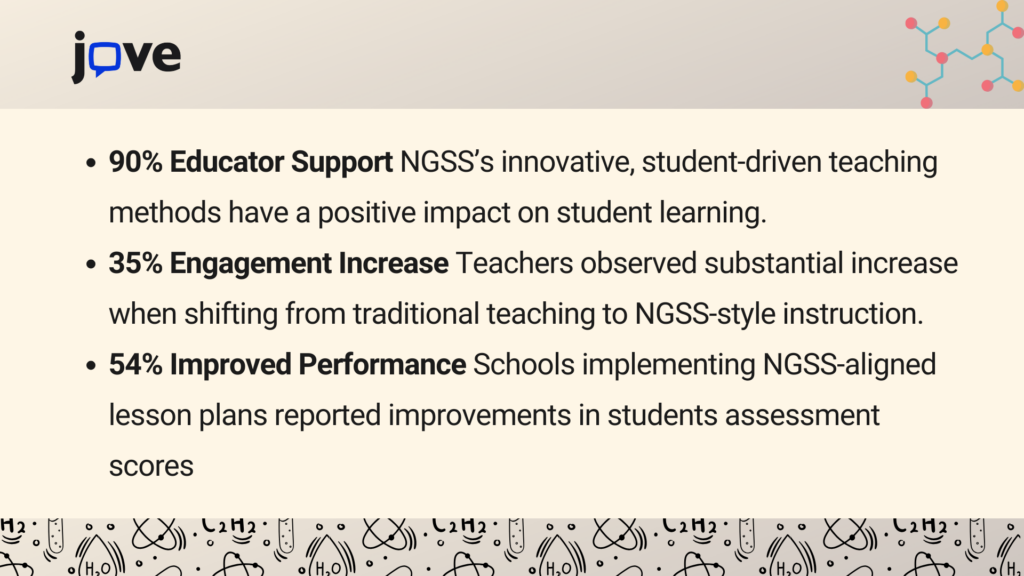
Source: ” A Powerful Lever for Equitable Learning, Language Development, and Learning in Other School Subjects (source).
Case Study: Real-World Success with NGSS Lesson Plan Alignment
To see NGSS alignment in action, let’s look at a real-world example of how an NGSS-aligned curriculum translated into classroom success. In a recent study, researchers examined the impact of implementing a comprehensive NGSS-aligned science curriculum in several middle schools. This curriculum was designed around NGSS principles—students explored phenomena, engaged in inquiry labs, and integrated core ideas with practices and crosscutting concepts. The results were impressive. Students who learned under the NGSS-aligned curriculum showed significantly higher learning gains than those who followed a traditional science curriculum. In fact, on an end-of-unit physical science test, the NGSS group outscored the control group by a substantial margin, with an effect size of +0.36 (source). To put that in perspective, an effect size of 0.36 suggests a noteworthy improvement in understanding, roughly equivalent to moving a student from the 50th percentile to the 64th percentile on that assessment. This case provides concrete evidence that aligning lesson plans with NGSS can boost student achievement in science.
Conclusion: The Future of Science Teaching is NGSS-Aligned and Innovative
By adopting innovative, NGSS-aligned lesson plans, educators can enhance engagement, improve comprehension, and prepare students for STEM careers. From technology-enhanced learning to inquiry-driven projects, modern science education must evolve to meet the needs of today’s students.
JoVE’s NGSS-aligned Science Education Library provides educators with comprehensive video resources to integrate standards-based science teaching seamlessly into their curriculum.
Ready to transform your science lessons?
Explore JoVE’s NGSS-aligned science videos today by booking a demo with us right now!

