
Mass vs Weight: Understanding the Difference in Middle School Science
Intro
Students often use mass and weight as if they mean the same thing, but these two terms describe very different ideas. Understanding this difference helps learners make sense of everyday situations, from why objects feel lighter on the Moon to how scales measure things in different ways. When these ideas are introduced clearly, students build stronger confidence in reading measurements and interpreting science data. With support from JoVE’s middle school video on mass and weight, this topic becomes easier to see and understand.
What Are Mass and Weight?
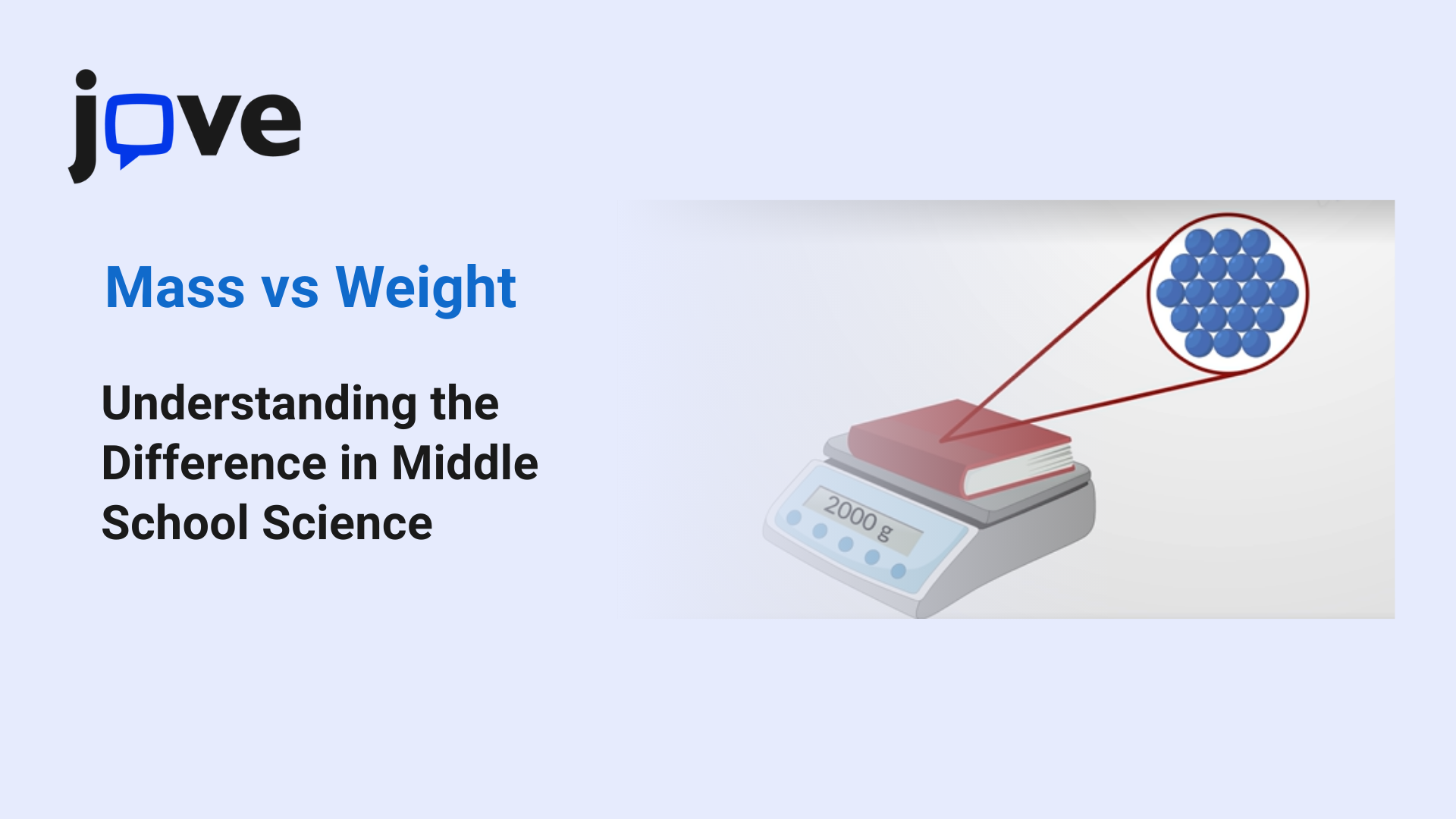
Mass is the amount of matter in an object. It does not change when the object moves from one place to another. Mass is measured in grams or kilograms.
Weight is the force of gravity acting on an object. Weight changes depending on how strong gravity is. The same object weighs less on the Moon because gravity is weaker there. Weight is measured in newtons.
These terms sound similar, but they describe different scientific ideas.
Why Do Students Confuse Them?
Students often confuse mass and weight because both relate to how heavy something feels. Stores use the word “weight” for most measurements, which adds to the confusion. Another issue appears when students see different types of scales. A balance scale measures mass, while a spring scale measures force. Even though both tools display numbers, they do not measure the same thing.
Clear definitions help students separate these ideas correctly.
Watch It in Action
JoVE Middle School Video: Mass and Weight
This video uses simple demonstrations to show how mass and weight differ and how each is measured.
Side-by-Side Comparison
| Feature | Mass | Weight |
| Meaning | Amount of matter in an object | Force of gravity acting on an object |
| Unit | Grams or kilograms | Newtons |
| Changes with location | No | Yes |
| Measured with | Balance scale | Spring scale |
| Example | Mass stays the same everywhere | Weight is lower on the Moon |
Real-Life Examples and Applications
Astronauts feel lighter in space because gravity is weaker. Their mass stays the same, but their weight changes. This makes it easier for students to visualize the difference.
Another helpful example comes from grocery shopping. A balance scale compares mass by using known weights. A digital spring scale measures force. Even though both tools are used to measure items, they gather different types of information.
Students can explore this idea by comparing these tools in a classroom activity. A balance will always show the same mass. A spring scale might show small differences depending on altitude because gravity changes.
Quick Check: Test Your Understanding
- Which quantity changes when you travel to the Moon?
- Which tool should be used to measure mass in the classroom?
- Why does an object weigh less where gravity is weaker?
Key Takeaways
- Mass is the amount of matter in an object.
- Weight is the pull of gravity on that object.
- Mass stays the same everywhere.
- Weight changes with gravity.
- Different tools measure each quantity.
Common Questions About Mass vs Weight
Why do objects weigh less on the Moon?
The Moon has weaker gravity, so it pulls with less force. Mass stays the same.
Is mass ever measured in newtons?
No. Newtons measure force, including weight, not mass.
Can weight change without changing mass?
Yes. Weight changes when gravity changes. Mass stays constant.
To make topics like mass vs weight easier for students to visualize, many educators rely on JoVE’s clear, standards-aligned videos. If you want to bring stronger visual learning into your science classroom, book a JoVE demo and see how these tools can support your instruction.

