
Understanding the Metric System and SI Units in Science
Why Scientists Around the World Use the Metric System
In 1999, NASA lost a $125 million Mars Climate Orbiter due to a unit mismatch—engineers used pounds instead of newtons. This high-profile error shows the importance of using a consistent, standardized measurement system in science.
That’s where the metric system in science plays a vital role. The metric system, along with SI units in science (International System of Units), provides a globally accepted framework for accurate and consistent measurement.
From measuring planetary distances in kilometers to examining bacteria in micrometers, these units support scientific accuracy and international collaboration. JoVE videos reinforce this concept by showing real-world lab scenarios where scientists apply these standards to ensure clarity and precision in experiments.
What Are SI Units and How Do They Work?
The SI system is built on multiples of 10, which makes metric conversion simple and scalable across different contexts. Examples include:
- 1 meter = 100 centimeters
- 1 kilogram = 1,000 grams
- 1 liter = 1,000 milliliters
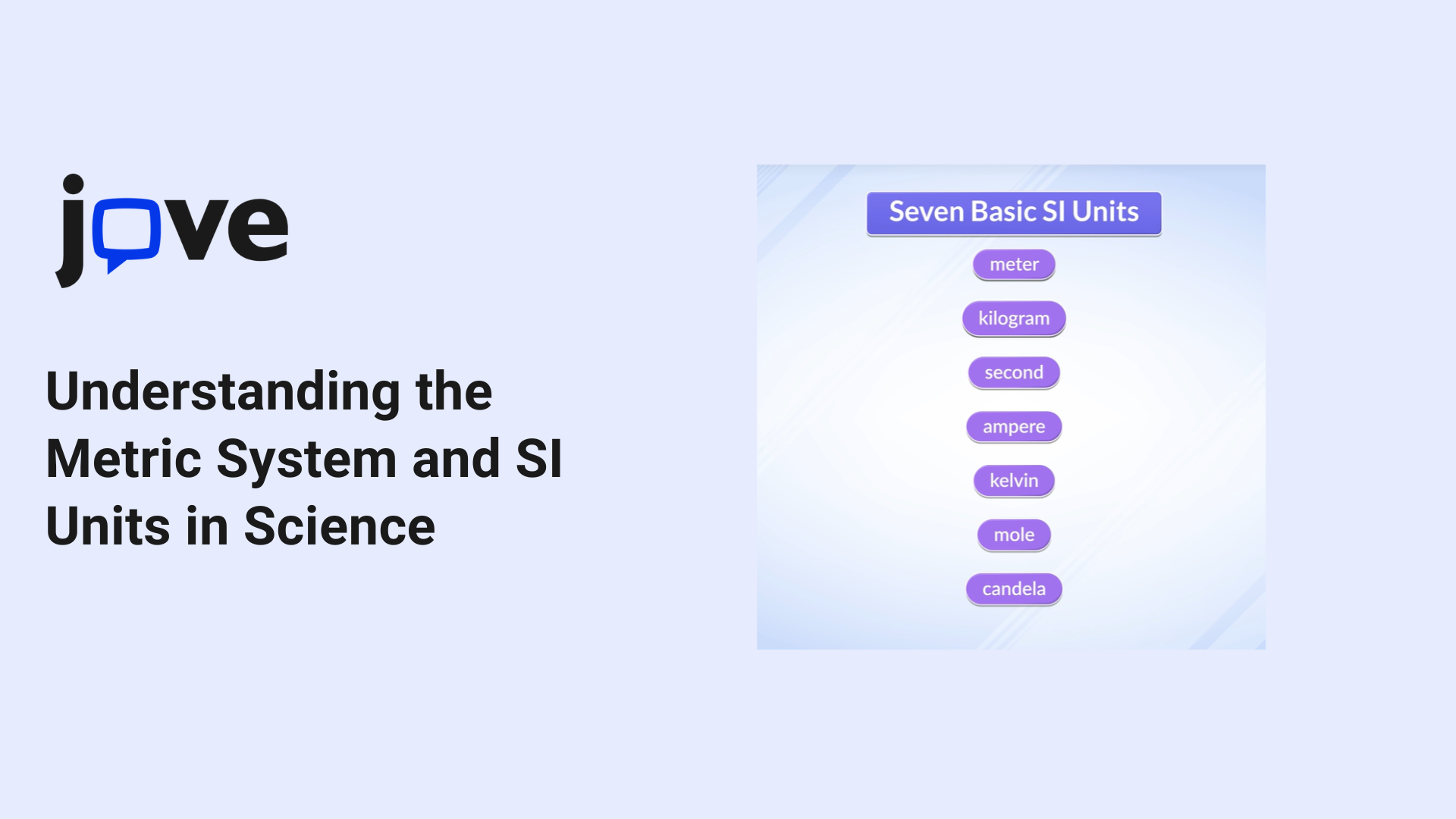
The seven base units are:
- Meter (m): length
- Kilogram (kg): mass
- Second (s): time
- Kelvin (K): temperature
- Ampere (A): electric current
- Mole (mol): amount of substance
- Candela (cd): luminous intensity
🔬 These units are used daily in scientific experiments and engineering labs.
🎥 JoVE’s video on metric-system and SI units demonstrate these measurements in action using rulers, graduated cylinders, thermometers, and balances—making abstract units tangible for students.
NGSS in Action: Measurement and Communication
The Next Generation Science Standards (NGSS) promote Science and Engineering Practices (SEPs) like Obtaining, Evaluating, and Communicating Information. This means students must not only take measurements but understand and explain what they mean.
Here are two real-world classroom activities aligned with these practices:
Activity 1: Measuring the World
Goal: Understand the global importance of SI units
What to Do: Have students research how scientists use SI units in real-world contexts:
- Space travel: kilometers
- Microscopy: micrometers
- Medicine: milliliters or milligrams
What You’ll Observe: Students will find examples of measurement used in different scientific fields and report how using SI units avoids costly or dangerous mistakes.
Why It Matters: This reinforces why scientists use the metric system and how consistent measurement supports international collaboration.
Activity 2: Metric Conversion Challenge
Goal: Practice converting metric values with confidence
What to Do: Give students a set of values (e.g., 3.2 kg → g, 250 mL → L) and walk through the conversion using a place-value strategy.
What You’ll Observe: Students will build fluency in metric conversion, noticing patterns based on place value.
Why It Matters: Helps students develop quantitative reasoning—a core component of NGSS—and ties directly into understanding the scientific measurement system.
🎥 JoVE videos can accompany both activities to visually reinforce procedures like measuring liquids or weighing objects.
Crosscutting Concept: Scale, Proportion, and Quantity
NGSS also highlights Crosscutting Concepts (CCCs) that help students connect scientific ideas across domains. One of the most relevant in measurement is Scale, Proportion, and Quantity.
The metric system in science is ideal for:
- Describing size and scale, from cells to solar systems
- Ensuring accuracy in lab measurements
- Preventing dangerous or costly unit conversion errors
Examples Students Can Explore:
- Micrometers to study bacteria
- Kiloliters for measuring water tanks or pools
- Grams for sugar packets
- Kilograms for comparing body weight or packaging mass
📏 When students understand that a small error in scale (like switching grams for kilograms) could lead to serious mistakes, they grasp the importance of real-world applications of SI units in science and engineering.
JoVE Helps Students Visualize Measurement Concepts
JoVE’s platform makes it easy for teachers to teach SI units in middle school using interactive, video-based instruction. JoVE provides:
✅ Animations of SI units used across biology, chemistry, and physics
✅ Lab demonstrations with tools like balances, rulers, and cylinders
✅ Built-in quizzes to assess understanding and retention
📊 A JoVE study showed students using its videos improved post-assessment performance by up to 100% compared to those using only handouts.
Conclusion: The Metric System Is the Language of Science
Whether measuring mass in grams or distance in kilometers, the metric system in science is essential to global communication and scientific accuracy.
By using JoVE’s curriculum-aligned visual learning tools and interactive strategies, educators can help students:
- Master metric conversion
- Apply SI units in science with confidence
- Connect classroom lessons to the real-world applications of SI units
🎓 Ready to help your students speak the universal language of science?
👉 Book a Demo to access JoVE’s full library of measurement-based STEM resources — no prep required.
Bring JoVE to your classroom starting as low as $2 per student.*
Explore funding resources to learn how your school can start using JoVE’s complete STEM video library today.
*Pricing based on 1,500 students.

