
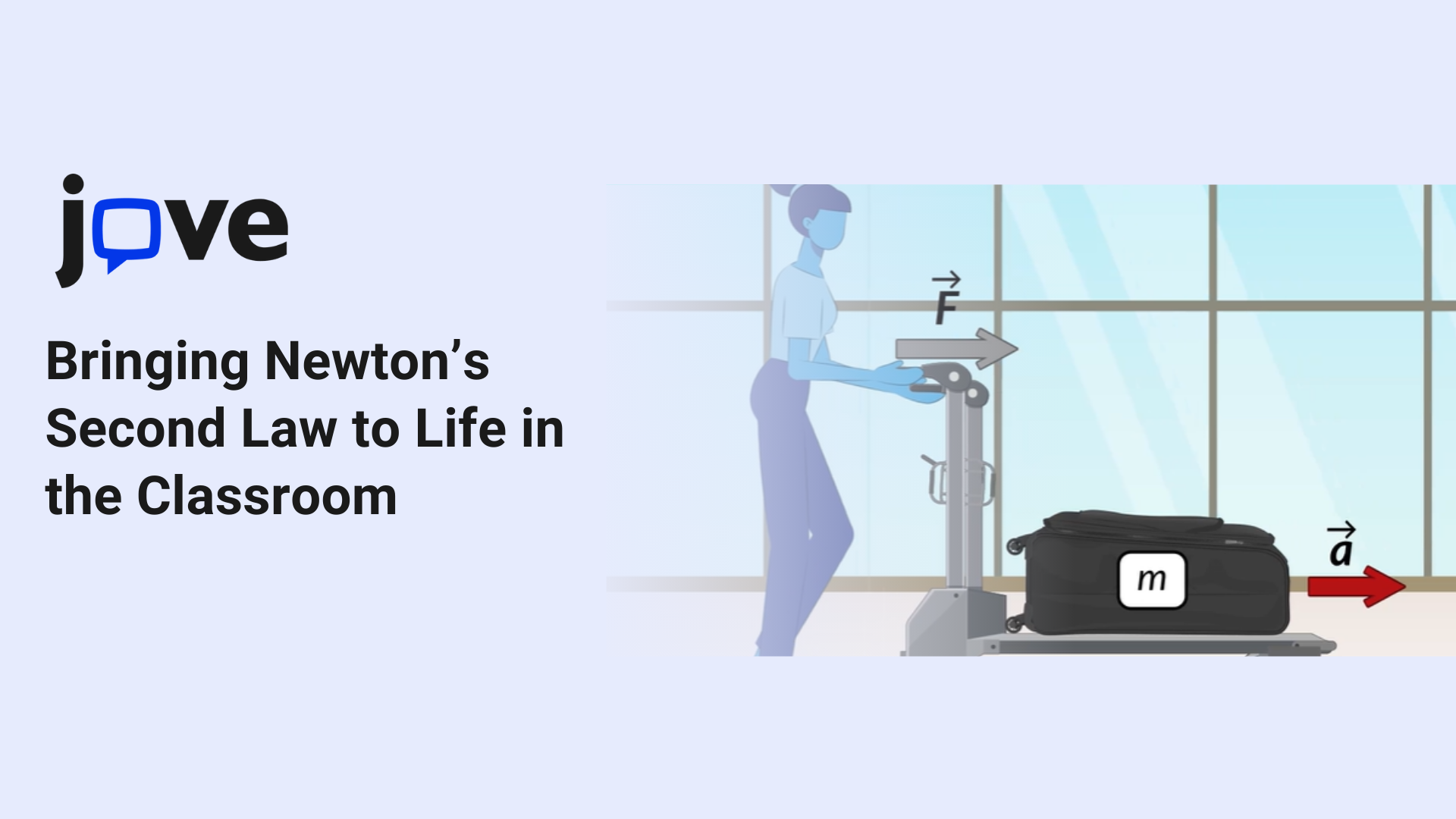
Force, Mass, and Acceleration: Bringing Newton’s Second Law to Life in the Classroom
Why Doesn’t a Bowling Ball Accelerate Like a Tennis Ball?
You push a bowling ball and a tennis ball with the same effort — only one shoots across the room. Why?
The answer is explained by Newton’s Second Law of Motion, a powerful concept in physics that relates force, mass, and acceleration. Teaching this law can be far more impactful when demonstrated visually and physically in class.
This article introduces a Newton’s Second Law experiment you can conduct with simple classroom materials, supported by NGSS-aligned Newton’s Second Law experiment videos from JoVE that bring theory to life.
What Is Newton’s Second Law of Motion?
Newton’s Second Law explains how the acceleration of an object depends on the net force applied and the mass of the object.
Formula:
F = m × a
Where:
- F = Force (Newtons)
- m = Mass (kg)
- a = Acceleration (m/s²)
💡 This law helps students understand why:
- More mass means less acceleration with the same force
- More force causes more acceleration with the same mass
This is the foundation for understanding mass and motion demonstrations and real-world physics.
Newton’s Second Law Experiment – The Cart and Weight Test
Objective: Show the relationship between force, mass, and acceleration using a hands-on lab.
Materials:
- Dynamics cart or toy car
- Stopwatch
- Masses or weights
- Smooth surface or ramp
- Pulley and string (optional)
- JoVE video on force and acceleration
Steps:
- Set up the cart on a smooth ramp or surface
- Add different masses to the cart
- Apply a consistent force (manual pull or hanging weight)
- Measure how long it takes to move a fixed distance
- Record and compare how acceleration changes as mass or force changes
🧪 This is a force mass acceleration lab for students that ties directly to MS-PS2-2 — Plan and conduct an investigation to provide evidence that the change in an object’s motion depends on the sum of the forces and the mass.
To explore how Newton’s Laws connect motion and forces, check out our articles on Newton’s First Law and Newton’s Third Law.
Real-World Applications for Students
Use real-life examples to make Newton’s Law meaningful:
- Why do heavier trucks accelerate slower than bicycles?
- Why does a football thrown by a pro athlete travel farther?
📌 Ask students to apply the equation F = ma to examples from sports, transportation, or amusement parks.
These connections help with how to teach Newton’s Second Law in the classroom through relatable scenarios.
JoVE Makes Force Visible
JoVE’s videos help you teach Newton’s Laws in middle and high school with clarity and engagement:
- Animations show force vectors and direction of motion
- Slow-motion clips reveal how acceleration changes over time
- Side-by-side experiments illustrate the effect of changing mass or force
📊 JoVE users show measurable learning gains — increasing post-lab comprehension from 28.2% to 89.5% on average.
Common Misconceptions – Resolved in Class
These JoVE-supported clarifications strengthen conceptual understanding:
- ❌ “Objects always move at the same speed regardless of weight.”
✅ Heavier mass = lower acceleration for the same force - ❌ “An object in motion doesn’t need force to keep going.”
✅ Newton’s Law shows that a net force is always needed to change motion
This makes it easier to reinforce concepts during a force and acceleration activity.
Activity Extension – Graph It!
Take your experiment a step further:
- Have students log acceleration for different masses or forces
- Plot force vs. acceleration on graph paper
- Use the slope to calculate system mass
📈 This makes your Newton’s Second Law experiment quantitative and visually concrete.
NGSS-Aligned and LMS-Ready
All of JoVE’s Newton’s Law content is built for classroom flexibility:
- Aligned to MS-PS2-1 and MS-PS2-2
- LMS integrations for Google Classroom, Canvas and other LMS platforms
This makes it ideal for any NGSS-aligned Newton’s Second Law experiment in middle school.
Conclusion – Physics That Moves Students
Newton’s Second Law turns equations into action. With JoVE’s visual tools, students don’t just memorize F=ma—they feel it through real-world experiments and hands-on activities.
Bring JoVE to your classroom starting at just $2 per student.*
Schools can fund JoVE through state and local options, or federal programs like Title I, III, IV, and EdTech—making implementation flexible and scalable.
Explore funding resources or book a free demo to access JoVE’s full suite of STEM learning videos and resources.
*Pricing is based on 1,500 students.

