
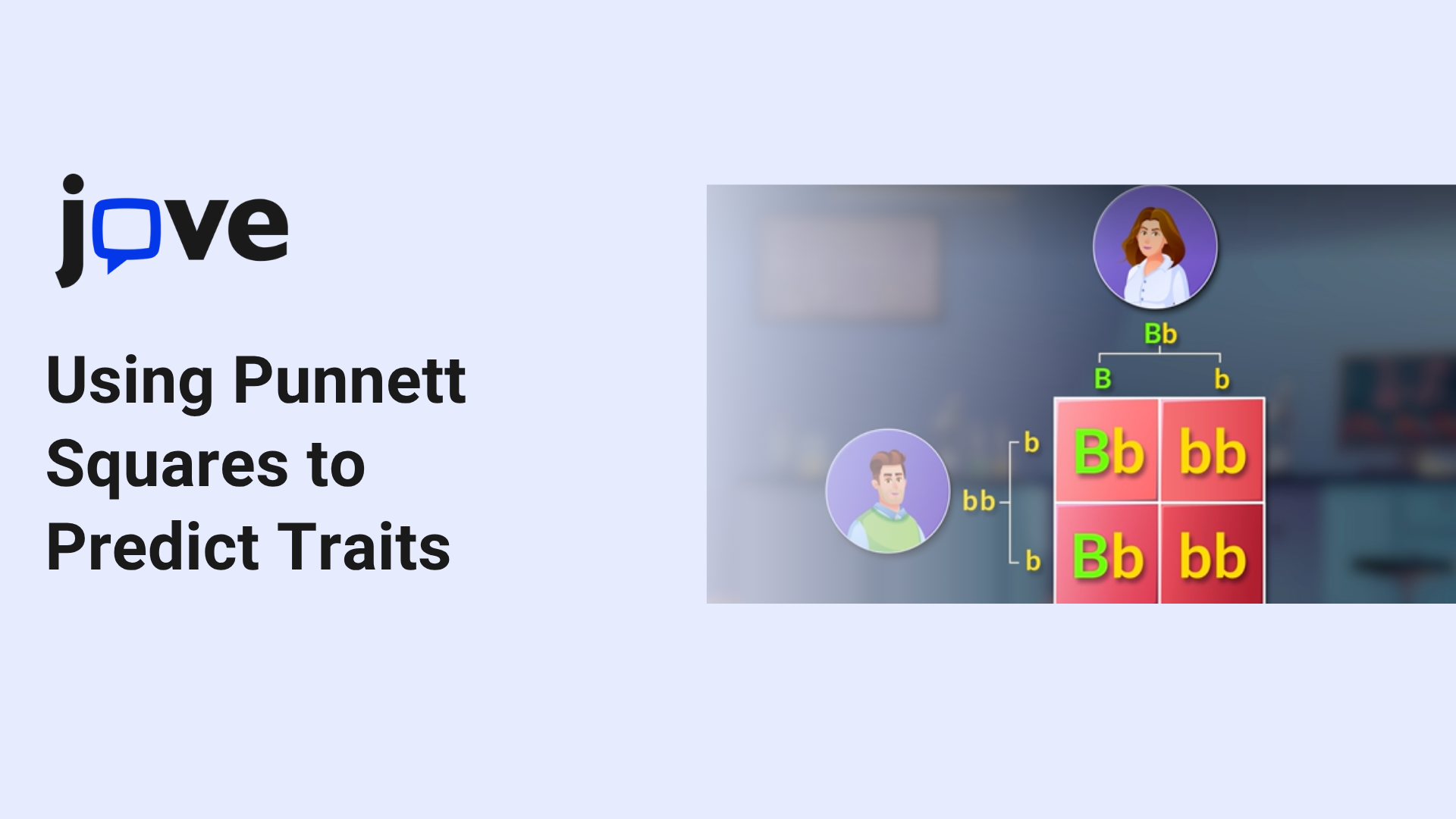
Using Punnett Squares to Predict Traits: A Visual Guide for Students
If you’re teaching genetics in middle school, Punnett squares can be your best friend. Punnett squares help transform complex ideas about how traits are passed down into visual tools students can actually see and understand.
Instead of talking about inheritance in the abstract, these simple charts let students watch dominant and recessive genes at work. Add in a quick classroom activity and a short JoVE video, and suddenly, Punnett squares aren’t just another worksheet — they’re the spark that helps genetics click.
How to Teach Punnett Squares in Middle School
So what’s a Punnett square, really? Think of it as a mini prediction machine. It shows every possible gene combo from two parents, making the outcome of traits feel a little less random — and a lot more like solving a puzzle.
Example:
Let’s say both Parent 1 and Parent 2 have the genotype Tt—one dominant allele (T) and one recessive (t). When we set up a Punnett square using these, we can visually map out all the possible combinations their offspring might inherit.
Here’s what the grid would show, along with the predicted genotypes and phenotypes:

This clearly ties into genetic trait probability, helping students make math connections while exploring biology.
JoVE’s animated concept videos help simplify this concept, making it easier for students to see how alleles combine and traits are passed on.
Visual Punnett Square Activity for Students
A great way to make Punnett squares interactive is through a classroom favorite we call the “Trait Predictor Game.” It’s a visual Punnett square activity for students that doubles as a science and math practice.
You’ll need:
- 2 cups with gene cards (e.g., “T” and “t”)
- Blank Punnett square templates
- Trait charts for interpretation (T = Tall, t = Short)
Steps:
- Students pull one card from each “parent” cup
- Record their gene pair in the Punnett square
- Analyze outcomes and match with a physical trait
- Graph class data and compare trait frequencies
It’s a simple activity that packs a lot of learning. Students walk away understanding not just how Punnett squares work, but why we use them.
Teaching Heredity and Dominant Recessive Genes
Once students have the basics down, take it a step further by introducing heredity and dominant recessive genes. This helps them see the bigger picture of how traits are inherited over time.
Use JoVE’s visual science tools to explain:
- What happens when a dominant allele masks a recessive one
- Why two tall parents might still have a short child
- How some traits “skip” a generation
Pro tip: Show examples like plant height or fur color where students can visually grasp how predicting traits in offspring works in action.
Punnett Square Lesson Plan Ideas
Need structure? Here’s a week-long outline that weaves in lessons, videos, and activities for how to teach Punnett squares in middle school:
Day | Focus | Activity |
Mon | Intro to heredity | Watch JoVE heredity video |
Tue | Card-sorting game with traits | |
Wed | Complete Tt × Tt chart as a class | |
Thu | Trait prediction challenge | Design your own square |
Fri | Class Punnett Tournament | Solve charts for speed and accuracy |
Whether you’re teaching remotely or in person, these Punnett square lesson plan ideas make the content more memorable and measurable.
Conclusion: Make Inheritance Predictable and Engaging
Teaching genetics doesn’t have to be overwhelming. With the help of Punnett squares, students can explore how traits are inherited in a way that feels logical and exciting. And with JoVE’s concept videos and hands-on learning tools, you can connect this concept to real-life science in every class.
Book a Free Demo to explore JoVE’s complete genetics collection, including visual Punnett square resources.
JoVE pricing starts at just $2 per student.*
(Pricing based on 1,500 students. Explore funding options here.)

