
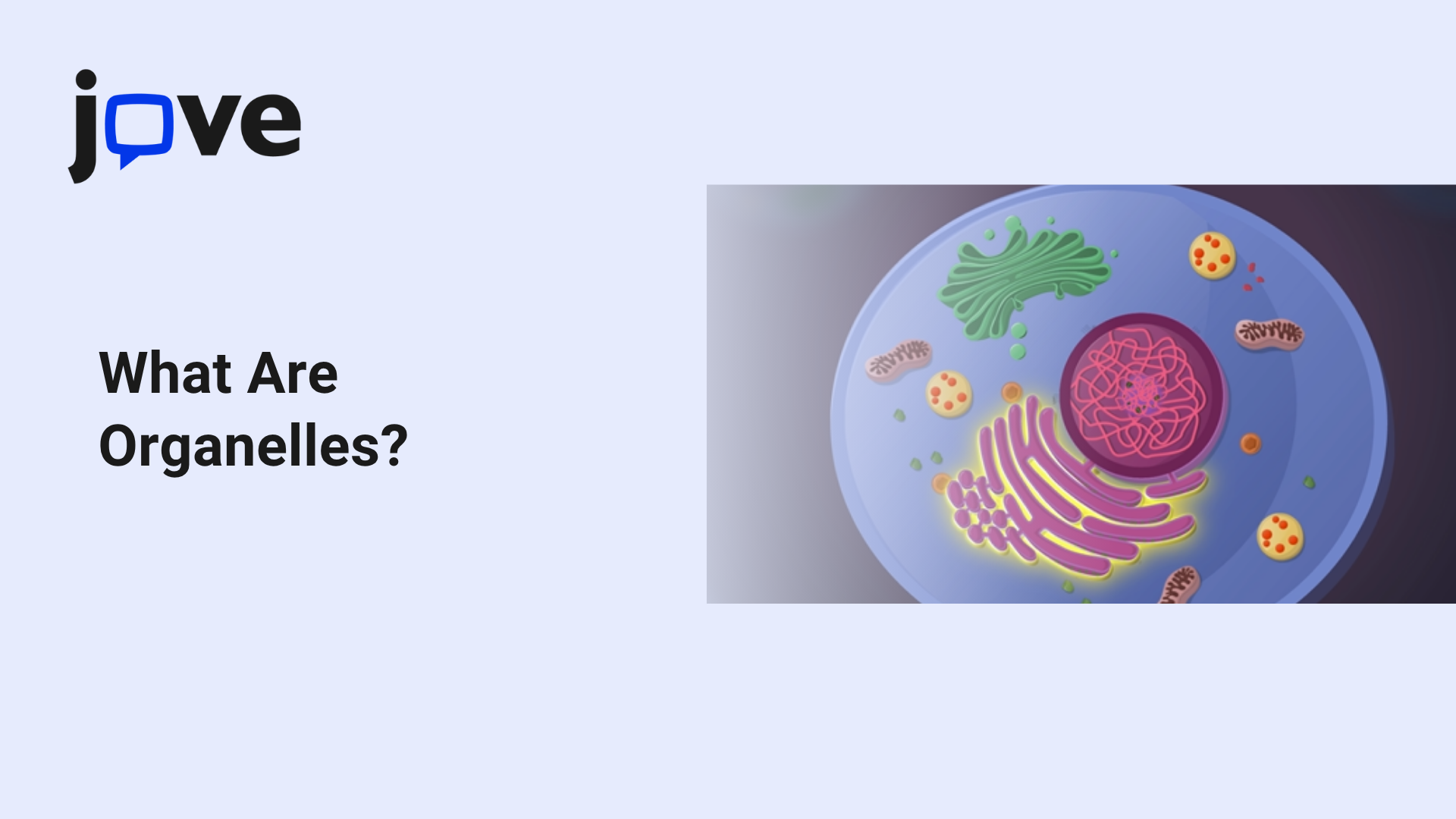
What Are Organelles? Helping Students Understand Cell Structures
Cells are like tiny factories, and inside them are specialized “workers” called organelles. Each organelle has a specific job that helps the cell survive, grow, and carry out its functions. Understanding organelles is an essential part of learning cell structure and function, and it becomes much easier for students when they can visualize what’s happening inside the cell.
JoVE’s Cell Organelles video offers a clear, visual tour of each structure, showing students exactly how these microscopic parts keep life running.
Unlock Free Full Access to JoVE!
Why Understanding Organelles Matters
Knowing cell organelles and their functions helps students connect biology to real-world systems:
- The nucleus is like the control center, directing activities.
- The mitochondria are the cell’s powerhouses.
- The chloroplasts in plants turn sunlight into energy.
By comparing organelles to familiar objects or systems, students see how each part works together to keep cells alive.
Types of Organelles to Teach in Class
Nucleus – The Control Center
Contains the cell’s DNA and controls its activities
Like a “brain” for the cell
Mitochondria – The Powerhouse
Produces energy through cellular respiration
Found in both plant and animal cells
Chloroplasts – The Solar Panels
Found only in plant cells and some protists
Capture sunlight and convert it into food via photosynthesis
Endoplasmic Reticulum (ER) – The Transport System
Rough ER: Makes proteins
Smooth ER: Produces lipids and detoxifies chemicals
Golgi Apparatus – The Packaging Center
Modifies, sorts, and ships proteins and lipids
Lysosomes – The Cleanup Crew
Break down waste and recycle materials
Plant vs. Animal Cell Organelles
Teaching plant and animal cell differences helps students see that while many organelles are shared, some are unique:
- Only in plants: Chloroplasts, cell wall, large central vacuole
- Only in animals: Centrioles
Pair this lesson with JoVE’s Plant Cell Structure and Animal Cell Structure videos for a side-by-side visual comparison.
Classroom Activities for Teaching Organelles
Activity 1: Organelle Matching Game
Create cards with organelle names, pictures, and functions. Students match them in small groups.
Supports: examples of organelles and their functions.
Activity 2: Build-a-Cell Model
Use craft supplies, modeling clay, or digital tools to create plant and animal cell models, labeling each organelle.
Supports: teaching plant and animal cell organelles.
Activity 3: Organelle Role Play
Assign each student an organelle role. As you “run” the cell, they act out their function — delivering energy, storing information, or cleaning up waste.
Supports: how to teach organelles in middle school.
FAQ: Teaching Organelles
Use visual aids, models, and interactive activities that connect each organelle’s function to a familiar job or object.
Nucleus, mitochondria, chloroplasts, endoplasmic reticulum, Golgi apparatus, lysosomes, and vacuoles.
Plants have chloroplasts, cell walls, and large central vacuoles, while animals have centrioles.
An organelle role play or cell model-building activity engages students in learning functions through movement and creativity.
Conclusion: Make Organelles Come Alive with JoVE
By making organelles more than just terms to memorize, you help students see cells as complex, dynamic systems. Pairing lessons with JoVE’s Cell Organelles, Cell Structure, and Plant and Animal Cells videos turns microscopic parts into vivid, memorable learning experiences.
Make cell biology engaging and visual – start your free JoVE trial by booking a demo with us.
JoVE’s science video library starts at just $2 per student*. Explore funding options now.
*Pricing based on 1,500 students.

