
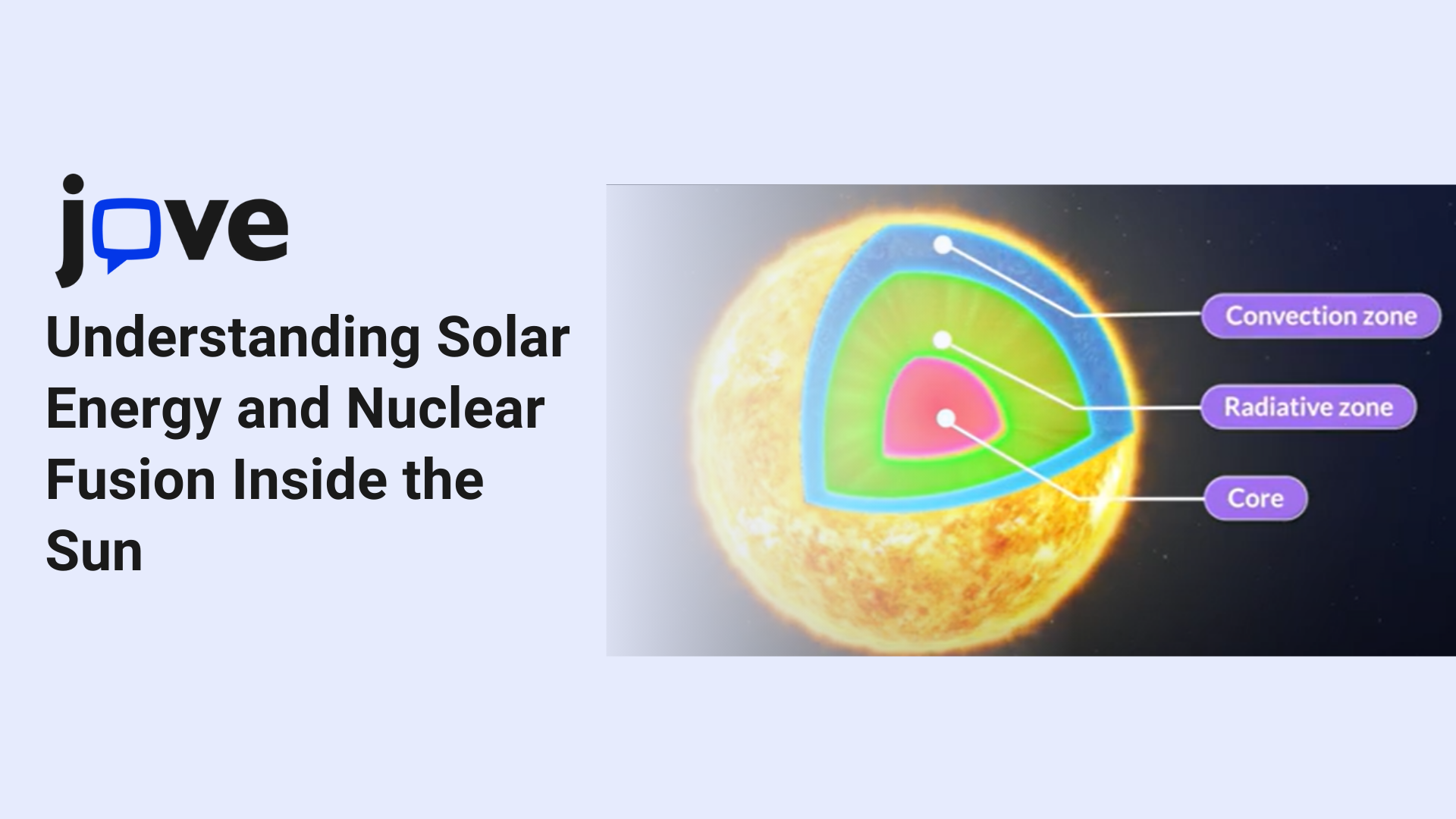
Understanding Solar Energy and Nuclear Fusion Inside the Sun
Introduction: What Really Powers the Sun?
In Ms. Bryant’s middle school science class, a student asked, “How can the sun burn without oxygen?” It was the perfect launchpad into one of the most fascinating science topics — solar energy and nuclear fusion.
Many students assume the sun is just a giant ball of fire. But through hands-on solar energy experiments and visual learning, students can understand the real forces at play: nuclear fusion reactions that fuel the sun and supply energy to life on Earth.
To simplify these complex concepts, Ms. Bryant used JoVE’s Science Education videos, combining animations with classroom activities that made solar science exciting and relatable.
What Is Solar Energy and Where Does It Come From?
Solar energy is the radiant energy emitted by the sun, primarily produced through a process called nuclear fusion — where hydrogen atoms fuse to form helium, releasing immense amounts of energy in the form of heat and light.
🎥 Watch JoVE’s Video on Energy and the Sun — This video explains nuclear fusion and energy transfer in a way that middle school students can grasp quickly.
Easy Solar Energy Experiments for the Classroom
To help students visualize how solar energy is captured and used, try these hands-on solar energy experiments:
1. Solar Oven Challenge
Objective: Demonstrate how solar radiation can be harnessed for heat.
✅ Wrap a cardboard pizza box with foil and plastic wrap
✅ Place marshmallows and chocolate inside
✅ Let students track temperature changes and melting rates over 30–45 minutes
→ This project helps explain heat transfer from the sun.
2. UV Bead Investigation
Objective: Show the sun’s invisible UV radiation.
✅ Distribute UV-sensitive beads to students
✅ Expose them to sunlight, shade, and filtered light
✅ Compare color intensity to demonstrate UV energy differences
→ Students learn that solar radiation includes more than visible light.
3. Solar Panel Circuit Build
Objective: Convert solar energy to electricity.
✅ Use a mini solar panel kit to power a small fan or light
✅ Encourage students to test different light intensities
→ They observe how solar energy powers everyday objects.
🎥 Pair it with JoVE’s Renewable Energy video to explain how solar panels work.
Explaining Nuclear Fusion to Middle Schoolers
Nuclear fusion might sound complicated, but with the right tools, you can simplify it:
✔ Use balloon models to represent hydrogen atoms fusing into helium
✔ Discuss mass-to-energy conversion with real-life analogies
These visuals make atomic-level processes approachable for young learners and reinforce cross-cutting NGSS and other standards concepts in energy transfer and matter interaction.
Common Misconceptions About the Sun and Energy
Many students believe the sun is on fire or that solar panels store sunlight like batteries. Address these myths early with clear demonstrations and visual reinforcement.
✅ Use JoVE’s videos to visually explain energy transfer, electromagnetic radiation, and how energy reaches Earth.
✅ Host a myth-busting quiz after your solar activities to reinforce correct understanding.
Teaching the Importance of Solar Energy on Earth
Solar energy is more than a science topic — it’s a foundation for sustainability and environmental responsibility.
Encourage students to explore:
🌞 How solar power reduces fossil fuel use
🔋 The role of solar energy in smart cities
🌍 Future innovations like solar-powered vehicles
🎥 See JoVE’s Middle School Energy Videos for examples of global solar applications.
Conclusion — Spark Curiosity About the Sun with JoVE
By integrating solar energy experiments and visual learning tools, teachers can demystify complex solar processes and engage students in one of science’s most powerful topics.
JoVE’s middle school science videos support NGSS-aligned teaching and simplify challenging topics like nuclear fusion in the sun, solar radiation, and energy conversion.
🔥 Ready to light up your classroom with solar science?
👉 Book a FREE Demo today and get full access to JoVE’s animated videos, interactive resources, and solar science experiments!

