
Breaking Down Compounds: Visual Strategies to Teach Bonding and Chemical Behavior
Chemistry Concepts That Stick
What happens when atoms come together to form something new? That question opens the door to one of chemistry’s core ideas—chemical compounds. From salt and sugar to plastics and proteins, compounds surround students every day, but understanding how they form—and behave—isn’t always easy.
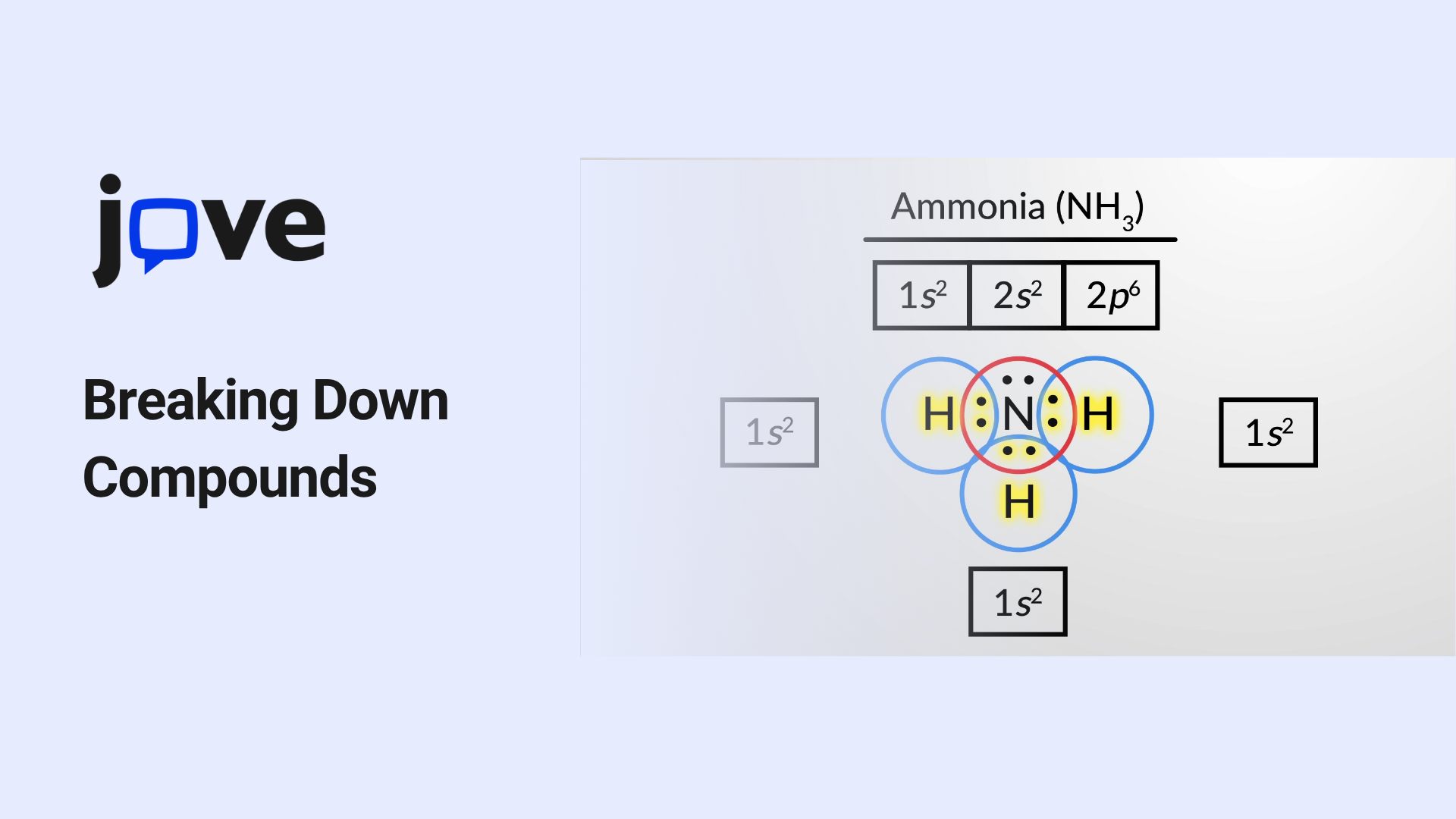
That’s why teachers are turning to visual learning tools to explain chemical compound structure. With JoVE’s NGSS-aligned chemistry labs and videos, educators can clearly demonstrate bonding, reaction types, and the logic of compound formation using real-world examples and dynamic models.
🎥 Begin with JoVE’s Covalent Bonding and Lewis Structures Video to provide students with a visual foundation.
Why Understanding Compounds is Essential
Compounds aren’t just a chapter in the textbook—they’re the foundation of everything from medicine to materials science. When students learn how substances interact, combine, and break apart, they begin to understand the building blocks of real-world change.
NGSS standard MS-PS1-2 requires students to “analyze and interpret data on the properties of substances before and after interactions to determine if a chemical reaction has occurred.” When students grasp types of chemical compounds,That means students need more than memorization—they need to see chemistry in action.
📘 This is how to teach chemical compounds in high school—by connecting abstract models to real-world transformations.
What Students Should Know Before Starting
As you introduce chemical compounds, review core concepts:
- Difference between elements and compounds
- Formation of ionic, covalent, and metallic bonds
- Properties of common compound types (salts, acids, bases, molecules)
- The role of electrons and the periodic table in predicting compound formation
🧪 JoVE’s bonding animations help students see how atoms interact to create complex substances.
Classroom Activity – Deconstruct and Classify Compounds
Objective:
Help students explore the structure and behavior of compounds through hands-on modeling and reaction observation.
Materials:
- Periodic table reference sheets
- Sample compounds (salt, sugar, vinegar, baking soda)
- Conductivity testers
- Molecular model kits or printed diagrams
- JoVE compound formation video
- NGSS-aligned lab worksheets
Instructions:
- Watch JoVE’s video on covalent bonding and Lewis Structures as a class.
- Assign each group a different compound to classify and break down—identify atoms, bond types, and structure.
- Students use molecular kits or diagrams to build or sketch the compound.
- Conduct simple tests (e.g., conductivity, solubility) to observe physical properties.
- Record and reflect on findings—connect structure to function.
🧠 This NGSS activity for understanding compound bonding promotes critical thinking and model-based reasoning.
Common Misconceptions – Clarified with Visuals
❌ “All compounds are molecules.”
✅ Clarified: Not all compounds are covalently bonded—ionic compounds like NaCl are structured as lattices.
❌ “Breaking bonds always releases energy.”
✅ Clarified: It often takes energy to break bonds; energy is released when new ones form.
🎥 Use JoVE’s Types of Chemical Bonds Video to clear up these common misunderstandings visually.
Real-World Application – Compounds in the Lab and Life
At Middle School & High School, students used JoVE’s chemistry resources to investigate food chemistry. In a unit called “Compounds on Your Plate,” they examined salt, baking soda, and citric acid—testing how each compound behaves in different environments.
By using NGSS-aligned chemistry labs, students connected bonding types with physical outcomes like fizzing, dissolving, or conductivity—bringing understanding compound formation to life.
They later built models to explain each compound’s behavior, reinforcing how structure and reaction type are interlinked
Crosscutting Concept – Structure and Function in Compounds
|
Bond Type |
Common Example |
Function or Behavior |
|
Ionic |
Table salt (NaCl) |
Conducts electricity in water |
|
Covalent |
Sugar (C₆H₁₂O₆) |
Dissolves easily, low melting point |
|
Metallic |
Copper (Cu) |
Conducts heat and electricity |
This structure-function relationship is central to teaching chemical behavior and compound utility in both labs and everyday life.
Conclusion – Build Understanding with Compounds That Matter
Teaching chemical compounds doesn’t have to feel abstract. With JoVE’s NGSS-aligned chemistry labs, students can visualize bonding, build molecules, and observe reactions—unlocking a deeper understanding of chemical structure and transformation.
By focusing on types of chemical compounds and using visual strategies for teaching bonding, educators help students go beyond memorization and into chemical thinking.
🔍 Ready to make chemical bonding meaningful?
JoVE access starts at just $2 per student.*
*Pricing based on 1,500 students.
Conclusion – Make Chemistry Stick with Clear Bonds
By teaching chemical bonds to students with the help of JoVE’s visual tools, educators move beyond memorization into deep understanding. Students not only see atoms connect—they understand why, how, and what it means.
Using a mix of NGSS-aligned chemistry activities, molecular modeling, and animated JoVE videos, teachers can ensure students master both the vocabulary and visual logic of bonding.
🧪 Ready to build better chemistry lessons?
JoVE access starts at just $2 per student.*
*Pricing based on 1,500 students.

