
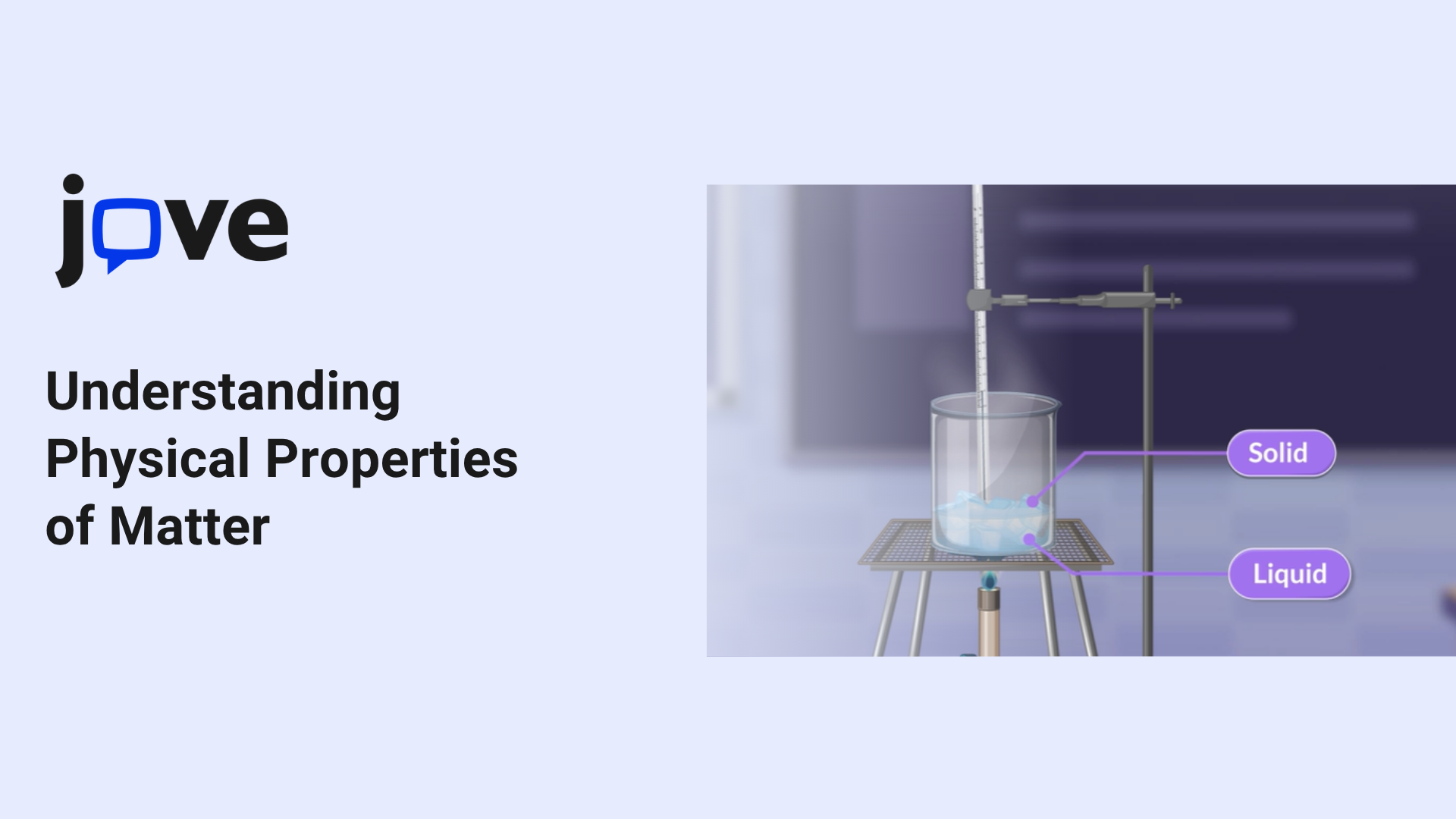
Understanding Physical Properties of Matter Through Models and Real-World Investigations
What Are Physical Properties of Matter?
When you touch a metal spoon or feel the softness of snow, you’re observing the physical properties of matter — characteristics that can be seen, measured, or tested without changing the substance itself.
These properties include:
- Color and texture
- Density
- Melting and boiling points
- Electrical and thermal conductivity
- State of matter (solid, liquid, gas)
These features help scientists and engineers classify substances and choose materials for specific purposes — from constructing bridges to designing smartphones.
🎥 JoVE’s science video on properties of matter simplify abstract ideas by blending animations, real-life examples, and clear narration — making concepts like conductivity and melting point easier for students to understand.
Why Physical Properties Matter in Science and Engineering
In many classrooms, students memorize facts about properties of matter — but don’t always understand why they matter. That’s where real-world examples become essential for teaching physical properties in a meaningful way.
Consider the following:
- Melting point helps engineers select materials that won’t deform under heat.
- Conductivity determines if a material is suitable for use in electronics.
- Expansion from temperature changes explains why bridges have built-in gaps or pipes burst during winter.
Understanding how to teach physical properties of matter through these real-life connections helps students move from passive memorization to active investigation.
Bringing NGSS Practices into the Classroom: Modeling and Inquiry
The Next Generation Science Standards (NGSS) highlight Science and Engineering Practices (SEPs) — active approaches that encourage students to think and work like scientists. One of these key practices is Developing and Using Models, which helps students visualize, predict, and explain how materials behave.
Here are three hands-on activities for physical properties you can use in your classroom:
Activity 1: Heating Up — Understanding Expansion
Materials: Metal spoon or rod, candle or other heat source
Instructions: Heat the metal gently and observe expansion. Allow it to cool and observe contraction.
💡Real-World Connection: Engineers apply this principle when designing bridges, pipelines, and machinery.
Activity 2: Conductivity Circuit Test
Materials: Battery, wires, small bulb, various test materials (foil, wood, paperclip, plastic)
Instructions: Build a simple circuit. Insert different materials and observe which conduct electricity.
🎥 JoVE’s conductivity video visually demonstrates this test and explains why it matters.
Activity 3: Melting Point Comparison
Materials: Ice cubes, butter, chocolate, thermometer
Instructions: Heat each material and record when it melts.
📊 Challenge: Have students chart the melting points and relate them to how materials are used in everyday life — from cooking to construction.
These science experiments in class support NGSS-aligned learning through observation, modeling, and inquiry.
Using Cause and Effect to Understand Material Behavior
Another NGSS framework is Crosscutting Concepts, which helps students connect ideas across scientific domains. One powerful theme is Cause and Effect — ideal for exploring the physical properties of matter.
Let’s apply this to real-world situations:
- Cause: Water freezes
Effect: It expands, which may burst pipes. - Cause: A metal rod is heated
Effect: It expands, requiring flexible design in structures. - Cause: A material conducts electricity
Effect: It can be used in circuits, but not in insulation.
By recognizing these patterns, students begin to predict outcomes and explain why materials behave the way they do — which is exactly the goal of how to teach physical properties of matter with impact.
How JoVE Supports Teaching Physical Properties
JoVE’s videos make it easier for educators to plan and teach engaging lessons aligned with NGSS.
With JoVE, you can:
- Use videos that bring physical properties to life
- Reinforce complex topics with animation and real-world examples
- Connect theory to application through hands-on activities for physical properties
- Align seamlessly with national and state standards
Conclusion: Bring Physical Properties to Life in Your Classroom
When students explore why chocolate melts faster than butter or how electricity flows through foil but not plastic, they aren’t just checking off curriculum boxes — they’re engaging in real science.
Using JoVE’s NGSS-aligned videos, you can simplify complex concepts and run physical property experiments in science class that deepen understanding.🎓
Book a demo to access JoVE’s full library of science videos and experiment guides — free for schools exploring new ways to enhance their STEM instruction.
Bring JoVE to your classroom starting as low as $2 per student.*
Explore funding resources to learn how your school can start using JoVE’s complete STEM video library today.
*Pricing based on 1,500 students.

