
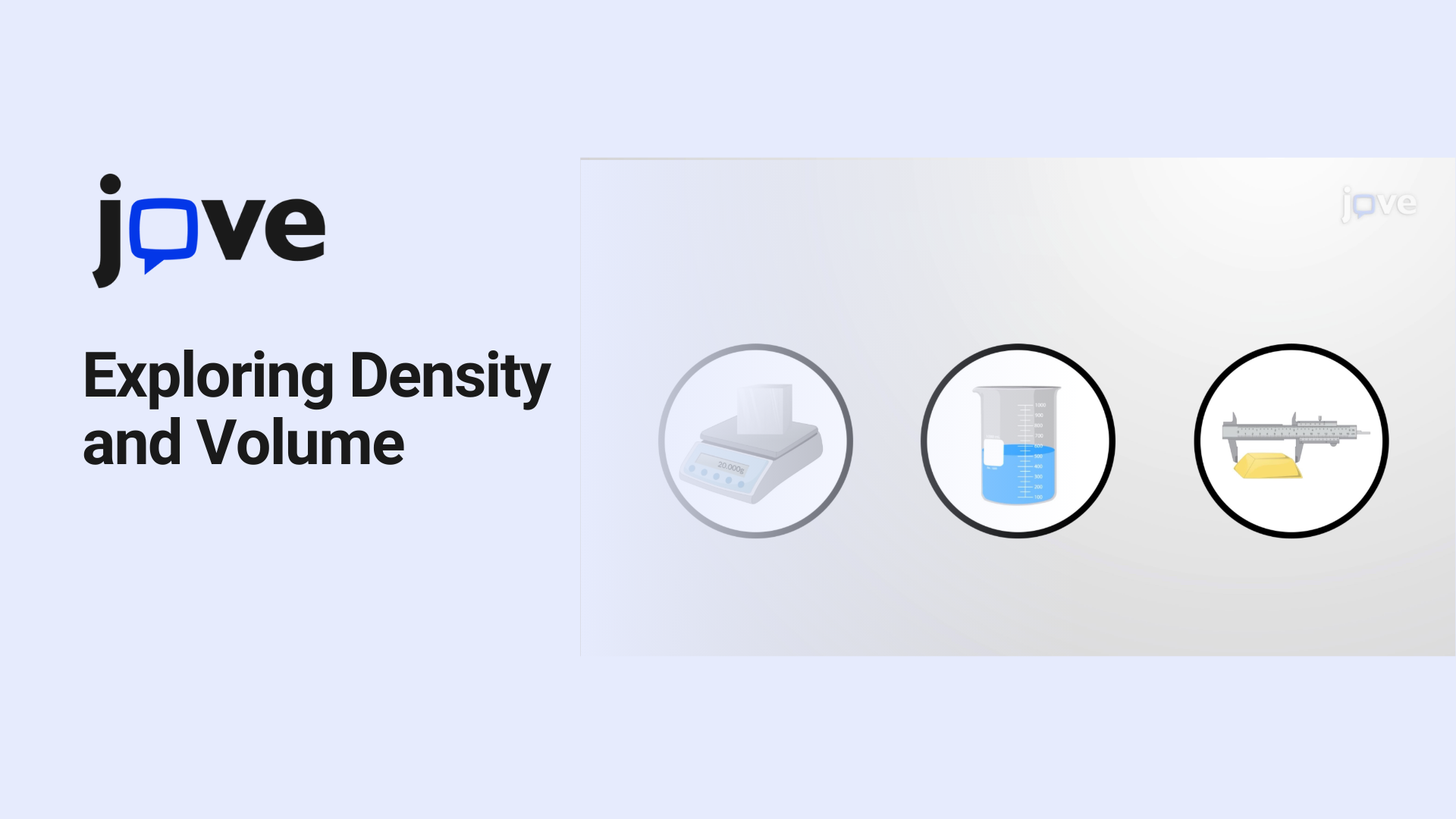
Exploring Density and Volume: Visual Science Learning for Middle School
From Floating Objects to Foundational Science
Why does a rock sink while a sponge floats? The answer lies in understanding density and volume, one of the most important early science topics for middle school learners. Yet many students struggle with how mass, volume, and shape relate to an object’s ability to float or sink.
That’s why teachers are turning to visual measurement activities and JoVE’s NGSS-aligned video lessons. These tools help students experiment, calculate, and compare materials to understand how mass and space interact—and why it matters.
🎥 Begin with JoVE’s Measurement: Derived Units to visually break down the concept using fixed measurement units for seven fundamental properties.
Why Teaching Density to Middle Schoolers Is So Effective
Middle school science is all about building foundational knowledge. Teaching density to middle schoolers helps them connect physical characteristics like weight and volume to observable behaviors in liquids and solids.
This supports NGSS standard MS-PS1-2, which asks students to “analyze and interpret data on the properties of substances before and after interactions.” Exploring density and volume provides a measurable way to meet that goal—through tools, math, and hands-on science investigations.
📘 This is how to teach density and volume to middle school students—by letting them test, measure, and explain outcomes with their own observations.
What Students Should Know Before Starting
Before jumping into labs, students should be able to:
- Define mass, volume, and density clearly
- Use formulas such as D = M ÷ V to calculate density
- Accurately use measuring tools like digital scales and graduated cylinders
- Identify materials and predict floating/sinking behavior
🎥 Use JoVE’s Determining the Density of a Solid and Liquid to walk students through setup and tool usage.
Classroom Activity – Density Displacement Lab
Objective:
Help students determine the density of objects using water displacement and calculated volume.
Materials:
- Digital scale or triple-beam balance
- Graduated cylinder (100mL+)
- Small solid objects (rubber stopper, coin, cork, marble)
- Water
- NGSS-aligned worksheet
- JoVE’s Measurement: Derived Units video
Instructions:
- Begin with JoVE’s video on density and volume to set context.
- In pairs, students record the mass of each object using the scale.
- Fill the graduated cylinder with water and note the starting volume.
- Submerge the object and measure the displaced water volume.
- Calculate density using D = M ÷ V.
- Record, compare, and explain which items floated and why.
🧠 These interactive science labs to explore object density reinforce measurable cause-and-effect and support math integration.
Common Misconceptions – Clarified Visually
❌ “Heavier things always sink.”
✅ Clarified: It’s not just about mass—density depends on mass per unit volume.
❌ “Volume doesn’t change when shape changes.”
✅ Clarified: Shape can affect how volume is measured and perceived.
🎥 Use JoVE’s States of Water to reinforce how matter behaves under different conditions.
Real-World Application – Floating or Sinking? Exploring Packaging Materials
At Middle School, students extended their density labs into a sustainability project. They compared packing peanuts, bubble wrap, and biodegradable foam for their density and volume—measuring floatability, compression, and mass efficiency.
Using JoVE’s video series, students connected understanding volume and mass with real-world design problems. They even pitched ideas for eco-friendly packaging based on lab data.
This project blended measurement, chemistry, and environmental science—all while building core NGSS skills.
Crosscutting Concept – Scale, Proportion, and QuantityAdd Your Heading Text Here
|
Measurement Concept |
Tool or Strategy |
Student Learning Outcome |
|
Mass |
Digital scale |
Identify how heavy an object is |
|
Volume |
Water displacement |
Understand how much space an object occupies |
|
Density |
D = M ÷ V |
Predict sinking or floating |
This chart helps reinforce NGSS physical science labs by connecting numerical data to material behavior.
Conclusion – Measure What Matters with Density and Volume
Teaching density and volume is a perfect opportunity to make middle school science hands-on and high impact. With JoVE’s engaging videos and NGSS-aligned activities for comparing mass and volume, students not only watch science—they do science.
By comparing objects, testing predictions, and calculating results, students gain confidence in using tools and applying formulas. This lays a strong foundation for future learning in chemistry, physics, and environmental science.
🔍 Ready to launch your next great measurement lesson?
👉 Book a FREE Demo today and get full access to JoVE’s animated videos, interactive resources, and solar science experiments!
JoVE access starts at just $2 per student.*
*Pricing based on 1,500 students.

