18.15
معامل الحجم هو مصطلح علمي يستخدم لوصف مقاومة المادة للضغط الموحد. وهو ثابت التناسب الذي يربط التغير في الضغط بالتغير النسبي في الحجم الناتج.
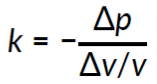
يصبح هذا…
يقيس معامل الكتلة مقاومة المادة للضغط المنتظم. يتم تعريفه على أنه ثابت التناسب بين التغير في الضغط والتغير النسبي الناتج في الحجم.
ضع في اعتبارك مكعبا متناحي الخواص لوحدة الحجم. عندما تتعرض لضغوط طبيعية ، فإنها تتشوه إلى مستطيلة متوازية السطوح بحجم جديد.
يطلق على الفرق بين هذا المجلد الجديد والمجلد الأصلي توسيع المادة. يمكن التعبير عن التوسع على أنه مجموع السلالات في جميع الاتجاهات الثلاثة.
في حالة الجسم المعرض لضغط هيدروستاتيكي منتظم ، فإن كل مكون من مكونات الإجهاد يساوي سالب الضغط الهيدروستاتيكي.
ينتج عن استبدال هذه القيم في معادلة التوسع تعبيرا يقدم الثابت المعروف باسم معامل الكتلة ، معبرا عنه بنفس وحدات معامل المرونة.
تنخفض المواد المستقرة تحت الضغط الهيدروستاتيكي في الحجم ، مما يجعل التوسع سالبا ومعامل السائبة موجبا.
يمكن أن تمتد المادة المثالية بنسبة بواسون الصفرية دون تقلص جانبي. على العكس من ذلك ، فإن نسبة بواسون البالغة 0.5 تدل على عدم قابلية الانضغاط المثالية.
View the full transcript and gain access to JoVE Core videos
Q1: What does bulk modulus measure in materials?
Bulk modulus measures a material's resistance to uniform compression. It is defined as the proportionality constant between a change in pressure and the resulting relative volume change. Materials with higher bulk modulus values resist compression more effectively than those with lower values.
Q2: How is dilatation related to bulk modulus?
Dilatation represents the total volume change of a material and is calculated as the sum of strains in all three directions. When a material undergoes uniform hydrostatic pressure, the dilatation becomes negative for stable materials. The bulk modulus is derived by substituting stress components into the dilatation equation.
Q3: What happens to an isotropic cube under hydrostatic pressure?
An isotropic cube of unit volume deforms into a rectangular parallelepiped when subjected to normal stresses. The difference between the new volume and original volume is termed dilatation. Under uniform hydrostatic pressure, each stress component equals the negative of the pressure applied.
Q4: How does Poisson's ratio affect material incompressibility?
Poisson's ratio determines lateral contraction behavior during deformation. A material with zero Poisson's ratio can stretch without lateral contraction. Conversely, a Poisson's ratio of 0.5 signifies perfect incompressibility, meaning the material maintains constant volume during deformation under the relation between Poisson's ratio, modulus of elasticity and modulus of rigidity.
Q5: Why is bulk modulus always positive for stable materials?
Stable materials decrease in volume when subjected to hydrostatic pressure, making dilatation negative. Since bulk modulus is the proportionality constant relating pressure change to relative volume change, the negative dilatation combined with negative pressure results in a positive bulk modulus value.
Q6: What units does bulk modulus use?
Bulk modulus is expressed in the same units as the modulus of elasticity, typically pascals (Pa) or megapascals (MPa). This consistency in units allows for direct comparison between bulk modulus and other elastic constants when analyzing material behavior under various loading conditions.
Q7: How does bulk modulus differ from other elastic constants?
Bulk modulus specifically measures resistance to uniform volumetric compression, while other elastic constants address different deformation modes. The modulus of elasticity measures resistance to axial loading, and modulus of rigidity measures resistance to shear. Bulk modulus uniquely characterizes material behavior under hydrostatic pressure.