This study analyzed 47 psychologist-teacher consultation sessions and identified four discourse modes: informative, directive, collaborative, and reflective. Psychologists primarily used informative discourse (34.2%), whereas teachers favored collaborative discourse (38.9%). These differences reflected institutional roles, while teachers’ participation varied according to professional experience and institutional power.
مقالة بحثية
Communicative Strategies in Educational Management Consultation: A Discourse-Analytic Study of Psychologist-Teacher Interactions
في هذه المقالة
ملخص
الملخص
Effective collaboration between educational psychologists and teachers is essential for addressing students’ academic, social, and emotional needs. This study examines how consultation interactions are organized into distinct discourse modes and how these shape professional relationships, knowledge exchange, and power dynamics. It hypothesizes that identifiable interactional modes are strategically used to negotiate roles, establish shared understanding, facilitate problem-solving, and construct professional identities. The study analyzed 47 naturally occurring consultation sessions involving 38 professionals (12 educational psychologists and 26 teachers) across 32 psychologist–teacher dyads in primary and secondary schools. Audio-recorded consultations were transcribed verbatim and analyzed using a multi-theoretical framework integrating critical discourse analysis, systemic functional linguistics, interpersonal pragmatics, and positioning theory. Four primary discourse modes emerged: informative, directive, collaborative, and reflective, each serving distinct communicative and relational purposes. Educational psychologists frequently used open-ended questioning, reframing, and joint problem definition to encourage teacher agency, shared decision-making, and collaborative problem-solving. Teachers displayed collaborative, deferential, and resistant orientations, influenced by professional experience, institutional hierarchy, and perceived differences in expertise. Shifts between discourse modes functioned as deliberate strategies for responding to evolving interactional demands and negotiating professional authority and identity. Consultation practices were also shaped by structural inequalities, including professional status, institutional hierarchies, and ableist assumptions. These findings highlight the value of discourse awareness and strategic communication training in promoting more equitable, reflective, and effective educational psychology consultation.
المقدمة
The ability of professionals to work well together in schools relies heavily on the quality of their communication. One of the most significant of these co-operative relationships is that between the classroom teacher and the educational psychologist, and it directly impacts how pupils' academic, behavioral, social, and emotional needs are identified, understood, and met1. Consultation has traditionally been viewed as a triadic, problem-solving process in which a specialist and a consultee work together to address a problem concerning a particular student or group of students2. This process has been studied for decades, including its structural phases and outcomes. However, the discussion has largely been at the level of procedures and results, and relatively little research has examined consultation from the perspective of the actual process of consultation as it is enacted in language3. This gap is important because how participants talk, how they ask questions, how they pose problems, and how they answer each other in a consultative encounter are not "features of the interaction" but, in fact, part of the interaction.
Language actively helps to define the roles, knowledge, and relational positions that constitute the consultation, as well as the institutional power dynamics and professional identity negotiations that shape (or do not shape) substantive collaboration. Educational psychologists work in institutional structures that are divided by discipline, credentialed, and have norms about what is considered expertise4. Teachers, in turn, bring in their pedagogical knowledge and extended knowledge of individual students, which are epistemologically relevant but are not necessarily accorded the same legitimacy within the consultative frame. To understand what the role of professional consultation in schools actually entails, it is crucial to examine how these asymmetries are enacted, reproduced, and sometimes challenged in discourse5. Although communication is a critical part of consultative work, the conversation between the educational psychologist and the teacher in consultative practice has been studied very little. Current studies have primarily used self-report scales, structured observation protocols, or simulated consultative analogs, all of which have limitations in representing the language and relational labor that actually occur between professionals during real-time consultation. While research using conversation analysis, systemic functional linguistics, and critical discourse analysis has contributed to the understanding of professional helping relationships and interprofessional dialogue in general, few studies have examined actual psychologist–teacher consultation sessions from a naturalistic, discourse-analytic perspective6.
The social dimensions of consultative interactions (the relationship among race, cultural and linguistic background, gender, and disability status within the institutional context of schooling) have also received little attention, as have questions of who is excluded from consultative interactions and how they are discursively constructed in consultative discourse7. This difference between the prescription and the accomplishment of consultative discourse at the level of language is therefore empirically underdeveloped as well as practically significant. Discourse analysis can be used to fill this void in a well-principled and empirically sound way. By focusing on the social nature of language, a discourse analytic approach enables analysis of how participants' linguistic choices 'perform' roles, negotiate epistemic authority, situate professional identity, and reinforce or challenge institutional inequalities during the consultation. This orientation is directly relevant to educational psychology in several ways.
First, the nature of the communicative approaches that psychologists use, either facilitative or directive, open-ended or prescriptive, does have real implications for teacher agency, shared decision making, and the nature of the collaborative process of consultation. Second, the nature of the interventions that students produce in consultation is influenced by how student difficulties are discussed, deficit-oriented, pathologizing language versus contextually needs-oriented, strengths-oriented language, and is an indicator of values regarding inclusion and disability. Third, the professional identity of an educational psychologist is discursively constructed, as the authority roles of psychologists and teachers in the consultation are negotiated, enacted, and sometimes challenged, moment by moment, through language choices. This level of granularity in understanding consultation discourse offers a more empirically grounded foundation for professional development, reflective practice, and outcome-focused research and consultation.
This study examines the discursive structuring of consultative interactions between educational psychologists and teachers, and how this structuring is discursively enacted and reproduced through the power relations, professional identity positions, and institutional asymmetries of school-based consultation. The central thesis is that consultative discourse can be distinguished into distinct and recognizable communicative modes: informative, directive, collaborative, and reflective, which are not random interactional events, but strategically used communicative practices that respond to the changing relational and institutional requirements of the consultation. Another hypothesis is that the communicative strategies used by educational psychologists and the participative orientations of teachers are influenced not only by their own communicative preferences but also by macro-level factors, such as professional experience, institutions, and the epistemological assumptions of the educational psychologists' training. To examine these hypotheses, the study analyzed 47 naturally occurring psychologist–teacher consultation sessions. The sessions were contributed by 38 individual professionals, 12 educational psychologists, and 26 teachers, who were represented in 32 psychologist–teacher dyadic pairings across primary and secondary schools in several educational districts. The differences in the numbers of individuals, dyads, and sessions reflect the participation of some professionals in more than one pairing and the contribution of repeat consultations by a subset of dyads. The audio-recorded sessions were transcribed verbatim and analyzed using a multi-theoretical framework integrating critical discourse analysis, systemic functional linguistics, interpersonal pragmatics, and positioning theory8.
The study also aimed to investigate the discursive construction of student difficulties in consultative talk, and to explore the institutional, relational, and intersectional variables that influence the patterns of consultative talk in the corpus. The novelty of this study lies in three complementary ways. First, the analysis is based on natural data from consultations, not simulations, self-reported data, or structured analogs, which helps maintain the ecological validity of consultative discourse in natural school settings and provides a window into the linguistic and relational dynamics of professional interaction as it actually occurs. Second, the study allows for a symmetrical analysis of both actors in the consultative dyad: the psychologist's communicative strategies and a wide spectrum of participatory orientations for teachers are explored, thus balancing the existing literature, which has tended to focus on the psychologist's perspective. Third, the study adopts a multi-level analytical approach that links the micro-texture of interactional language to the macro-structures of institutional power, professional identity, and structural inequality. This integration allows the study to examine how broader social conditions, including professional hierarchy, disciplinary epistemology, ableist assumptions, and intersecting dimensions of identity, are enacted and reproduced at the level of individual discourse choices, and to draw implications for consultative practice, professional training, and inclusive education policy that are grounded in the actual communicative realities of school-based consultation.
These aims are addressed through five research questions. RQ1 asks how discourse modes are sequentially and temporally distributed across the stages and duration of a consultation session. RQ2 asks what discourse strategies educational psychologists employ and how these strategies position teachers within the interaction. RQ3 asks which participatory orientations teachers adopt in response to psychologists' discourse and how these orientations relate to teachers' experience. RQ4 asks how student difficulties are discursively framed, in deficit-oriented versus contextual terms, within consultative talk. RQ5 asks how institutional power dynamics are enacted and reproduced through discourse choices across the consultation.
البروتوكول
This naturalistic discourse-analytic study examined recorded educational psychologist–teacher consultation sessions, associated post-consultation interviews, and documentary materials. The study was approved by the Science and Technology Ethics Committee of Northeast Normal University (approval no. 202502097). All participating educational psychologists and teachers provided written informed consent before data collection. Consent covered the audio recording of consultation sessions and post-consultation interviews, as well as the collection of anonymized contextual information about the students discussed during the consultations, where relevant.
Participants and dyadic structure
The sample comprised 38 individual professionals: 12 educational psychologists and 26 teachers. These professionals were represented in 32 psychologist–teacher dyadic pairings. The individual-participant count and dyad count describe different analytical levels: the former refers to unique professionals, whereas the latter refers to the psychologist–teacher pairings through which the consultations were conducted. Individual professionals could therefore be represented in more than one dyadic pairing.
The 32 dyadic pairings contributed 47 recorded consultation sessions. Each dyad contributed at least one recorded consultation, while the 15 recordings beyond the initial 32 represented repeat consultations contributed by a subset of dyads. Consequently, the number of consultation sessions exceeded the number of dyadic pairings. Unique identifiers were assigned separately to participants, dyads, and sessions to distinguish repeated contributions by the same professional or dyad during data management and analysis.
Baseline and contextual information
Baseline contextual information was collected from each participant using a short, structured questionnaire administered before each consultation session was recorded. The questionnaire covered years of professional experience, school type, and district, the presenting student concern that prompted the consultation, and the history of the consultative relationship within the dyad. For professionals or dyads contributing more than one consultation, stable participant and dyad identifiers were retained across sessions, while a separate session identifier was assigned to each recorded consultation. When participants provided consent and the information was relevant to the presenting issue, anonymized contextual data were also collected about the student (s) whose needs were the focus of the consultation. These data included the nature of any identified learning, behavioral, or developmental concern. The presence of disability-related framing in pre-consultation documents was also noted to support the subsequent analysis of deficit-oriented versus contextual framing in consultative discourse (RQ4).
Intersectional contextual factors disclosed by participants, including language background, gender, and professional status, were recorded as contextualizing variables for the analysis of teacher participatory orientations (RQ3) and institutional power dynamics (RQ1 and RQ5).
Consultation recording and data storage
A small, inconspicuous digital audio recorder was provided to each participating dyad and positioned so that both participants’ voices were audible without altering the seating arrangement or consultation format. Participants were asked to conduct the consultation as they normally would and not to modify their communication because of the recording. A total of 47 consultation sessions were recorded from the 32 psychologist–teacher dyadic pairings. Each dyad contributed at least one recorded consultation, and 15 additional recordings represented repeat consultations contributed by a subset of dyads. The recordings yielded approximately 35 hours of consultative discourse. Session durations ranged from 22 to 78 min, with a mean duration of 44 min.
Data protection protocols were followed for all audio recordings. Immediately after each session, recordings were transferred to encrypted, password-protected institutional storage. Original recordings were retained for the duration of the project and for the institutional archiving period specified in the ethics approval.
Post-consultation interviews
Where participant availability permitted, a semi-structured post-consultation interview was conducted separately with the participating educational psychologist, the teacher, or both professionals immediately after the recorded consultation. A total of 59 participant-level post-consultation interviews were completed across the 47 consultation sessions. Interviews were therefore not available for both professionals after every recorded session. All completed interviews were audio-recorded and transcribed verbatim.
The interview protocol generated two types of data. First, participants provided reflective accounts of the communicative dynamics, relational tenor, and perceived outcomes of the consultation. Second, they provided contextual information about the institutional setting, the history of the consultative relationship, and the factors they believed had shaped their communicative approach during the session.
Interview data were treated as a supplementary rather than a primary source of analytical evidence. They were used to interpret and contextualize the recorded interactional data in relation to institutional power, professional identity, and intersectional positioning.
Documentary materials
Where consent was provided, professional documents related to the consultation were collected, including referral forms, previous assessment reports, and intervention plans. These materials were analyzed as contextual evidence of the institutional genres and professional discourse conventions embedded in consultative talk. Pre-consultation documents were also reviewed for evidence of deficit-oriented or contextual framing of student concerns in relation to RQ4.
Transcription and corpus preparation
All 47 consultation sessions and all post-consultation interviews were transcribed verbatim using a modified version of conversation-analytic transcription conventions. The transcripts preserved prosodic and interactional features relevant to the identification of discourse modes, including pauses measured in tenths of a second, overlapping speech, stress and emphasis, marked changes in pitch or pace, and audible non-lexical tokens.
A trained research assistant transcribed each session. After transcription, a second researcher who had not participated in the original transcription checked each transcript against the corresponding audio recording. Discrepancies were resolved through repeated listening and discussion, and all resolutions were documented in the research audit trail.
The final analytical corpus comprised 47 consultation transcripts and 59 participant-level post-consultation interview transcripts. The 47 consultation transcripts represented 32 psychologist–teacher dyadic pairings, with 15 recordings constituting additional consultations contributed by a subset of dyads. The interview transcripts represented the participant-session occasions on which a post-consultation interview was completed; interviews were not available for both professionals following every session. Consultation and interview transcripts were linked through separate participant, dyad, and session identifiers. In total, the corpus contained approximately 420,000 words of transcribed professional discourse.
Open coding
In the first stage, all consultations were divided into analytically meaningful units. Each unit consisted of a continuous stretch of talk by one speaker that served a recognizable communicative purpose. Units were assigned provisional descriptive labels, such as information-giving, questioning, advising, problem elaboration, and collaborative reformulation. This stage was exploratory and was intended to map the discursive field rather than establish fixed analytical categories.
Discourse modes by participant role
In the second stage, the provisionally coded segments were compared, contrasted, and systematically consolidated across transcripts. Patterns of similarity, difference, and recurrence were identified. This stage combined inductive analysis with deductive guidance from the theoretical framework. It produced four discourse-mode categories, informative, directive, collaborative, and reflective, and eight discourse-strategy categories that were used in the subsequent analysis.
Power and identity coding
In the third stage, an additional coding layer was developed specifically for RQ3–RQ5. This analysis focused on institutional power dynamics, professional identity positioning, and intersectional contextual factors. Coding included explicit and implicit indicators of authority and expertise negotiation, examples of deficit-oriented versus contextual approaches to student difficulties, and evidence of unequal participation associated with professional hierarchy, language background, and gender positioning. This stage drew primarily on the critical discourse analysis and positioning theory components of the theoretical framework.
Micro-level linguistic analysis
In the fourth stage, a purposive subcorpus of interactional extracts was selected for close analysis. Extracts were chosen on the basis of analytical richness, meaning that they clearly illustrated patterns identified during the earlier stages, and typicality, meaning that they represented recurring rather than exceptional cases. Selected extracts were analyzed using systemic functional linguistics, with attention to modality, clause structure, and lexical choice, and conversation analysis, with attention to turn design, sequential organization, and repair sequences.
Inter-coder reliability and analytical trustworthiness
A second independent coder was trained using the coding scheme developed during the focused-coding stage. Training was conducted using a separate corpus of five consultation transcripts, distinct from the primary analytical corpus. The second coder then independently applied the finalized coding scheme to a randomly selected 20% of the primary corpus, comprising nine transcripts. Inter-coder agreement for categorical discourse-mode coding was calculated using Cohen’s kappa. A value of κ ≥ 0.75 was established as the threshold for acceptable reliability, consistent with standards commonly applied in qualitative discourse-analytic research.
Disagreements between the primary analyst and the second coder were resolved through structured discussion. Where consensus could not be reached, a third researcher acted as an arbitrator. All disagreements, resolutions, and arbitration decisions were documented in the research audit trail.
Analytical trustworthiness was further supported through peer debriefing, member checking, and reflexive documentation. Peer debriefing involved regular analytical discussions with the wider research team. Member checking involved sharing initial interpretations with a subsample of six participants, including three psychologists and three teachers, for respondent validation. A reflexive research journal was also maintained to document analytical decisions, assumptions, and emerging interpretations throughout the study.
Statistical analysis
The frequency and proportional distribution of each discourse mode and discourse strategy were calculated separately for educational psychologists and teachers and reported as percentages of the total coded units for each participant group.
Chi-square tests of independence were used to determine whether the distributions of discourse modes differed significantly between psychologists and teachers. For each comparison, the chi-square statistic, degrees of freedom, and p-value were reported. Statistical significance was set at p < 0.05. Cramér’s V was calculated for all statistically significant group differences to assess practical significance in addition to statistical significance.
For the analysis of temporal changes in discourse-mode use across consultation sessions (RQ1), the mean proportional distribution of each discourse mode was calculated across six 10-min intervals. This analysis included all sessions lasting at least 60 min (n = 19). Means and standard deviations were calculated for each interval and discourse mode.
Correlation analysis was used to examine relationships between teachers’ professional experience and the frequency of participatory orientations. Pearson’s r or Spearman’s ρ was reported, depending on the distribution of the data, together with 95% confidence intervals. Consistent with the qualitative-primary mixed-methods design, all statistical analyses were treated as descriptive and hypothesis-generating. Statistical findings were interpreted alongside the qualitative discourse analysis rather than as independent confirmatory evidence.
النتائج
Inter-coder reliability
Inter-coder reliability for the primary discourse-mode coding scheme was established using a randomly selected 20% sub-corpus (nine consultation transcripts). Cohen's κ was 0.81 (95% CI: 0.76–0.86), exceeding the pre-specified threshold of κ ≥ 0.75 and indicating strong agreement between coders. All coding disagreements were resolved through structured consensus discussions, with unresolved cases (n = 7) adjudicated by a third researcher and documented in the audit trail. These findings support the credibility and analytical validity of the coding framework used throughout the study. All participant, dyad, and session identifiers were pseudonymized during transcription and replaced with non-identifying analytical codes before coding and analysis.
Focused coding
Focused coding of the 47 consultation sessions contributed by the 32 psychologist–teacher dyadic pairings identified four recurrent discourse modes: informative, directive, collaborative, and reflective. These categories emerged through iterative comparison of open-coded segments and reached theoretical saturation when additional data consistently aligned with existing categories without generating new analytically distinct variants. Table 1 summarizes the defining linguistic characteristics of each discourse mode.
The distribution of discourse modes differed significantly between educational psychologists and teachers (χ2 (3) = 84.7, p < 0.001, Cramér's V = 0.43), indicating a moderate-to-large effect. As shown in Figure 1, informative discourse was the most common mode among psychologists (34.2% of coded units), followed by collaborative (28.5%), directive (22.7%), and reflective discourse (14.6%). In contrast, teachers most frequently employed collaborative discourse (38.9%), followed by reflective (31.4%), informative (18.3%), and directive discourse (11.4%).
These findings support the study hypothesis that discourse modes reflect the institutional power relations and professional identities embedded within educational consultation. Psychologists' greater use of informative and directive discourse is consistent with their role as specialists in knowledge, whereas teachers' predominance of collaborative and reflective discourse reflects a more participatory, consultative orientation, acknowledging their comparatively limited institutional authority.
The following extract illustrates the co-occurrence of informative and directive discourse by the psychologist alongside the teacher's collaborative response:
EP04 [informative]: "So, what we're seeing in the assessment data is a profile that's consistent with working memory difficulties. It's not about effort or motivation; it's about how information is being held and processed in the moment."
T11 [collaborative]: "That actually makes sense of something I've been noticing. He gets the instructions, and then by the time he starts the task, it's like he's forgotten the first part."
EP04 [directive]: "Exactly. So what we'd want to do is think about breaking tasks into single steps and building in more retrieval practice, rather than assuming he needs more explanation."
This interaction demonstrates how the psychologist initially frames the teacher's observations through specialist psychological knowledge before directing the discussion toward intervention planning. Although the teacher integrates this interpretation with her classroom experience, the psychologist subsequently re-establishes expert authority through directive recommendations. This pattern, a collaborative opening followed by a directive closure, was observed in 61% of strategy-negotiation sequences, suggesting that facilitative communication frequently coexists with underlying institutional asymmetry.
Distribution of discourse modes across consultation stages
Analysis of the sequential organization of all 47 recorded consultation sessions, including repeat consultations contributed by a subset of the 32 dyads, showed that discourse modes varied systematically across consultation stages rather than remaining constant throughout the interaction. Five consultation phases were identified: opening and rapport building, problem elaboration, deliberation and analysis, strategy negotiation, and closing and action planning. The proportional distribution of discourse modes across these stages is presented in Table 2 and illustrated in Figure 2.
Mode distribution differed significantly across consultation stages (χ2 (12) = 127.3, p < 0.001, Cramér's V = 0.38). Informative discourse predominated during problem elaboration (M = 48.3%, SD = 9.1%), when psychologists interpreted teachers' concerns using specialist knowledge. Directive discourse reached its highest level during strategy negotiation (M = 38.6%, SD = 11.4%), reflecting the transition to intervention planning. Collaborative discourse was most prominent during strategy negotiation (M = 42.1%, SD = 8.7%) and closing (M = 44.8%, SD = 10.2%), consistent with shared decision-making. Reflective discourse occurred throughout consultations but was most evident during opening (M = 22.4%, SD = 7.6%) and closing phases (M = 28.9%, SD = 9.3%). These findings indicate that discourse-mode selection is responsive to the communicative demands of different consultation phases rather than representing fixed individual communication styles.
Psychologist discourse strategies
Focused coding identified eight discourse strategies used by educational psychologists. Table 3 summarizes each strategy together with its frequency and primary relational function, while Figure 3 illustrates their distribution. Inter-coder reliability for strategy coding was κ = 0.78 (95% CI: 0.72–0.84). Open-ended questioning was the most frequently used strategy (24.3% of strategic moves), followed by collaborative reformulation (19.8%) and reframing (17.2%). Directive advice-giving accounted for only 4.8% of coded strategies, challenging assumptions that educational consultation is predominantly prescriptive and directly addressing RQ2 regarding how psychologists' discourse positions teachers within consultation9.
The following extract illustrates open-ended questioning:
EP02: "What does a good day look like for her in your classroom? What's different about those days?"
T14: "On good days, she's usually near the front; she's had a settled morning at home, I think, and I've given her a clear visual of what's happening. She responds really well to that kind of structure."
EP02: "That's really useful. So she's already showing you what works. That's the foundation of any intervention plan we build together."
Here, the psychologist's question invites the teacher to draw upon her classroom expertise, positioning her as an active knowledge holder rather than a passive recipient of professional advice. By explicitly validating the teacher's observations, the psychologist establishes a more collaborative epistemic relationship. This interactional sequence, elicitation, teacher knowledge sharing, and expert validation, occurred in 38% of collaborative discourse segments.
Teacher participatory orientations
The power-and-identity analysis identified five teacher participatory orientations: collaborative alignment, deferential acceptance, passive reception, active resistance, and negotiatory engagement. Table 4 presents the defining discourse features of these orientations, their associations with psychologists’ communicative strategies, and their overall prevalence within the consultation corpus. Collaborative alignment was characterized by teachers extending, applying, or jointly reformulating psychologists’ interpretations. Negotiative engagement involved teachers contributing alternative interpretations or modifying proposed strategies based on their classroom knowledge. In contrast, deferential acceptance and passive reception involved limited elaboration of psychologists’ knowledge claims or recommendations. Active resistance occurred when teachers explicitly challenged, rejected, or reformulated a psychologist’s interpretation or proposed course of action.
Teacher participatory orientations varied significantly by professional experience, χ2(4) = 41.2, p < 0.001, Cramér’s V = 0.39. As shown in Figure 4, experienced teachers with more than five years of professional experience demonstrated comparatively higher levels of collaborative alignment and negotiatory engagement. Novice teachers with five or fewer years of experience were more likely to adopt deferential acceptance and passive reception. Active resistance occurred infrequently in both groups. These findings indicate that professional experience was associated with how confidently teachers contributed knowledge, negotiated interpretations, and responded to psychologists’ recommendations during consultation.
Deficit-oriented and contextual framing of student difficulties (RQ4)
Analysis of the discursive construction of student difficulties identified both deficit-oriented and contextual forms of framing across the consultation corpus. Deficit-oriented formulations located the source of difficulty primarily within the student, for example, by characterizing problematic behavior in terms of the child's actions or presumed disposition. In contrast, contextual formulations related the presenting difficulty to environmental demands, classroom conditions, regulatory needs, or the interaction between the student and the educational setting. These forms of framing were not treated as mutually exclusive quantitative categories; rather, the qualitative analysis examined how participants constructed, maintained, or reformulated understandings of student difficulty during consultation. Accordingly, the findings are interpreted as recurrent discourse patterns rather than as evidence that either deficit-oriented or contextual framing predominated across the corpus.
The following extract illustrates a shift from deficit-oriented description toward contextual reframing:
T07: "He's just really disruptive. He can't sit still, he's always calling out, and it makes it very difficult for the rest of the class."
EP09 [reframing]: "I'm wondering if we could think about that behavior slightly differently. What you're describing sounds like it could be a child who's communicating that the environment isn't quite meeting his regulatory needs, rather than a child who's choosing to be difficult."
T07: "I hadn't thought of it like that... so you mean it's not that he doesn't want to behave?"
This exchange demonstrates how the presenting concern could be reformulated within the consultation from an individualizing description of disruptive behavior toward a contextual, needs-based interpretation. The teacher initially describes the difficulty primarily through the student's observable behavior, whereas the psychologist redirects attention toward the relationship between the student's regulatory needs and the classroom environment. The teacher's response indicates uptake of this alternative interpretation rather than immediate resistance. Reframing, therefore, functioned not simply as a conversational strategy but as a means of changing the explanatory basis for understanding a student's difficulty, potentially broadening subsequent problem-solving beyond responses directed solely at the student. Taken together, these patterns answer RQ4 by showing that student difficulties were not uniformly framed: deficit-oriented descriptions and contextual reformulations coexisted within consultative discourse, and reframing was one mechanism by which explanations could shift from the student alone to the interaction between student needs and the educational context.
Institutional power dynamics and professional positioning (RQ5)
Institutional power dynamics were enacted through differences in epistemic positioning, control over interpretation, and the negotiation of recommendations during consultation. Psychologists occupied a comparatively authoritative position when translating teachers’ classroom observations into specialist psychological formulations. This pattern was consistent with the distribution of discourse modes reported above: psychologists used informative (34.2%) and directive (22.7%) discourse more frequently than teachers, whereas teachers used collaborative (38.9%) and reflective (31.4%) discourse more frequently. These differences indicate that professional roles were associated with unequal access to particular forms of epistemic authority, although the interaction was not uniformly hierarchical.
The relationship between collaboration and professional authority was particularly visible during strategy negotiation. As illustrated in the EP04/T11 interaction reported above, the psychologist initially incorporated the teacher’s classroom observations into a shared interpretation but subsequently redirected the exchange toward specialist recommendations. Across the coded strategy-negotiation sequences, a collaborative opening followed by a directive closure occurred in 61% of cases. This pattern indicates that facilitative communication and institutional authority were not mutually exclusive: psychologists could invite teacher participation while retaining greater influence over how problems were professionally interpreted and how intervention options were finalized.
Teacher participation nevertheless demonstrated that this authority was negotiable rather than absolute. The power-and-identity analysis identified negotiatory engagement when teachers modified psychologists’ interpretations or proposed strategies based on classroom knowledge, and active resistance when teachers explicitly challenged, rejected, or reformulated a psychologist’s interpretation or recommendation. Experienced teachers showed comparatively greater collaborative alignment and negotiatory engagement, whereas novice teachers more often adopted deferential acceptance and passive reception. Taken together, these findings answer RQ5 by showing that institutional power was reproduced through differential epistemic authority and directive control, but was also negotiated when teachers mobilized their experiential knowledge to modify or challenge psychologists’ professional formulations.
Temporal distribution of discourse modes across consultation sessions
A supplementary temporal analysis examined discourse-mode use across six consecutive 10-minute intervals within the 19 consultation sessions that lasted at least 60 minutes. Table 5 reports the mean proportional distribution of informative, directive, collaborative, and reflective discourse within each interval, while Figure 5 illustrates the direction of change across the six intervals. This analysis used the consultation session as the unit of temporal organization and was intended to describe within-session patterns rather than changes within individual participants or dyads.
Informative discourse was most prominent during the earlier intervals and declined progressively as consultations proceeded. Directive discourse increased after the opening phase and reached its highest level during the middle intervals, corresponding to the movement from problem description toward interpretation and intervention planning. Collaborative discourse increased steadily across the session and became the predominant mode during the later intervals. Reflective discourse remained less prominent during the early and middle portions but reached its highest level in the final interval. Together, Table 5 and Figure 5 demonstrate a broad progression from information exchange and professional interpretation toward collaborative decision-making, reflection, and action planning.
Because this analysis included only the 19 sessions lasting at least 60 minutes, the temporal pattern should be interpreted as descriptive of this subset of longer sessions rather than as a universal sequence applicable to all consultations. Across all 47 recorded consultation sessions, students and families were largely absent as active participants. Students were discussed exclusively as subjects of professional description, while families were mentioned in 34% of sessions and were positioned primarily as sources of contextual information rather than as contributors to decision-making10.
Comparison with previous consultation research
Table 6 provides a contextual comparison of the present study with five previous studies of consultation or professional discourse across data sources, analytical frameworks, participant-role balance, treatment of directive discourse, conceptualization of teacher agency, inclusion of temporal analysis, study contexts, and principal contributions. Table 6 is a contextual synthesis rather than an additional empirical analysis of the 47 consultation sessions. The comparison highlights three features that distinguish the present study: the use of naturally occurring psychologist–teacher consultation recordings, symmetrical analytical attention to psychologists’ communicative strategies and teachers’ participatory orientations, and examination of discourse organization across both consultation stages and session duration. The table also situates the present treatment of directive discourse and teacher agency within the wider consultation literature. Accordingly, Table 6 complements the empirical findings by showing how the study’s methodological and analytical contributions differ from approaches used in previous research.
DATA AVAILABILITY:
The de-identified datasets are provided as Supplementary File 1.
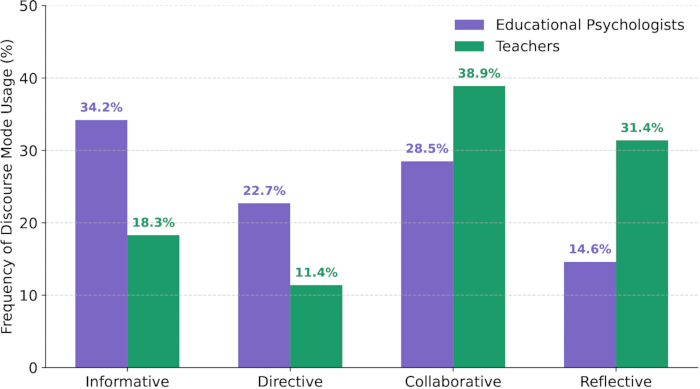
Figure 1: Distribution of discourse modes between educational psychologists and teachers. Frequency of the four identified discourse modes, informative, directive, collaborative, and reflective, used by educational psychologists and teachers across 47 consultation sessions contributed by 32 psychologist–teacher dyadic pairings. Educational psychologists demonstrated higher proportions of informative (34.2%) and directive (22.7%) discourse, whereas teachers more frequently employed collaborative (38.9%) and reflective (31.4%) discourse. The overall distribution differed significantly between participant groups (χ2 (3) = 84.7, p < 0.001, Cramér's V = 0.43), indicating distinct communicative roles during consultation. Please click here to view a larger version of this figure.
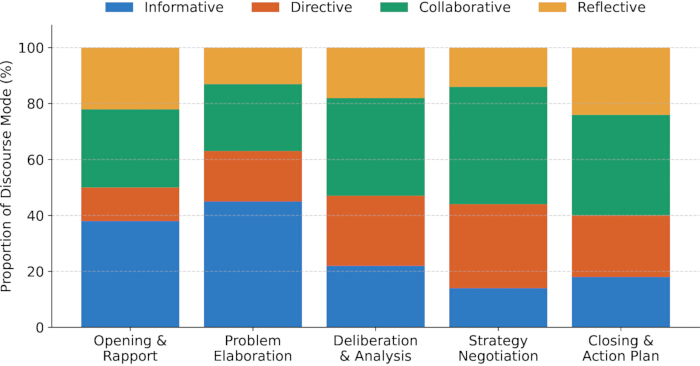
Figure 2: Distribution of discourse modes across consultation stages. Proportional distribution of informative, directive, collaborative, and reflective discourse across the five consultation stages: opening and rapport building, problem elaboration, deliberation and analysis, strategy negotiation, and closing and action planning. Informative discourse predominated during problem elaboration; directive discourse peaked during strategy negotiation; collaborative discourse increased during strategy negotiation and closing; and reflective discourse was most prominent during the opening and closing stages. These findings demonstrate stage-specific variation in discourse-mode use throughout the consultation process. Please click here to view a larger version of this figure.
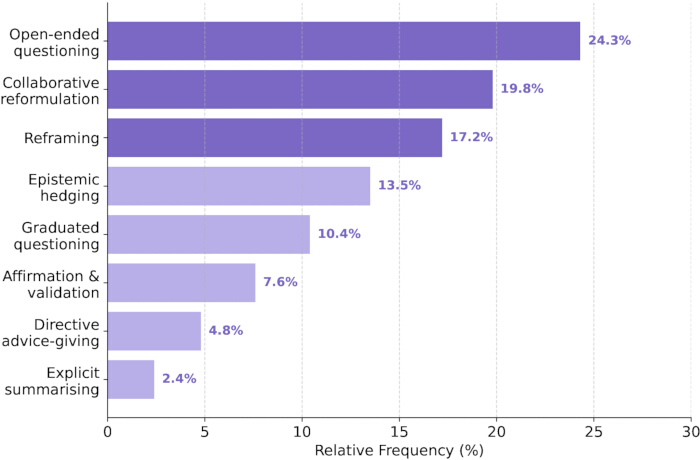
Figure 3: Frequency of psychologist discourse strategies. Relative frequency of the eight discourse strategies identified during focused coding of psychologist communicative moves. Open-ended questioning (24.3%), collaborative reformulation (19.8%), and reframing (17.2%) were the most frequently observed strategies, whereas directive advice-giving (4.8%) and explicit summarising (2.4%) occurred least frequently. These findings indicate a predominance of facilitative over prescriptive communication strategies during educational consultation. Please click here to view a larger version of this figure.
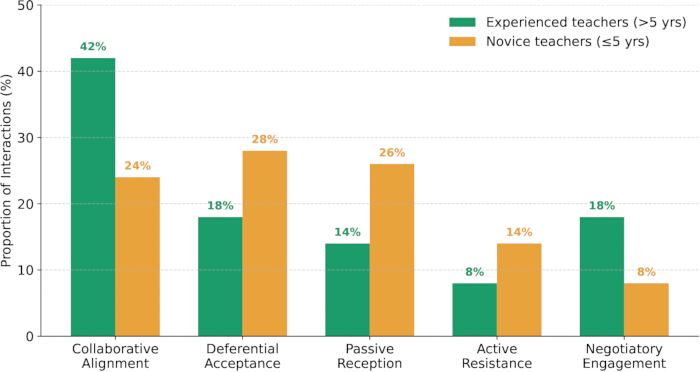
Figure 4: Teacher participatory orientations according to professional experience. Distribution of collaborative alignment, deferential acceptance, passive reception, active resistance, and negotiatory engagement among experienced teachers with more than five years of professional experience and novice teachers with five or fewer years of experience. Experienced teachers demonstrated a comparatively greater degree of collaborative alignment and negotiatory engagement, whereas novice teachers more frequently demonstrated deferential acceptance and passive reception. Active resistance was infrequent in both groups. The distribution differed significantly by professional experience, χ2(4) = 41.2, p < 0.001, Cramér’s V = 0.39. Please click here to view a larger version of this figure.
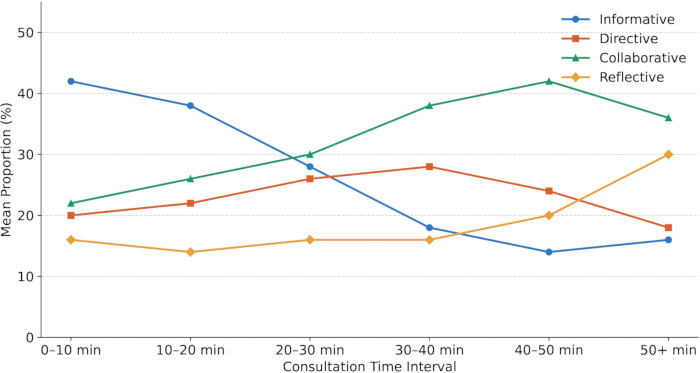
Figure 5: Temporal changes in discourse modes across consultation sessions. Mean proportional distribution of informative, directive, collaborative, and reflective discourse across six consecutive ten-minute intervals in the 19 sessions lasting at least 60 minutes. Informative discourse declined across the intervals; directive discourse peaked in the middle portion of the sessions; collaborative discourse increased and became predominant in the later intervals; and reflective discourse reached its highest level in the final interval. The analysis is descriptive and applies only to the longer-session subset. Please click here to view a larger version of this figure.
| Discourse Mode | Key Linguistic Features | Primary Interactional Function | Example Extract |
| Informative | Declarative clauses, factual assertion, technical vocabulary, low modality | Knowledge transmission; establishing shared informational base | Research suggests that children with working memory difficulties often struggle with multi-step instructions. |
| Directive | Imperative structures, high modality (should, must, need to), second-person address | Guiding teacher action; asserting expert authority | You'll want to break tasks into smaller, clearly sequenced steps for this student. |
| Collaborative | Open-ended questions, hedged proposals, co-construction sequences, turn-sharing | Joint problem-solving; building shared understanding | I wonder if we might think together about what seems to trigger these episodes in class? |
| Reflective | Metalinguistic commentary, epistemic verbs (think, wonder, notice), self-reference | Critical examination of assumptions; promoting teacher agency | It's interesting, isn't it, when I reflect on what you've described, I find myself questioning whether the current seating arrangement is actually helping. |
Table 1: Defining features and functions of identified discourse modes. Summary of the four discourse modes (informative, directive, collaborative, reflective) identified through focused coding (Stage 2), showing the key linguistic features, primary interactional function, and an illustrative example extract for each mode.
| Consultation Stage | Informative | Directive | Collaborative | Reflective | Total |
| Opening & Rapport | 38 | 12 | 28 | 22 | 100 |
| Problem Elaboration | 45 | 18 | 24 | 13 | 100 |
| Deliberation & Analysis | 22 | 25 | 35 | 18 | 100 |
| Strategy Negotiation | 14 | 30 | 42 | 14 | 100 |
| Closing & Action Plan | 18 | 22 | 36 | 24 | 100 |
Table 2: Mean proportional distribution of discourse modes across consultation stages (%). Percentage of coded discourse units classified as informative, directive, collaborative, or reflective within each of the five consultation phases (opening and rapport-building, problem elaboration, deliberation and analysis, strategy negotiation, closing and action planning). Each row sums to 100.
| Discourse Strategy | Linguistic Realization | Relative Frequency (%) | Primary Relational Function |
| Open-ended questioning | Wh- questions; non-presuppositional interrogatives | 24.3 | Inviting teacher elaboration; promoting agency |
| Collaborative reformulation | Partial repetition + extension; summarising with invitation to confirm | 19.8 | Building shared understanding; checking alignment |
| Reframing | Contrastive discourse markers; alternative descriptors; epistemic distancing | 17.2 | Reconceptualizing presenting concern; shifting interpretive frame |
| Epistemic hedging | Modal verbs (might, could); hedging adverbs (perhaps, possibly) | 13.5 | Softening expert assertions; maintaining collaborative stance |
| Graduated questioning | Scaffolded question sequences; moving from general to specific | 10.4 | Building teacher reflective capacity; eliciting contextual detail |
| Affirmation & validation | Acknowledgment tokens; evaluative praise; echoing teacher contributions | 7.6 | Maintaining rapport; reinforcing teacher confidence |
| Directive advice-giving | Imperative structures; high-modality recommendations | 4.8 | Asserting expert authority; providing clear guidance |
| Explicit summarising | Metalinguistic framing; recapitulation sequences | 2.4 | Consolidating shared understanding; marking stage transitions |
Table 3: Discourse strategies employed by educational psychologists: features, frequency, and function. The eight discourse strategies identified through focused coding of psychologist communicative moves, with linguistic realization, relative frequency (% of identifiable strategic moves), and primary relational function.
| Participatory Orientation | Defining Discourse Features | Association with EP Strategy | Prevalence |
| Collaborative alignment | Active co-construction; initiating questions; shared problem elaboration | High open-ended questioning; collaborative reformulation | Most frequent overall |
| Deferential acceptance | Minimal response tokens; affirmative back-channeling; low initiation | Directive advice-giving; high EP turn length | Common among novice teachers |
| Passive reception | Sustained silence; brief acknowledgments; absence of elaboration | Predominantly informative EP discourse | Moderate prevalence |
| Active resistance | Explicit disagreement; counter-assertion; topic redirection | Reframing; directive discourse | Less frequent; contextually specific |
| Negotiatory engagement | Qualified acceptance; conditional agreement; alternative proposals | Collaborative reformulation; graduated questioning | Significant among experienced teachers |
Table 4: Teacher participatory orientations in educational consultation. Defining discourse features, associations with psychologists’ strategy types, and overall prevalence of the five teacher participatory orientations identified through power-and-identity coding: collaborative alignment, deferential acceptance, passive reception, active resistance, and negotiatory engagement.
| Time Interval | Informative | Directive | Collaborative | Reflective |
| 0–10 min | 42 | 20 | 22 | 16 |
| 10–20 min | 38 | 22 | 26 | 14 |
| 20–30 min | 28 | 26 | 30 | 16 |
| 30–40 min | 18 | 28 | 38 | 16 |
| 40–50 min | 14 | 24 | 42 | 20 |
| 50+ min | 16 | 18 | 36 | 30 |
Table 5: Temporal distribution of discourse modes across consultation sessions. Mean percentage of informative, directive, collaborative, and reflective discourse within six consecutive ten-minute intervals across the 19 recorded consultation sessions lasting at least 60 minutes. The session was used as the unit of temporal organization.
| Dimension | Present Study | Ekström & Stevanovic (2023) | Royle & Atkinson (2025) | Zatloukal & Wiesner (2022) | Cheng (2024) | Meyers et al. (2012) |
| Data Type | Naturally occurring audio-recorded consultation | Structured analog consultation | Self-report & observation | Narrative-based interview | Workplace discourse corpus | Conceptual/review |
| Analytical Framework | Discourse analysis + SFL + positioning theory | Social influence theory | Behavioral consultation model | Narrative therapy framework | Genre & register analysis | Ecological systems theory |
| Focus | Discourse modes & strategies across full interaction | Influence patterns in EP talk | EP-teacher relational dynamics | Collaborative narrative construction | Professional discourse genres | Systemic contextual factors |
| Participant Role | Both EP and teacher discourse analyzed equally | Primarily EP-focused | Primarily EP-focused | Jointly focused | Workplace professionals broadly | Conceptual - no participants |
| Directive Discourse | Low (4.8% of EP strategies) | High - directives dominant | Moderate directiveness noted | Low - narrative co-construction | Context-dependent | Advocates reduced directiveness |
| Teacher Agency | Five distinct orientations identified; experience-mediated | Teacher as consultee/recipient | Limited teacher voice examined | Teacher positioned as co-author | Role-dependent agency | Agency advocated theoretically |
| Temporal Analysis | Yes - staged modal trajectory documented | No temporal analysis | No temporal analysis | No temporal analysis | Partial - genre stages | No temporal analysis |
| Context | Multiple schools; naturalistic | Laboratory/analog setting | Single school district | Clinical/therapeutic context | Workplace broadly | Theoretical synthesis |
| Key Contribution | Modal variability; teacher orientation typology; temporal trajectory | Social influence in consultation | Relational trust in consultation | Narrative as consultative resource | Genre conventions in professions | Ecological framing of consultation |
Table 6: Comparison of the present study with previously published research. Comparison of the present study with five previous studies of consultation or professional discourse according to data source, analytical framework, participant-role balance, treatment of directive discourse, conceptualization of teacher agency, inclusion of temporal analysis, study context, and principal contribution. This table provides a contextual synthesis complementing the empirical findings reported above.
Supplementary File 1: De-identified data package supporting the discourse analysis. The package contains de-identified participant, dyad, and session metadata; coded discourse units; inter-coder reliability datasets for discourse modes, discourse strategies, and teacher participatory orientations; the study codebook; an R script for verification of descriptive statistics and reliability analyses; and a README describing file structure, linkage variables, data scope, confidentiality procedures, and ethics information.Please click here to download this file.
المناقشة
This study identified four recurrent discourse modes, informative, directive, collaborative, and reflective, and showed that their distribution varied systematically by participant role and consultation stage. Psychologists used informative and directive discourse more often, whereas teachers used collaborative and reflective discourse more often. Across the consultation process, informative and directive modes were more prominent during problem elaboration and intervention planning, while collaborative and reflective discourse became more prominent as consultations moved toward shared decision-making and closure. The temporal analysis of the 19 longer sessions showed a similar descriptive progression. Together, these findings indicate that discourse modes were functionally organized rather than incidental conversational features. In relation to the studies summarized in Table 6, the present study extends previous consultation research through naturalistic recordings, symmetrical attention to both professional roles, and analysis of sequential and temporal discourse organization11,12,13.
Psychologists’ communicative strategies further showed that facilitative practice and institutional authority could coexist. Open-ended questioning, collaborative reformulation, and reframing were used more frequently than explicitly directive advice, suggesting an orientation toward eliciting teacher knowledge and supporting collaborative problem-solving14,15. However, facilitative communication did not eliminate professional asymmetry. The recurring pattern in which collaborative openings were followed by directive conclusions, observed in 61% of coded strategy-negotiation sequences, shows that psychologists could invite participation while retaining greater influence over how problems were interpreted and how recommendations were finalized. This finding is consistent with critical discourse perspectives in which institutional authority is enacted not only through overt direction but also through control over the interpretation and evaluation of professional knowledge16. Thus, collaboration reduced overt prescriptiveness but did not necessarily remove the unequal epistemic positioning associated with professional roles.
Teacher participation likewise demonstrated that consultation was a site of negotiated rather than fixed professional positioning. Collaborative alignment and negotiatory engagement reflected active contributions to problem interpretation and intervention planning, whereas deferential acceptance and passive reception involved more limited elaboration of psychologists’ knowledge claims. Experienced teachers showed comparatively greater collaborative and negotiatory participation, while novice teachers more often adopted deferential or passive orientations17. This pattern is consistent with positioning theory, which conceptualizes professional identity and agency as interactionally negotiated rather than predetermined18,19,20. Episodes of active resistance were uncommon but analytically important because teachers sometimes drew on detailed classroom knowledge to challenge or reformulate psychologists’ interpretations21. These findings suggest that professional experience may be associated with greater confidence in asserting experiential knowledge, although the observed associations should not be interpreted causally because school culture, presenting concerns, and previous consultative relationships may also shape participation22.
The analysis of student framing adds an equity dimension to these interactional patterns. Both deficit-oriented and contextual formulations occurred in the consultation discourse: some descriptions located difficulties primarily within the student, whereas contextual reframing redirected attention toward environmental demands, classroom conditions, regulatory needs, and the interaction between learner and setting. Such reframing could therefore broaden the explanatory basis of a presenting concern rather than treating the student alone as the source of difficulty. The occurrence of deficit-oriented formulations remains important because individualizing discourse may orient problem-solving toward remedial responses rather than contextual or strengths-based alternatives23,24,25,26. This issue is compounded by the limited epistemic participation of students and families. Students were discussed throughout the consultations, but were not active participants, while families were mentioned in only 34% of sessions and primarily as sources of contextual information. Their absence raises questions about whose knowledge is recognized in professional decision-making and supports greater attention to student and family voice in consultative practice27.
Three practical implications follow. First, discourse awareness and critical reflexivity should form part of educational psychologists’ professional preparation so that practitioners can recognize how questioning, reframing, advice-giving, and specialist terminology position other participants and reproduce or challenge institutional asymmetries28. Second, psychologists should sustain collaborative communication through the decision-making stage rather than using facilitative strategies primarily during problem exploration and then reverting to directive closure. Open-ended questioning and collaborative reformulation are most useful when teachers retain meaningful opportunities to influence both interpretation and intervention planning. Third, consultation frameworks should create structured opportunities for students and families to contribute relevant experiential knowledge rather than positioning them only as recipients of professional decisions. Such changes would extend collaboration beyond the psychologist–teacher dyad and better align consultative practice with ecological and inclusive approaches to educational support29.
Several limitations qualify these conclusions. The study was conducted within a single national and institutional context, limiting transferability to other educational systems, cultural settings, and languages; audio recording may also have influenced participants’ communication. Incomplete demographic information constrained the intersectional analysis, and the naturalistic, cross-sectional, and primarily descriptive design does not support causal conclusions about relationships among professional experience, institutional position, discourse mode, or participation. Future research should therefore examine these patterns longitudinally and across educational systems, evaluate consultation models that incorporate students and families as active participants, and test whether training in discourse awareness and critical reflexivity produces measurable changes in consultative practice. Despite these limitations, the study demonstrates that educational consultation is organized through recurring communicative practices that simultaneously structure problem-solving, professional identity, authority, and participation. Overall, educational consultation is organized through recurring communicative practices that structure problem-solving, professional identity, authority, participation, and whose knowledge becomes influential in decision-making.
الإفصاحات
The authors declare no conflicts of interest. No external funding was received for this study. The views expressed in this manuscript are solely those of the authors and do not represent those of any affiliated institutions.
شكر وتقدير
The authors would like to thank the educational psychologists and teachers who participated in this study and generously gave their time and access to naturally occurring consultative interactions. The authors also acknowledge the research assistants who contributed to the transcription and inter-coder reliability verification processes.
المواد
| الاسم | الشركة | رقم فهرسي | التعليقات |
|---|---|---|---|
| Background/baseline participant questionnaire | In-house instrument | N/A | Short structured questionnaire administered to each participant before recording; captured years of experience, school type/district, presenting student concern, and history of the consultative relationship. |
| Digital audio recorder | Sony Corporation | ICD-PX470 | Sony ICD-PX470 Digital Voice Recorder; small, unobtrusive digital audio recording device used to record all 47 psychologist–teacher consultation sessions and 59 post-consultation interviews; positioned so both speakers' voices were audible without altering seating arrangements. |
| Encrypted, password-protected institutional data storage system | Northeast Normal University Data Management Centre | N/A | Secure institutional server/storage solution used to store audio recordings immediately after each session, consistent with data protection protocols and the approving ethics committee's archiving requirements. |
| Institutional Review Board (IRB) / ethics approval and informed consent documentation | Science and Technology Ethics Committee of Northeast Normal University | 202502097 | Ethics approval and signed informed consent obtained from all participating educational psychologists and teachers prior to data collection; consent also covered collection of anonymized contextual student data where relevant. |
| Qualitative data analysis (coding) software | N/A — manual coding | N/A | Coding was performed manually; no dedicated qualitative data analysis software package was used to manage the four-stage coding process (open coding, focused coding, power-and-identity coding, micro-level linguistic analysis) across the 47-transcript corpus. |
| Semi-structured interview protocol | In-house instrument | N/A | Post-consultation interview guide used with each psychologist and teacher to elicit reflective accounts of the session and contextual information about the institutional setting and consultative relationship. |
| Spreadsheet software | Microsoft Corporation | Microsoft Excel https://www.microsoft.com/microsoft-365/excel | Used to prepare Tables 1–6 as individual files for upload to the journal submission system, per editorial requirements. |
| Statistical analysis software | R Core Team / The R Foundation | R version 4.4.1 | Used to compute inter-coder reliability (Cohen's Kappa), chi-square tests of independence, Cramér's V effect sizes, and Pearson's r / Spearman's rho correlations with 95% confidence intervals. |
| Word-processing / transcription software | Microsoft Corporation | Microsoft Office Word (AppVersion 16.0000) https://www.microsoft.com/microsoft-365/word | Confirmed via the manuscript file's own embedded metadata (docProps/app.xml), which identifies Microsoft Office Word, AppVersion 16.0000, as the application used to produce the document. This confirms the software used for the manuscript file itself; please confirm the same application was used for verbatim transcription, or specify a different tool if a dedicated transcription program was used. |
المراجع
- Chen S, Wang R, Wang T, Zhou W. The impact of student–teacher policy perception on employment intentions in rural schools for educational sustainable development based on push–pull theory: An empirical study from China. Sustainability. 2022;14(11):6639.
- Borteye EM, Lamptey RB, White E, Humphrey-Ackumey SAY. Knowledge and use of Google educational tools by postgraduate students in a Ghanaian university. Int J Inf Sci Manag. 2024;22(1):1-15.
- Webster L, et al. Mediation of consultee's conceptual development in new teacher groups: Using questions to improve coherency. J Educ Psychol Consult. 2003;14(3-4):281-301.
- Chenneville T, Haskett M, Sumpter E, Wasilewski S. Interprofessional collaboration: Ethical considerations for school psychologists. School Psychol. 2024;39(4):433-443.
- Jortveit M. Collaboration between teachers and educational-psychological service counselors. Sch Psychol Int. 2023;44(3):326-343.
- Jing Y, et al. Bibliometric mapping techniques in educational technology research: A systematic literature review. Educ Inf Technol. 2024;29(8):9283-9311.
- Collier-Meek MA, et al. Reflections on consultation: Applying a DisCrit and equitable implementation lens to help school psychologists disrupt disparities. J Educ Psychol Consult. 2023;33(1):10-44. doi:10.1080/10474412.2022.2131558.
- Cheng S. A review of interpersonal metafunction studies in systemic functional linguistics (2012–2022). J World Lang. 2024;10(3):623-667.
- Royle B, Atkinson C. Identifying core components of consultation for trainee educational psychologists and initial training. Educ Psychol Pract. 2025;41(3):374-391.
- Gaspar CR, Sahay D. Expanding the concept of parent involvement to special education: Considerations for inclusivity. J Fam Theory Rev. 2025;17(3):423-445. doi:10.1111/jftr.12634.
- Segal A, Plotkin Amrami G. Therapeutic discourse in teacher professional discourse: On multidimensionality and elasticity of psychology-based reasoning. Res Pap Educ. 2024;39(2):206-228. doi:10.1080/02671522.2022.2125051.
- Zorda EM, et al. Challenging hierarchies and fostering collaboration: A critical discourse analysis of interprofessional education in healthcare training. J Osteopath Med. 2026. doi:10.1515/jom-2024-0244.
- Mohammad Nezhad P, Stolz SA. Unveiling teachers' professional agency and decision-making in professional learning: The illusion of choice. Prof Dev Educ. 2025;51(6):1067-1087. doi:10.1080/19415257.2024.2349058.
- Uzunçıbuk H, et al. Assessment of the readability of online orthodontic educational resources related to ‘orthodontic treatment’: A cross-sectional study. Semin Orthod. 2024;30(4):463-468. doi:10.1053/j.sodo.2024.01.015.
- Zatloukal L, Wiesner A. Solution-focused therapy through the lens of discourse analysis. J Construct Psychol. 2022;35(4):1256-1275.
- Ekström M, Stevanovic M. Conversation analysis and power: Examining the descendants and antecedents of social action. Front Sociol. 2023;8:1196672.
- Kosel C, Bauer E, Seidel T. Where experience makes a difference: Teachers' judgment accuracy and diagnostic reasoning regarding student learning characteristics. Front Psychol. 2024;15:1278472.
- Huang X, Wang C. Pre-service teachers' professional identity transformation: A positioning theory perspective. Prof Dev Educ. 2024;50(1):174-191. doi:10.1080/19415257.2021.1942143.
- Yao B, Li W. The role of a teacher in modern music education: Can a student learn music with the help of modernized online educational technologies without teachers? Educ Inf Technol. 2023;28(11):14595-14610.
- Wu X. A longitudinal study of EFL teacher agency and sustainable identity development: A positioning theory perspective. Sustainability. 2023;15(1):48. doi:10.3390/su15010048.
- Lomba-Portela L, Domínguez-Lloria S, Pino-Juste MR. Resistances to educational change: Teachers' perceptions. Educ Sci. 2022;12(5):359.
- Li Y, et al. Decoding vocational teachers' professional identity: Organizational climate and teacher self-efficacy as key factors in the Chinese educational context. Int J Educ Res. 2025;132:102651.
- Keefe ES. From detractive to democratic: The duty of teacher education to disrupt structural ableism and reimagine disability. Teach Coll Rec. 2022;124(3):115-147.
- Clifton J. Facilitator talk. ELT J. 2006;60(2):142-150.
- Nieminen JH. Unveiling ableism and disablism in assessment: A critical analysis of disabled students' experiences of assessment and assessment accommodations. High Educ. 2023;85(3):613-636.
- Alfrey L, Jeanes R. Challenging ableism and the “disability as problem” discourse: How initial teacher education can support the inclusion of students with a disability in physical education. Sport Educ Soc. 2023;28(3):286-299.
- Sharma P. Barriers faced when eliciting the voice of children and young people with special educational needs and disabilities for their Education, Health and Care Plans and Annual Reviews. Br J Spec Educ. 2021;48(4):455-476.
- Gogitsaeva OU, Gurieva SD, Kochisov VK, Kochisov SV. Development of professional identity of future educational psychologists. Eur Proc Soc Behav Sci. 2021;107:570-579. doi:10.15405/epsbs.2021.05.77.
- Meyers AB, et al. Ecological approaches to organizational consultation and systems change in educational settings. J Educ Psychol Consult. 2012;22(1-2):106-124.