This protocol presents a predefined-angle placebo acupuncture device designed to support allocation concealment for participants and acupuncturists. A healthy-volunteer feasibility assessment evaluates standardized 30° oblique and perpendicular use, needling discomfort, and treatment-guessing behavior.
مقالة منهجية
A Placebo Acupuncture Device for Standardized Acupuncture Control Procedures
في هذه المقالة
ملخص
الملخص
Reliable placebo controls are difficult to implement in acupuncture trials because skin penetration, insertion direction, tactile feedback, and operator-participant interactions can reveal treatment allocation. This article describes a predefined-angle placebo acupuncture device designed to standardize a penetrating real-needle procedure and a nonpenetrating pressure-contact control while supporting allocation concealment for participants and treating acupuncturists. The system combines an opaque sleeve, matched 25 mm external needle exposure, a 0.35 mm x 65 mm sharp real needle or a 0.35 mm x 42 mm blunt placebo needle, internal resistance-generating material, and a medical-grade adhesive pad. In the present feasibility study, Yintang (DU29; historically also designated EX-HN3 in some international nomenclature systems) was treated using a predefined 30° oblique configuration, whereas right Hegu (LI4) was treated using a perpendicular configuration. At full advancement, the real needle penetrated approximately 25 mm, whereas the blunt placebo tip extended approximately 2 mm beyond the adhesive pad and compressed the skin without penetration. In 60 healthy volunteers randomized 1:1, no statistically significant between-group difference in VAS-rated needling discomfort was observed (4.63 ± 1.56 vs. 4.97 ± 1.67; t = −0.7976, p = 0.4283). Agreement between actual allocation and participant guesses was minimal (Cohen's κ = 0.033, 95% CI: −0.218 to 0.285), and agreement with acupuncturist guesses was low (κ = 0.133, 95% CI: −0.117 to 0.384). Group-specific Bang Blinding Index confidence intervals all included zero, although the relatively wide intervals did not exclude partial unblinding. These findings provide preliminary estimates of treatment-guessing behavior rather than confirmation of successful blinding. The placebo configuration should be regarded as a nonpenetrating pressure-contact control, not a physiologically inert placebo.
المقدمة
Placebo controls are an important methodological tool in explanatory clinical trials because they help distinguish treatment-specific effects from nonspecific effects. In pharmacological trials, an inactive placebo can usually be made to resemble the active treatment in appearance, formulation, and mode of administration, allowing treatment allocation to be concealed from participants and, when feasible, clinicians and outcome assessors1. Acupuncture presents a more complex methodological challenge because it is an invasive and procedure-based intervention rather than a single, clearly defined treatment exposure. Its effects may depend on the treatment site, skin penetration, insertion depth and direction, needle retention, needling sensations, and interactions between the acupuncturist and participant2,3. Therefore, an appropriate acupuncture control should specify which components of real acupuncture are retained, modified, or removed. The terms sham acupuncture and placebo acupuncture are related but are not necessarily interchangeable. Sham acupuncture may alter one or more components of the real procedure, such as the acupoint, penetration depth, insertion direction, or stimulation technique. Placebo acupuncture generally aims to reproduce the treatment context while minimizing treatment-specific stimulation, often by using a nonpenetrating or otherwise modified procedure. However, a nonpenetrating procedure should not automatically be considered physiologically inert, because contact or pressure on the skin may still produce sensory and physiological responses4,5. The interpretation of a placebo-acupuncture group therefore depends on the specific control procedure and on the research question being addressed. A placebo or sham control is particularly relevant when the aim is to estimate treatment-specific effects in an explanatory efficacy trial, whereas usual care, waiting-list, or active-treatment comparisons may be more appropriate for pragmatic effectiveness studies5.
Accordingly, between-group effects in future trials using this device should be interpreted as the contrast between penetrating needling and a nonpenetrating cutaneous pressure procedure under a matched treatment context, rather than as the difference between acupuncture and a physiologically inert placebo. The methodological importance of clearly defined acupuncture controls is also reflected in the published literature. By the end of 2018, 1,758 acupuncture trials had been registered in the World Health Organization International Clinical Trials Registry Platform6. In a separate analysis of 425 acupuncture and moxibustion trials registered between 2013 and 2015, 164 trials used sham acupuncture as a control, while many reports provided insufficient information about the sham procedure7. Similar deficiencies have been identified in published randomized trials: a critical review of 609 sham-controlled acupuncture trials found that only 15.8% reported an assessment of blinding, and only 5.2% and 2.7% reported the insertion angle and insertion direction, respectively8. Reporting guidelines such as ACURATE and SHARE have consequently emphasized the need to describe sham procedures in sufficient detail to support reproducibility and interpretation9,10. Several placebo acupuncture devices have been developed to improve procedural credibility. The Streitberger device uses a blunt retractable needle and is primarily intended to blind participants, whereas the Park device adds a guide tube and adhesive base to improve stability and standardize the treatment site11,12. These devices remain limited in their ability to conceal allocation from the acupuncturist and may constrain the needling procedure. The Takakura device addressed the additional challenge of practitioner blinding by using matched penetrating and nonpenetrating needles, an opaque guiding structure, and internal resistance13. Nevertheless, existing devices differ in their ability to reproduce external appearance, tactile experience, and needling direction, and no device can be assumed to be universally appropriate for every acupuncture protocol13-15. The present method was developed as a predefined-angle, nonpenetrating pressure-contact control that maintains a similar external appearance and operating sequence between the real-needle and placebo-needle configurations. The device uses an opaque sleeve, a sharp real needle or shorter blunt placebo needle, internal resistance-generating material, and a medical-grade adhesive pad (Figure 1A,B). In the present feasibility assessment, Yintang (DU29) was used to evaluate a predefined 30° oblique configuration and right Hegu (LI4) to evaluate a perpendicular configuration. The study evaluated device operation, VAS-rated needling discomfort, and treatment-allocation guessing by participants and acupuncturists. The method is intended as a standardized research control procedure and not as a complete therapeutic acupuncture intervention.
البروتوكول
The following protocol describes an exploratory healthy-volunteer feasibility assessment of a predefined-angle placebo acupuncture device. The primary objective was to obtain preliminary estimates of device operation, procedural discomfort, and treatment-guessing behavior rather than to evaluate clinical efficacy for a disease or symptom. The study protocol was approved by the Ethics Committee of The First Affiliated Hospital of Guangzhou University of Chinese Medicine (Approval No. k-2023-014), and all participants provided written informed consent before enrollment. No formal hypothesis-based sample-size calculation was performed; a pragmatic sample of 60 participants (30 per group) was selected for this initial feasibility assessment. The study was not prospectively registered because it was originally designed as an exploratory device-feasibility study in healthy volunteers rather than a disease-specific therapeutic trial. Future confirmatory validation studies will be prospectively registered.
The materials, equipment, and software used in this protocol are listed in the Table of Materials.
1. Participant enrollment and preparation
- Recruit healthy adult volunteers from The First Affiliated Hospital of Guangzhou University of Chinese Medicine according to the prespecified eligibility criteria.
- Apply the inclusion criteria: (i) men or women aged 18-70 years; (ii) generally healthy, without clinically apparent disease requiring active treatment at enrollment; and (iii) no participation in another clinical study within the previous 1 month.
- Apply the exclusion criteria: (i) a severe systemic disease, including heart failure, malignancy, or renal failure; (ii) alcohol or drug abuse within the previous 3 months; (iii) fear of acupuncture; or (iv) pregnancy or breastfeeding.
- Explain the study procedures, potential discomfort, and participant responsibilities and obtain written informed consent before enrollment.
- Assign each enrolled participant a unique study identification number. Record age, sex, and previous acupuncture experience.
- Position the participant comfortably and ensure that Yintang (DU29) and the right Hegu (LI4) are readily accessible. These two sites are included to evaluate the 30° oblique and perpendicular device configurations rather than to compare acupoint-specific therapeutic effects.
- Use a fixed treatment order for all participants: perform 30° oblique needling at Yintang first, followed by perpendicular needling at the right Hegu.
- Instruct the participant not to inspect the internal structure of the device or attempt to identify the concealed needle configuration during the procedure.
- Have the procedures performed by three licensed acupuncturists, each with approximately 2 years of clinical acupuncture experience. Provide standardized training in device operation and study procedures before the feasibility assessment. For each participant, have the same treating acupuncturist perform both the Yintang and right-Hegu placements and subsequently provide the single global allocation guess.
2. Randomization and preparation of coded devices
- Use simple randomization. Have an independent researcher set a random-number seed and use IBM SPSS Statistics to generate a 1:1 allocation sequence for the real-needle and placebo-needle groups.
- Assign the allocation sequence and device preparation to an independent researcher who knows the allocation but does not perform acupuncture treatment or the participant/acupuncturist blinding assessments.
- Prepare two coded devices under the same participant allocation: a predefined 30° oblique configuration for Yintang and a perpendicular configuration for the right Hegu.
- Label each prepared device with a neutral study code that does not reveal whether it contains a real or placebo needle.
- Keep participants and treating acupuncturists unaware of needle allocation throughout the procedure. Keep the allocation list inaccessible until completion of the blinding assessments.
- Provide only the neutrally coded device to the treating acupuncturist. Do not provide an allocation card or any information that may reveal the concealed needle configuration.
3. Preparation of the acupuncture device
- Select the predefined 30° oblique sleeve configuration for Yintang and the perpendicular sleeve configuration for the right Hegu.
- Have the independent researcher insert the coded needle into the predefined needle channel and adjust the assembly so that 25 mm of the needle shaft remains externally exposed before advancement.
- Inspect the external integrity of the coded device. Confirm that the opaque sleeve, internal resistance-generating structure, needle shaft, and medical-grade adhesive pad are intact and that the concealed needle tip is not visible.
- Use a needle with a shaft diameter of 0.35 mm in both configurations. The real needle has a shaft length of 65 mm, excluding the handle, whereas the placebo needle has a shaft length of 42 mm, excluding the handle. Before advancement, 25 mm of the needle shaft remains externally exposed above the device body in both configurations.
- Advance both configurations to the predefined full-advancement endpoint. In the real-needle configuration, full advancement corresponds to an effective skin penetration depth of approximately 25 mm at the tested sites. In the placebo-needle configuration, the blunt tip extends approximately 2 mm beyond the adhesive pad and compresses, but does not penetrate, the skin.
- Use the needle-sleeve device supplied after manufacturer-specified high-temperature disinfection and designated for single use. Discard all single-use materials after the procedure.
- Before handoff to the treating acupuncturist, perform an operational quality-control check. Replace the device if the concealed tip becomes visible, the adhesive interface loosens, the sleeve shifts grossly, the needle channel appears damaged, or resistance during needle movement is clearly abnormal.
- Do not allow the treating acupuncturist to inspect the concealed needle tip during device preparation or treatment.
4. Acupoint preparation and device placement
- Locate Yintang and right Hegu according to the prespecified acupuncture procedure.
- Disinfect the skin over the selected acupoint using the same procedure in both the real-needle and placebo-needle conditions. Allow the skin surface to dry before attaching the device.
- Remove the protective liner from the medical-grade adhesive pad without touching the adhesive surface unnecessarily.
- Position the center of the device over the selected acupoint and align the needle channel with the predetermined needling direction.
- Press the adhesive pad evenly against the skin to secure the device.
- Confirm that the sleeve remains stable and does not shift when gentle axial force is applied to the needle shaft.
5. Standardized acupuncture procedure
- 30° oblique needling at Yintang
- Secure the device over Yintang using the predefined 30° oblique sleeve configuration.
- Align the sleeve so that the needle channel remains at 30° relative to the skin surface.
- Advance the needle through the predefined channel using a continuous and standardized movement until the full-advancement endpoint is reached.
- In the real-needle configuration, advance to an effective penetration depth of approximately 25 mm. In the placebo-needle configuration, advance until the blunt tip produces the fixed approximately 2 mm skin-contact excursion without penetration.
- Immediately proceed to withdrawal after full advancement. Do not retain, lift-thrust, rotate, or intentionally elicit Deqi during the study procedure.
- Perpendicular needling at the right Hegu
- Secure the device over the right Hegu using the perpendicular sleeve configuration.
- Hold the sleeve steadily so that the needle channel remains perpendicular to the skin surface during advancement.
- Advance the needle through the perpendicular channel using the same standardized movement applied in the corresponding real-needle and placebo-needle procedures.
- Advance to the full-advancement endpoint. In the real-needle configuration, this corresponds to an effective penetration depth of approximately 25 mm. In the placebo-needle configuration, the blunt tip produces a fixed, approximately 2 mm skin-contact excursion without penetration.
- Immediately proceed to withdrawal after full advancement. Do not retain, lift-thrust, rotate, or intentionally elicit Deqi during the study procedure.
- Needle withdrawal
- Have an independent third-party assessor who is unaware of treatment allocation perform needle and device withdrawal. Do not allow the treating acupuncturist to inspect the puncture site after withdrawal.
- Have the independent assessor withdraw the needle along the original predefined channel while stabilizing the sleeve.
- Remove the device and adhesive pad together after the needle has been withdrawn.
- Apply gentle pressure to the treatment site using a sterile cotton swab immediately after device removal.
- Inspect and document bleeding, visible puncture marks, indentation, redness, tenderness, adhesive-related skin reactions, or other immediate reactions.
- Discard the single-use device and document any adverse event or device malfunction occurring during or immediately after the procedure.
- The device mechanically permits bidirectional needle rotation without obvious displacement of the sleeve or loosening of the adhesive interface. Rotational and lifting-thrusting manipulations were not used as experimental variables in this feasibility study, and quantitative validation of manipulation-related resistance remains outside the present study scope.
6. Participant blinding and VAS assessment
- After completing the two placements under the same treatment allocation (Yintang first, followed by the right Hegu), complete one global participant blinding assessment and one global VAS assessment before revealing treatment allocation.
- Ask the participant to make a judgment indicating whether they believe that they received the real-needle or placebo-needle configuration.
- Record the participant's global allocation guess using the predefined study form without providing feedback regarding the correctness of the guess.
- Ask the participant to rate overall needling discomfort across both placements using a 0-to-10 VAS. Record one global score per participant. Treat the participant, rather than each individual needling placement, as the unit of analysis.
7. Acupuncturist blinding assessment
- After completion of both placements and before treatment allocation is revealed, obtain one global treatment-allocation guess from the treating acupuncturist for each participant.
- Ask the treating acupuncturist to make a judgment of real-needle versus placebo-needle allocation.
- Record one global acupuncturist guess per participant using the predefined study form. Do not provide feedback regarding the actual allocation.
- Prevent discussion of allocation guesses among participants, treating acupuncturists, the independent withdrawal assessor, and the researcher responsible for allocation concealment until all blinding assessments have been completed.
8. Data recording and statistical analysis
- Have independent researchers who were not involved in allocation or device preparation enter participant characteristics, VAS scores, coded treatment allocation, participant guesses, and acupuncturist guesses into the prespecified dataset and perform the statistical analyses. Keep these researchers unaware of the identity of the treatment codes until all prespecified analyses have been completed.
- Verify the dataset for missing or implausible values before statistical analysis.
- Assess the distribution of continuous variables using the Shapiro–Wilk test.
- Express normally distributed continuous variables as mean ± standard deviation and compare groups using an independent-samples t-test.
- Express non-normally distributed continuous variables as median and interquartile range and compare groups using the Mann–Whitney U test.
- Express categorical variables as number and percentage and compare groups using the chi-square test or Fisher's exact test, as appropriate.
- Evaluate agreement between actual treatment allocation and participant guesses using Cohen's kappa coefficient and report κ, the 95% confidence interval, and p value.
- Calculate the Bang Blinding Index (BI) separately within each treatment-allocation group for participants and acupuncturists. Define BI as the proportion of correct guesses minus the proportion of incorrect guesses, ranging from −1 to 1. Values near 0 indicate approximate random guessing, positive values indicate a tendency toward correct identification, and negative values indicate a tendency toward opposite guessing. Report 95% confidence intervals. Because the original assessment used a forced-choice binary response without an 'uncertain' category, calculate BI using correct and incorrect guesses only.
- Evaluate agreement between actual treatment allocation and acupuncturist guesses using Cohen's kappa coefficient and report κ, the 95% confidence interval, and p value.
- Apply a two-sided significance level of p < 0.05 for hypothesis tests. No equivalence margin was prespecified. Therefore, do not interpret a nonsignificant VAS difference as evidence of sensory equivalence.
النتائج
A total of 60 individuals were screened for eligibility. All 60 met the prespecified eligibility criteria, and none were excluded before enrollment or randomization. The 60 eligible healthy volunteers were randomized 1:1, with 30 assigned to the real-needle group and 30 to the placebo-needle group. No participant withdrew, and all 60 participants completed both needling procedures and the reported assessments. All 60 participants reported previous acupuncture experience. All participants received a full explanation of the study procedures before providing written informed consent. Each participant underwent 30° oblique needling at Yintang first, followed by perpendicular needling at the right Hegu, under the same treatment allocation. One global VAS score and one global allocation guess were recorded after completion of both placements. The mean age was 27.63 ± 3.35 years in the real-needle group and 28.37 ± 3.76 years in the placebo-needle group, with no statistically significant between-group difference (t = −0.7984, p = 0.4279). The real-needle group included 13 men and 17 women, whereas the placebo-needle group included 16 men and 14 women. Sex distribution did not differ significantly between groups (χ2 = 0.601, p = 0.438). Baseline characteristics are summarized in Table 1.
The mean VAS score was 4.63 ± 1.56 in the real-needle group and 4.97 ± 1.67 in the placebo-needle group. No statistically significant between-group difference in VAS-rated needling discomfort was observed (t = −0.7976, p = 0.4283). Because no equivalence margin was prespecified, this result was not interpreted as evidence of sensory equivalence. For participant blinding, 17 of 30 participants (56.7%) in the real-needle group and 14 of 30 participants (46.7%) in the placebo-needle group correctly identified their allocation. Agreement between actual allocation and participant guesses was minimal (Cohen's κ = 0.033, 95% CI: −0.218 to 0.285, p = 0.795). For acupuncturist blinding, 16 of 30 participants (53.3%) in the real-needle group and 18 of 30 participants (60.0%) in the placebo-needle group were correctly identified. Agreement between actual allocation and acupuncturist guesses was low (Cohen's κ = 0.133, 95% CI: −0.117 to 0.384, p = 0.301). Among participants, the Bang BI was 0.133 (95% CI: −0.221 to 0.488) in the real-needle group and −0.067 (95% CI: −0.424 to 0.290) in the placebo-needle group. Among acupuncturists, the Bang BI was 0.067 (95% CI: −0.290 to 0.424) in the real-needle group and 0.200 (95% CI: −0.151 to 0.551) in the placebo-needle group. All BI confidence intervals included zero, but the relatively wide intervals did not exclude partial unblinding. These findings are therefore interpreted as preliminary estimates of treatment-guessing behavior rather than confirmation of successful blinding. The results are summarized in Table 2.
Minor bleeding was the only adverse event observed. It occurred in 7 of 30 participants (23.3%) in the real-needle group and in 0 of 30 participants in the placebo-needle group. Visible puncture marks, indentation, redness, tenderness, and adhesive-related reactions were not observed in either group (0 of 30 participants in each group for each recorded outcome). No placebo needle penetrated the skin, and no device malfunction occurred during the feasibility study. No other local or systemic adverse reactions were observed.
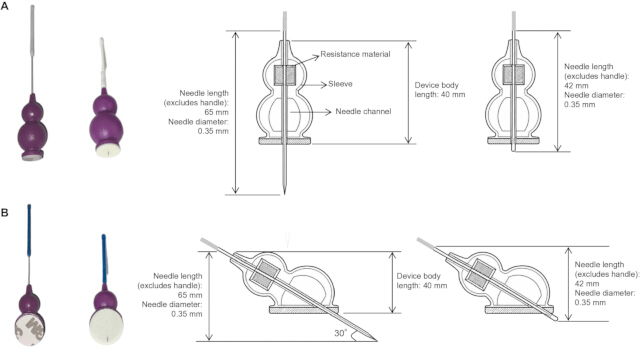
Figure 1: External appearance and structural schematics of the real-needle and placebo-needle configurations. (A) Perpendicular configuration. (B) Predefined 30° oblique configuration. The schematics are not drawn to scale and display only verified study-relevant structural features and dimensions. Please click here to view a larger version of this figure.
| Characteristic | Real needle group (n = 30) | Placebo needle group (n = 30) | Test statistic | p value |
| Age, years | 27.63 ± 3.35 | 28.37 ± 3.76 | t = −0.7984 | 0.4279 |
| Sex, n (%) | χ² = 0.601 | 0.438 | ||
| Male | 13 (43.3) | 16 (53.3) | ||
| Female | 17 (56.7) | 14 (46.7) | ||
| Previous acupuncture experience, n (%) | 30 (100.0) | 30 (100.0) | — | — |
Table 1: Baseline characteristics of the healthy volunteers. Age is presented as mean ± standard deviation, and sex and previous acupuncture experience are presented as number and percentage. Age was compared using an independent-samples t-test, and sex was compared using the chi-square test. All participants had previous acupuncture experience.
| Outcome | Real needle group (n = 30) | Placebo needle group (n = 30) | Overall statistic | p value |
| VAS score | 4.63 ± 1.56 | 4.97 ± 1.67 | t = −0.7976 | 0.4283 |
| Participant judgment | ||||
| Guessed real needle, n (%) | 17 (56.7) | 16 (53.3) | ||
| Guessed placebo needle, n (%) | 13 (43.3) | 14 (46.7) | ||
| Cohen's κ (95% CI) | 0.033 (−0.218 to 0.285) | 0.795 | ||
| Bang BI (95% CI) | 0.133 (−0.221 to 0.488) | −0.067 (−0.424 to 0.290) | ||
| Acupuncturist judgment | ||||
| Guessed real needle, n (%) | 16 (53.3) | 12 (40.0) | ||
| Guessed placebo needle, n (%) | 14 (46.7) | 18 (60.0) | ||
| Cohen's κ (95% CI) | 0.133 (−0.117 to 0.384) | 0.301 | ||
| Bang BI (95% CI) | 0.067 (−0.290 to 0.424) | 0.200 (−0.151 to 0.551) |
Table 2: VAS-rated needling discomfort and blinding assessments. One global visual analog scale (VAS) score and one global treatment-allocation guess were recorded per participant after completion of both needling placements. Participant and acupuncturist blinding were assessed using treatment-allocation guesses, Cohen's kappa coefficients, and group-specific Bang Blinding Index (BI) estimates with 95% confidence intervals (CI). The Bang BI was calculated separately within each actual allocation group as the proportion of correct guesses minus the proportion of incorrect guesses. No equivalence margin was prespecified for the VAS analysis.
المناقشة
Developing an ideal placebo control for acupuncture remains challenging. A nonpenetrating procedure can reduce some treatment-specific stimulation, but blunt skin contact and pressure may still evoke sensory or physiological responses5. The present placebo configuration should therefore be regarded as a nonpenetrating pressure-contact control rather than a physiologically inert placebo. In future trials, between-group effects should be interpreted as the contrast between penetrating needling and nonpenetrating cutaneous pressure within a matched treatment context. The present device is consequently best viewed as a standardized methodological control rather than an inert comparator.
Comparison with representative placebo acupuncture devices helps define the intended role of the present system. The Streitberger and Park devices provide established approaches to participant blinding but are mainly designed for single-blind use and can constrain the needling procedure15. The Takakura system demonstrated that practitioner blinding can be approached by matching penetrating and nonpenetrating devices and incorporating resistance within a guiding structure13. The present device uses an opaque sleeve, adhesive fixation, and predefined needle channels to support both participant and acupuncturist allocation concealment. Importantly, the angles are fixed by sleeve geometry rather than continuously adjustable. The present feasibility study evaluated only a 30° oblique configuration at Yintang and a perpendicular configuration at the right Hegu.
Potential residual tactile cues remain important. Although the real and placebo needles have the same 0.35 mm diameter and matched 25 mm external exposure, their total lengths differ by 23 mm. Because acupuncture needles are thin and lightweight and the length difference is concealed within the opaque device, any mass or center-of-gravity difference is expected to be subtle during routine handling. However, it was not quantified mechanically. Likewise, tissue resistance during penetration and withdrawal cannot be assumed to be physically identical to resistance generated by the internal filling material. This was one reason acupuncturist treatment guessing was assessed empirically. Under the standardized conditions tested, acupuncturist κ and Bang BI estimates did not show a clear directional ability to identify allocation, but this empirical finding does not establish mechanical equivalence. The device permits bidirectional needle rotation without obvious sleeve displacement or loosening of the adhesive interface, as can be demonstrated operationally in the accompanying video, but rotational resistance and repeated manual manipulation were not quantitatively validated.
The VAS analysis showed no statistically significant between-group difference in reported needling discomfort, but no equivalence margin was prespecified. Therefore, this result does not establish sensory equivalence. Direct blinding assessment was consequently emphasized. Participant agreement with actual allocation was minimal (κ = 0.033, 95% CI: −0.218 to 0.285), and acupuncturist agreement was low (κ = 0.133, 95% CI: −0.117 to 0.384). The Bang BI further characterized the direction of guessing: participant estimates were 0.133 and −0.067 in the real-needle and placebo-needle groups, respectively, and acupuncturist estimates were 0.067 and 0.200. All corresponding 95% confidence intervals included zero but were relatively wide. Overall, 33 of 60 participants guessed that they had received the real-needle configuration, indicating a modest overall tendency toward the “real” response that is not fully represented by Cohen's kappa alone. These findings should therefore be interpreted as preliminary estimates of treatment-guessing behavior and do not exclude partial unblinding. In addition, the original assessment required a binary real/placebo response without an “uncertain” option, which may have encouraged forced guessing. Future validation studies should include an explicit uncertainty category.
The present experiment was a methodological feasibility assessment rather than a therapeutic acupuncture trial for a specific disease or symptom. To minimize operator-dependent variation, the protocol used immediate withdrawal after full advancement and did not include needle retention, lifting-thrusting, rotation, or systematic Deqi elicitation. Accordingly, the term “real-needle configuration” is used to distinguish the penetrating device condition from a complete therapeutic acupuncture session. Each participant received the two placements in a fixed order (Yintang first, followed by the right Hegu) under the same allocation, but VAS and allocation guesses were recorded globally at the participant level rather than separately for the two sites. Site-specific sensory and blinding performance therefore cannot be determined retrospectively.
Several limitations should be considered. First, the sample comprised 60 healthy volunteers and was not prospectively powered to establish successful blinding. The confidence intervals remain compatible with partial unblinding. Blinding performance may differ across acupoints with different skin thickness or tissue compliance, repeated treatment sessions, patient populations, practitioners with different experience, or protocols using other depths, angles, retention periods, or manual stimulation. Second, manufacturer-level sleeve/channel dimensions, dimensional tolerances, and the quantitative formulation and amount of the internal resistance-generating material were not available as verified experimental records and were not retrospectively assigned. Some manufacturing details are also associated with ongoing intellectual-property development. The present report therefore supports reproducibility of the standardized experimental use of the device rather than serving as a complete manufacturing blueprint. Third, minor bleeding occurred in 7 of 30 participants in the real-needle group and in none of the placebo-needle participants. Withdrawal and site inspection were performed by an independent third-party assessor so that the treating acupuncturist did not receive this visual cue. No placebo needle penetrated the skin, and no adhesive- or needle-related allergic reaction was observed. These findings support further methodological evaluation of the device but do not establish successful blinding or physiological inertness.
الإفصاحات
The authors declare that they have no competing financial interests or other conflicts of interest related to this work.
شكر وتقدير
The authors thank all healthy volunteers who participated in the feasibility assessment. The authors also thank the members of the research team who assisted with participant coordination, device preparation, and data collection. This work was supported by China Postdoctoral Science Foundation (447645), the National Natural Science Foundation of China (82474622), and Project of Guangdong Provincial Administration of Traditional Chinese Medicine (20271207), Think Tank Research Project of the Lingnan Medicine Inheritance Program, Guangzhou Demonstration Project for the Inheritance, Innovation and Development of Traditional Chinese Medicine (2026ZKYB16) and Health Talent Project of the Guangdong Provincial Health Commission under the Guangdong Special Support Program (0820250115).
المواد
| الاسم | الشركة | رقم فهرسي | التعليقات |
|---|---|---|---|
| Internal resistance-generating material | Custom internal filling structure; quantitative formulation, density, hardness, rheological properties, and filling quantity were not available as verified experimental records | Laozongyi Medical Device Co. | NO.26381 |
| Medical-grade adhesive pad | Medical-grade adhesive pad used to fix the device to the skin | 3M | NO.70000127483 |
| Opaque sleeve, 30° oblique | Predefined 30° needle channel relative to the skin surface; used at Yintang | Laozongyi Medical Device Co. | NO.250801019 |
| Opaque sleeve, perpendicular | Predefined perpendicular needle channel; used at Hegu | Laozongyi Medical Device Co. | NO.250802029 |
| Placebo needle | 0.35 mm diameter × 42 mm total length; blunt tip; 25 mm externally exposed before advancement; approximately 2 mm distal tip excursion at full advancement | Laozongyi Medical Device Co. | NO.250801 |
| Real needle | 0.35 mm diameter × 65 mm total length; sharp tip; 25 mm externally exposed before advancement; approximately 25 mm effective penetration depth at full advancement | Laozongyi Medical Device Co. | NO.250802 |
| SPSS Statistics | IBM | version 26 | |
| Note: The custom needle-sleeve device was supplied after manufacturer-specified high-temperature disinfection and was designated for single use. The separately sourced 3M adhesive pad should be used according to its manufacturer instructions; no claim is made that it underwent the same high-temperature processing. |
المراجع
- Ernst E, Saradeth T, Resch KL. The powerful placebo. Lancet. 1991;337(8741):611.
- Liu XY, Yan SY, Liu BY. Sham acupuncture and placebo acupuncture in clinical trials. Zhongguo Zhen Jiu. 2023;43(7):821-4.
- Wang YT et al. Analysis of placebo effect of acupuncture. Zhen Ci Yan Jiu. 2024;49(8):875-9.
- Ernst E, Resch KL. Concept of true and perceived placebo effects. BMJ. 1995;311(7004):551-3.
- Zhang YQ et al. How to design high quality acupuncture trials—a consensus informed by evidence. BMJ. 2022;376:e067476.
- Matsuura Y, Takazawa Wlch N, Sakai T, Tsutani K. Clinical trial registration and publication in acupuncture studies: a systematic review. Integr Med Res. 2020;9(1):56-61.
- Liu Y et al. Analysis of the registration information on interventions of acupuncture and moxibustion trials in the International Clinical Trials Registry Platform. Evid Based Complement Alternat Med. 2018;2018:1054629.
- Xie Y et al. Descriptions of sham acupuncture in randomised controlled trials: a critical review of the literature. BMC Complement Med Ther. 2023;23(1):173.
- Lee YS et al. ACURATE: a guide for reporting sham controls in trials using acupuncture. J Evid Based Med. 2023;16(1):82-90.
- Ma P et al. The SHARE: SHam Acupuncture REporting guidelines and a checklist in clinical trials. J Evid Based Med. 2023;16(4):428-31.
- Park J et al. Validating a new non-penetrating sham acupuncture device: two randomised controlled trials. Acupunct Med. 2002;20(4):168-74.
- Streitberger K, Kleinhenz J. Introducing a placebo needle into acupuncture research. Lancet. 1998;352(9125):364-5.
- Takakura N, Yajima H. A double-blind placebo needle for acupuncture research. BMC Complement Altern Med. 2007;7:31.
- Zhang CS et al. Placebo devices as effective control methods in acupuncture clinical trials: a systematic review. PLoS One. 2015;10(11):e0140825.
- Zhang GS et al. Systematic review of acupuncture placebo devices with a focus on the credibility of blinding of healthy participants and/or acupuncturists. Acupunct Med. 2018;36(4):204-14.
إعادة الطباعة والأذونات
تم نشر هذه المقالة
الفيديو قريباً