18.4
在亲电芳香族取代反应中,亲电子试剂取代芳香族化合物的氢。
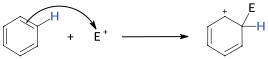
通过这些反应可以将许多官能团添加到芳香族化合物中。 所有亲电芳香族取代反应均通过两步机制发生。 第一步,芳环的π系统与亲电子试剂反应,形成芳烃离子,该离子是共振稳定的。 它通常被称为西格玛络合物,因为亲电子试剂与芳环形成西格玛键。
在第二步中…

亲电芳香取代反应是指亲电试剂取代芳香环上的一个氢原子的反应。
这些反应能够将不同的官能团引入芳香环上。
反应机理的第一步中,芳香环的π体系进攻亲电试剂,形成一个共振稳定的芳正离子(arenium离子)。
芳基正离子也被称为σ络合物,因为亲电试剂与芳香环形成了σ键。
第二步中,芳正离子发生去质子化,恢复芳香性,得到取代产物。
从自由能图中可以明显看出,第一步是吸能反应,因为环失去了其芳香稳定性。这一步的活化自由能较高,反应速率较慢,因此是决速步。
相比之下,第二步是放能反应,因为它恢复了体系的芳香稳定性。该步骤的活化自由能较低,反应速度快。
总体而言,亲电芳香取代反应是放能反应。
View the full transcript and gain access to JoVE Core videos
Q1: What happens in the first step of an electrophilic aromatic substitution reaction?
In the first step, the π system of the aromatic ring attacks the electrophile, forming an arenium ion, also called a sigma complex. This intermediate is resonance-stabilized because the electrophile forms a sigma bond with the aromatic ring. This step is endergonic and rate-determining because the ring loses its aromatic stability.
Q2: Why is the first step of electrophilic aromatic substitution the rate-determining step?
The first step is rate-determining because it has a higher free energy of activation and is slow. During this step, the aromatic ring loses its aromatic stability, making the reaction endergonic. The second step, which restores aromaticity, is fast and exergonic with lower activation energy.
Q3: What is an arenium ion in aromatic substitution?
An arenium ion is the resonance-stabilized intermediate formed when the π system of an aromatic ring attacks an electrophile. It is also called a sigma complex because the electrophile forms a sigma bond with the aromatic ring. This intermediate is then deprotonated in the second step to restore aromaticity.
Q4: How does the second step of electrophilic aromatic substitution restore aromaticity?
In the second step, the arenium ion is deprotonated, which restores the aromatic character of the ring and yields the substituted product. This step is exergonic because it restores aromatic stability to the system. It has a lower free energy of activation and proceeds rapidly compared to the first step.
Q5: What functional groups can be introduced through electrophilic aromatic substitution?
Many functional groups can be added to aromatic compounds through electrophilic aromatic substitution reactions. These include halogens, nitro groups, sulfonic acid groups, and alkyl or acyl groups. The specific functional group introduced depends on the electrophile used in the reaction.
Q6: Is electrophilic aromatic substitution an overall exergonic or endergonic reaction?
Overall, electrophilic aromatic substitution reactions are exergonic. Although the first step is endergonic and rate-determining, the second step is exergonic and restores aromatic stability. The favorable energy release in the second step outweighs the energy cost of the first step, making the overall process thermodynamically favorable.
Q7: How does a free energy diagram illustrate the two-step mechanism of electrophilic aromatic substitution?
A free energy diagram shows that the first step has a higher activation energy and is endergonic, representing the rate-determining step where aromaticity is lost. The second step has lower activation energy and is exergonic, restoring aromaticity. The overall reaction is exergonic, with the final product at lower free energy than the starting material.