2.4
在描述物体的位移和速度以及作用在物体上的力时,笛卡尔坐标系是一个非常方便使用的工具。 然而,当我们需要描述物体的旋转时,它就变得非常繁琐。 所以,在描述旋转时,一般采用极坐标系。
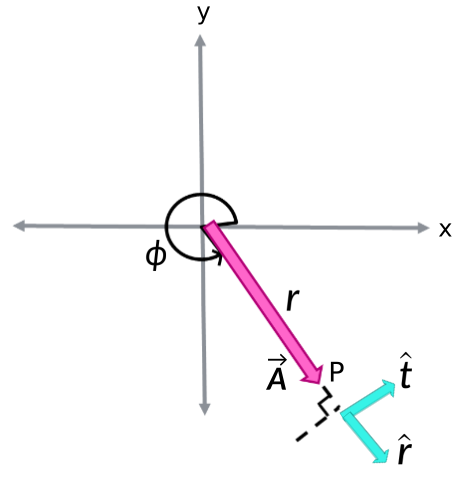
在极坐标系中,如上图所示,平面上一点的位置是由两个极坐标给出的。 第一个极坐标是径向坐标,它是从原点到该点的距离。 第二…
笛卡尔坐标系可以描述物体的直线运动及其动力学特性。然而,使用极坐标系来描述旋转运动则更为简便。
在极坐标系中,一个矢量由两个标量分量定义:径向分量和极角。
径向分量表示该向量从原点出发的径向距离。
极角表示向量与正x轴之间的夹角。
此处,正交单位矢量分别沿径向方向及其垂直方向。
如果已知矢量在极坐标系中的标量分量,则可求得其在直角坐标系中的分量。
柱面坐标系是极坐标在三维空间中的推广,适用于描述具有柱对称性的系统。
该系统使用径向距离、方位角和 z 方向来定义一个矢量。
前两个标量分量与极坐标系中的分量类似,而第三个分量表示相对于xy平面的高度。
变换方程将柱坐标系中的向量转换为笛卡尔坐标系中的向量。
View the full transcript and gain access to JoVE Core videos
Q1: Why are polar coordinates better for describing rotations than Cartesian coordinates?
Polar coordinates simplify rotational motion because they use a radial distance and polar angle, which naturally align with circular motion. The Cartesian coordinate system, while convenient for linear displacements and forces, becomes cumbersome when describing rotations. Polar coordinates directly represent angular relationships, making rotational dynamics more intuitive and mathematically elegant.
Q2: What are the two scalar components that define a vector in polar coordinates?
A vector in polar coordinates is defined by the radial component and the polar angle. The radial component specifies the distance from the origin to the point. The polar angle indicates the angle between the vector and the positive x-axis, measured counterclockwise in radians. Together, these two scalars completely describe a point's location in a plane.
Q3: How do you convert a vector from polar coordinates to Cartesian coordinates?
Transformation equations relate polar and Cartesian coordinates, allowing conversion between the two systems. If you know the radial distance and polar angle in polar coordinates, you can apply these equations to obtain the x and y components in the Cartesian coordinate system. This conversion is essential when working across different coordinate frameworks in physics problems.
Q4: What is the relationship between polar and cylindrical coordinates?
Cylindrical coordinates are a three-dimensional generalization of polar coordinates. They extend the radial distance and azimuthal angle from polar coordinates and add a third component: the z-coordinate, which represents height from the xy plane. This makes cylindrical coordinates ideal for describing three-dimensional systems with cylindrical symmetry.
Q5: Why are cylindrical coordinates preferred for systems with cylindrical symmetry?
Cylindrical coordinates simplify mathematical calculations for cylindrical systems because they require fewer parameters. For example, describing a cylinder's surface requires all three Cartesian coordinates, but cylindrical coordinates need only the radius parameter. This efficiency reduces computational complexity and makes solving problems involving cylindrical geometry more straightforward.
Q6: What do the orthogonal unit vectors represent in polar coordinates?
In polar coordinates, orthogonal unit vectors point along the radial direction and perpendicular to it. The radial unit vector points outward from the origin, while the perpendicular unit vector indicates the direction of increasing polar angle in the counterclockwise sense. These orthogonal directions form the basis for expressing vectors in polar form.
Q7: What three scalar components define a vector in cylindrical coordinates?
A vector in cylindrical coordinates is defined by three scalar components: the radial distance (distance from the z-axis to the point), the azimuthal angle (angle from the x-axis), and the z-coordinate (height from the xy plane). The radial and azimuthal components mirror polar coordinates, while the z-component extends the system into three dimensions.