7.5
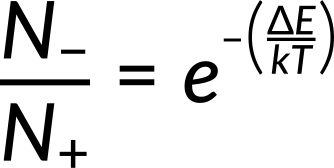
在接近绝于对零度的温度时,并在存在磁场的情况下,大多数原子核更倾向于低能量的自旋上升状态而不是高能量的自旋下降状态。随着温度逐渐升高,热碰撞所产生的能量能够在两种状态之间更均匀地分配自旋。玻尔兹曼分布方程给出了−½ (N−) 自旋态和+½ (N+) 自旋态中所预测的自旋数量之比。
这里,ΔE 是两个…
在接近绝对零度的温度下,存在磁场时,大多数原子核倾向于处于较低能量的自旋 +½ 态,而非较高能量的自旋 −½ 态。
在室温下,热碰撞的能量使得自旋在两种状态之间的分布更加均匀,这符合玻尔兹曼分布方程的描述。
N+ 和 N− 分别表示预测处于自旋 +½ 态和自旋 −½ 态的自旋数目。
自旋态之间的能量差 ΔE 可表示为 hν,其中 h 为普朗克常数,ν 为核磁共振仪器的工作频率。k 为玻尔兹曼常数,T 为以开尔文为单位测量的绝对温度。
例如,在60 MHz的仪器中,于298开尔文下,较低能级状态在两百万个产生核磁共振信号的原子核中,大约有九到十个的过剩布居数。
使用更高的工作频率会增大能隙和过剩粒子数。
View the full transcript and gain access to JoVE Core videos
Q1: Why do nuclei prefer the lower energy spin state at low temperatures?
At near absolute zero temperatures in a magnetic field, nuclei occupy the lower energy spin +½ state because it is energetically favorable. Thermal energy is insufficient to excite nuclei to the higher energy spin −½ state. This preference decreases as temperature increases, allowing thermal collisions to distribute spins more equally between both states.
Q2: How does the Boltzmann distribution describe spin state populations?
The Boltzmann distribution equation predicts the ratio of nuclei in the spin −½ and spin +½ states using the energy difference (ΔE), Boltzmann constant (k), and absolute temperature (T). At room temperature, this ratio is slightly less than one, meaning slightly more nuclei occupy the lower energy state. The equation shows that higher temperatures favor more equal population distribution between states.
Q3: What is the relationship between NMR operating frequency and spin population?
The energy difference between spin states (ΔE) equals hν, where h is Planck's constant and ν is the NMR instrument's operating frequency. Higher operating frequencies increase this energy gap, creating a larger excess population in the lower energy state. For example, at 60 MHz and 298 K, approximately 9-10 excess nuclei exist per 2 million total nuclei, producing the detectable NMR signal.
Q4: Why is the excess population of nuclei significant despite being small?
Although only 9-10 excess nuclei exist per 2 million in a 60 MHz instrument at room temperature, this small population difference is responsible for net magnetization. These excess spins in the lower energy state create the net magnetic moment that produces the observable NMR signal. Without this population excess, no detectable signal would be generated.
Q5: How does temperature affect the distribution of nuclear spins between energy states?
Increasing temperature provides more thermal energy, causing nuclei to distribute more equally between the spin +½ and spin −½ states. At room temperature, thermal collisions continuously excite nuclei between states, reducing the population excess in the lower energy state compared to near absolute zero. This temperature-dependent distribution is quantified by the Boltzmann distribution equation.
Q6: What constants are essential for calculating spin state populations in NMR?
Three key constants determine spin populations: Planck's constant (h = 6.626 × 10⁻³⁴ J·s), the Boltzmann constant (k = 1.38 × 10⁻²³ J·K⁻¹), and the NMR operating frequency (ν). These values combine in the Boltzmann distribution equation to predict the ratio of nuclei in each spin state. The operating frequency directly influences the energy difference and resulting population excess.
Q7: How can increasing the NMR instrument frequency improve signal detection?
Higher operating frequencies increase the energy gap between spin states, creating a larger excess population in the lower energy state. This larger population difference generates stronger net magnetization and produces a more intense NMR signal. Therefore, upgrading to higher-frequency NMR spectrometers enhances signal strength and improves analytical sensitivity.