29.4
细直导线产生的磁场

Consider an infinitely long, thin, straight current carrying wire. The magnetic field created by the current in its proximity can be calculated using the Biot-Savart law.
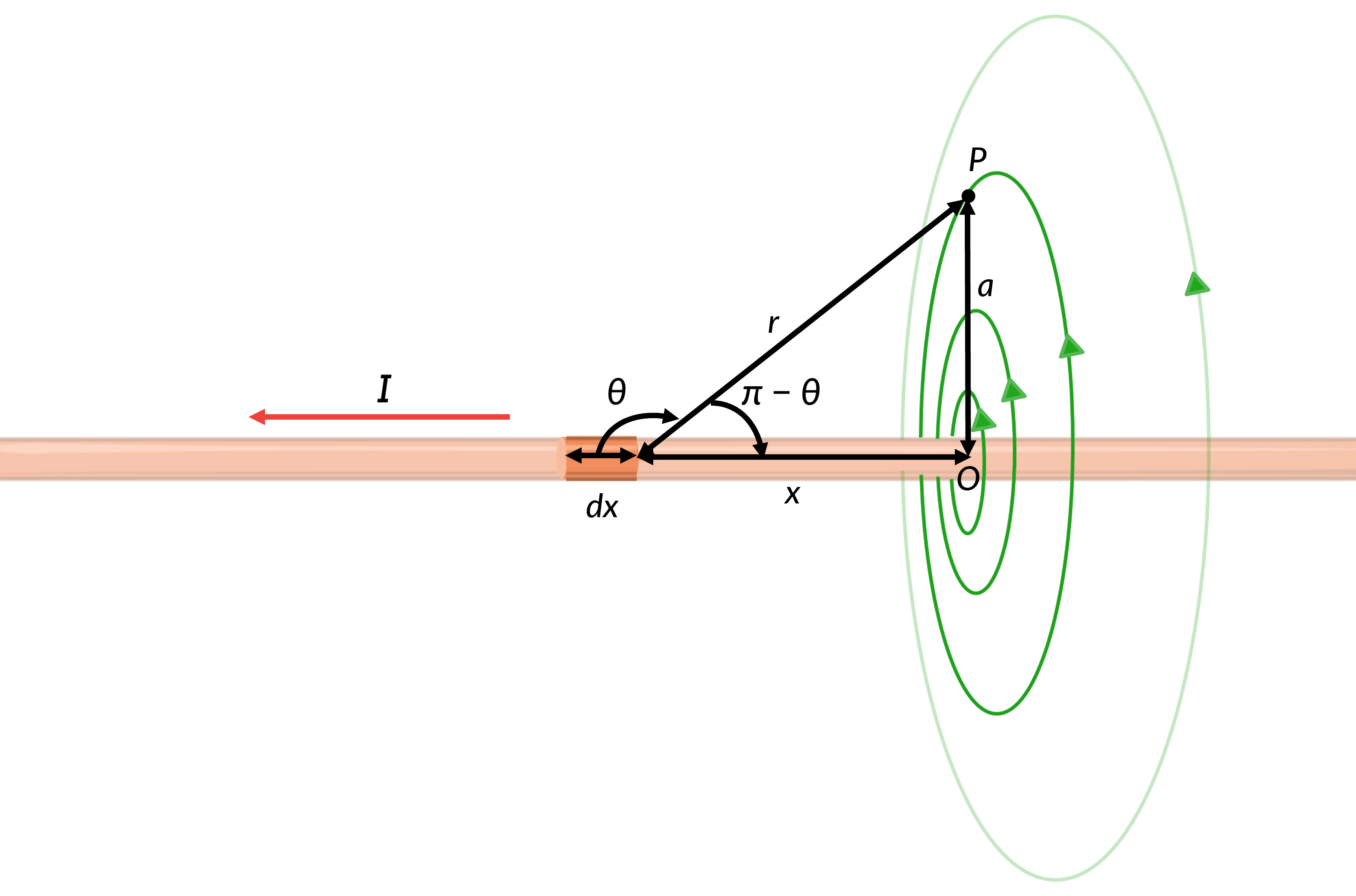
To estimate the magnetic field at a point P, consider a small current element of length "dx", at a distance "x" from the origin. The length of the line joining "dx" and "P" can be estimated using the Pythagorean theorem.
The angle subtended by the current element with the line joining P can be expressed as a over r.
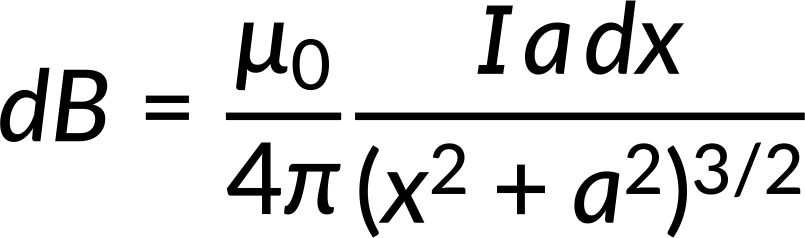
Substituting these terms gives the expression for the magnetic field created by the current element.
Since the wire is infinitely long, integrating the equation from zero to infinity gives the expression for the total magnetic field at P, produced by the current carrying wire.
Following the right-hand rule, if the thumb points along the current direction, then the fingers curl along the direction of the magnetic field lines. These lines are concentric around the wire, and their magnitude decreases with increasing distance, which increases the space between the field lines.
版权所有 © 2026 MyJoVE Corporation。保留所有权利。