4.5
笛卡尔形式的矢量公式是利用位置矢量和力矢量来计算力矩的过程。力矩被定义为这些矢量的叉积,使其成为向量。位置和力矢量的笛卡尔形式涉及到单位矢量,并且可以通过行列式的形式来表示叉积。
可以将行列式进行展开,并以此来确定力矩的笛卡尔矢量形式。
例如,假设一个10N的力作用在一个绕x方向旋转的门上,给定的位…
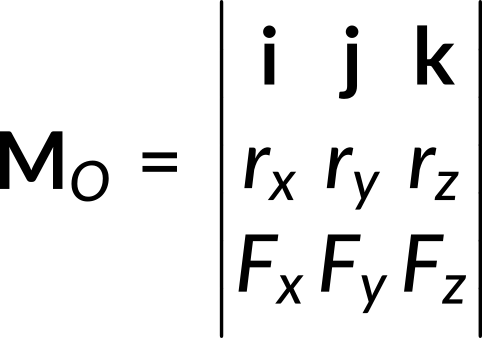
力矩定义为位置矢量与力矢量的叉乘积。
力矩的叉积可以用行列式形式表示,使用单位矢量以及位置矢量和力矢量的笛卡尔形式。
通过展开行列式,确定力矩的笛卡尔矢量表达式。
假设一个大小为 10 N 的力作用在旋转门上,作用点的位置矢量以笛卡尔分量形式给出。此处需要确定力矩的矢量表达式。
在这种情况下,力矢量垂直于 y-z 平面,导致力矢量的 y 和 z 分量为零。通过位置矢量和力矢量构建一个行列式。
最后,通过展开行列式,可确定旋转门绕 z 轴的力矩。
此处,力矩方向为正的 z 方向,表示门沿逆时针方向旋转。
View the full transcript and gain access to JoVE Core videos
Q1: How is the moment of force calculated using Cartesian form?
The moment of force is calculated as the cross-product of position and force vectors expressed in Cartesian form. A determinant is constructed using the position vector components and force vector components with unit vectors. Expanding this determinant yields the Cartesian vector formulation of the moment, which indicates both magnitude and rotational direction about a specific axis.
Q2: What role do unit vectors play in expressing the cross-product determinant?
Unit vectors i, j, and k form the first row of the determinant used to express the cross-product in Cartesian form. They define the x, y, and z directions respectively. The position and force vector components fill the remaining rows, allowing the determinant expansion to produce moment components in each coordinate direction.
Q3: Why are some force vector components zero in the revolving door example?
The force is applied perpendicular to the y-z plane, meaning it acts only along the x-direction. Therefore, the y and z components of the force vector are zero, while only the x-component equals 10 N. This simplifies the determinant calculation and reveals that the moment acts exclusively about the z-axis.
Q4: What does a positive moment value indicate about rotational direction?
A positive moment value indicates counterclockwise rotation when viewed from the positive direction of the axis. In the revolving door example, the positive 40 N·m moment about the z-axis means the door rotates counterclockwise. The sign convention helps determine both magnitude and sense of rotation in three-dimensional space.
Q5: How does the determinant method relate to the moment of a force about an axis vector?
The determinant method is the mathematical tool for computing moment of a force about an axis vector. By arranging position and force components in determinant form and expanding, you obtain the vector components of the moment. This approach directly produces the moment vector, which specifies both rotational magnitude and axis orientation.
Q6: What information does the Cartesian vector formulation provide about moment components?
The Cartesian vector formulation expresses the moment as components along the x, y, and z axes, revealing how the moment distributes in three-dimensional space. Each component indicates the rotational effect about its respective axis. This detailed breakdown is essential for analyzing complex force systems and understanding resultant moment vector formulation.
Q7: When should you use Cartesian form instead of scalar formulation for moment calculations?
Use Cartesian form when forces act in three dimensions or when you need complete moment vector information including direction and all components. Scalar formulation works for planar problems with perpendicular forces and distances. Cartesian form provides comprehensive results for complex spatial configurations and is necessary for moment of a force scalar formulation comparisons.
