6.8
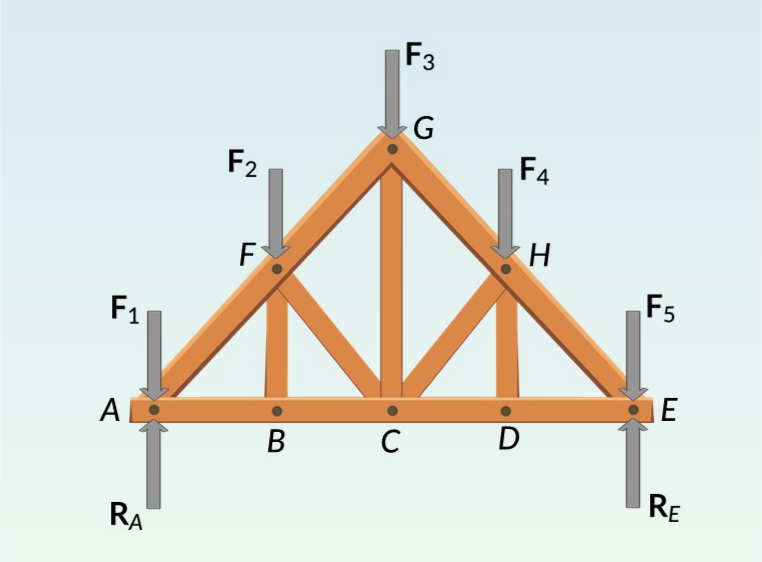
假设有一个对称的屋顶桁架结构,该结构由垂直、对角和水平支撑的构件组成。每个水平支撑构件的长度为4m。垂直支撑的构件FB和HD的长度为4m,而支撑构件GC的长度为6m。在连接点F、G和H处的荷载为2kN,而在连接点A和E处的荷载为1kN。
采用截面法来计算支撑构件DC和HC上的作用力。将力矩平衡条件应…
考虑一个由竖直杆、斜杆和水平杆组成的对称屋顶桁架结构。
绘制受力图,以使用截面法分析 DC 和 HC 构件上的受力情况。
此处,水平杆件和竖直杆件的载荷及其长度均为已知参数。
首先,对点 A 求力矩和,计算出点 E 处的支座反力。
此外,利用桁架的力平衡条件,可确定 A 点的支座反力。
桁架的对称性确保了两个支座反力相等。
现在,沿一个相交平面进行切割 直流电 HC 和 HG 成员,并绘制较小部分的受力分析图。
对点 H 取力矩和,可得沿 DC 方向的力。正值表示该力为拉力。
沿 HC 的力被分解为正弦和余弦分量,并利用三角学估算角度 theta。
在 E 点的力矩平衡条件可得出 HC 上的力,负号表示该力为压力。
Q1: How do you calculate reaction forces in a symmetrical roof truss using the method of sections?
For a symmetrical roof truss, apply moment equilibrium about a support point, substituting known loads and distances into the moment equation. This yields the reaction force at one support. Then use vertical force equilibrium to find the reaction at the other support. Due to symmetry, both reaction forces are equal. In the example, both reaction forces equal 4 kN.
Q2: What does a positive force value indicate when analyzing truss members?
A positive force value indicates a tensile force, meaning the member is being pulled or stretched. Conversely, a negative force value indicates a compressive force, where the member is being pushed or compressed. In the roof truss example, member DC experiences a tensile force of 3 kN, while member CH experiences a compressive force of -1.41 kN.
Q3: How does the method of sections isolate forces on specific truss members?
The method of sections involves making a cut through a truss along a plane that intersects the members you want to analyze. A free-body diagram is drawn for the smaller section created by this cut. Moment and force equilibrium equations are then applied to this isolated section to calculate internal forces on the cut members without analyzing the entire truss.
Q4: Why is moment equilibrium applied at specific points when using the method of sections?
Moment equilibrium is applied at points where unknown forces intersect or align, eliminating those unknowns from the equation. For example, taking moments about point H eliminates the force at H from the calculation, allowing you to solve directly for the force on member DC. This strategic point selection simplifies the analysis and reduces the number of simultaneous equations needed.
Q5: What role does trigonometry play in analyzing diagonal truss members?
Trigonometry is used to resolve diagonal member forces into horizontal and vertical components and to determine the angle between members and the horizontal axis. In the roof truss example, trigonometry revealed that member CH makes a 45-degree angle with the horizontal. This angle information is essential for applying force equilibrium conditions and calculating accurate member forces.
Q6: How does truss symmetry simplify the analysis process?
Truss symmetry ensures that reaction forces and member forces are equal on both sides of the centerline, reducing calculation work. In a symmetrical roof truss, once you calculate the reaction force at one support, you immediately know the reaction force at the opposite support is identical. This property eliminates redundant calculations and provides a quick verification check for your results.
Q7: What information must be known before applying the method of sections to a truss?
You must know the loads acting at each joint, the lengths of all members, and the geometry of the truss structure. These known parameters allow you to set up moment and force equilibrium equations. Additionally, you need to identify which members you want to analyze and determine an appropriate cutting plane that intersects those members without cutting through more than three unknowns.