6.13
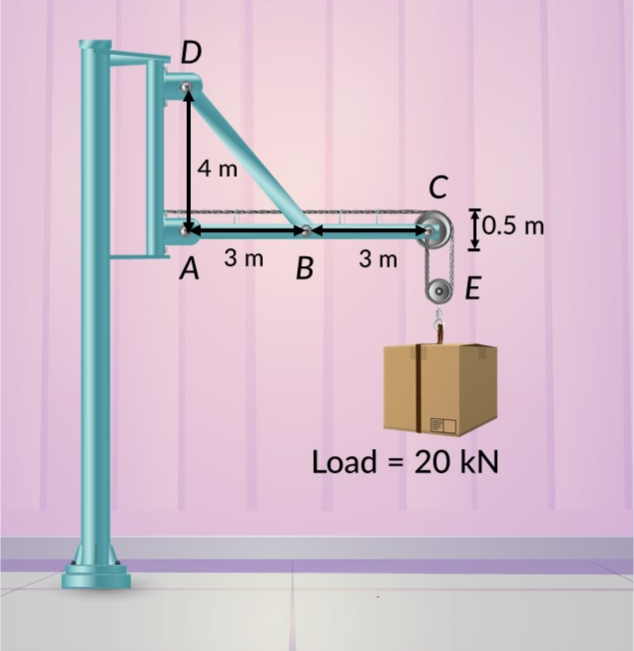
假设有一台悬臂起重机,其外部负载悬挂在滑轮上。起重机构件的尺寸如图所示。假设滑轮是无摩擦的,需要对框架结构进行系统分析,以确定销关节处的反作用力。
系统由两个主要的结构组件组成:双力杆BD和多力杆ABC。双力杆BD指的是一个直线元素,并受到两端的力所产生的作用,并在其长度上没有额外的力。这些力的大小…
考虑一个滑轮施加外部载荷的悬臂起重机。
如果已知起重机各构件的尺寸,且滑轮无摩擦,那么销接点处的反作用力是多少?
该系统为框架结构,由二力构件 BD 和多力构件 ABC 组成。
通过分析受力图并应用下部滑轮部分的力平衡条件,可求得缆绳中的张力。
考虑点 C,垂直缆索中的张力方向向下,而水平缆索中的张力方向指向铰接点 A。
在构件 DB 中,力 FBD 可通过斜率三角形表示。
节点 A 的力矩平衡条件给出了沿 BD 方向的力。
根据力的平衡条件,计算铰链 A 处的水平和竖直方向的支座反力。
现在,考虑构件 BD 的受力分析图,可在节点 D 处应用力的平衡条件,以求得 D 点的水平和竖直方向的支座反力。
Q1: What is the difference between a two-force member and a multi-force member in frame analysis?
A two-force member is a straight element subjected only to forces at its two ends, with forces equal in magnitude but opposite in direction, causing pure tension or compression. A multi-force member experiences more than two forces distributed along its length, including external loads, reaction forces at pin joints, and cable forces, resulting in complex stress distribution.
Q2: How do you determine cable tension in a jib crane pulley system?
For a frictionless pulley system, the load weight balances the tension in the cables. In the lower pulley section, each cable carries an upward tension equal to half the total load. For the upper pulley, the vertical cable tension remains the same as the lower section since it is part of the continuous cable system.
Q3: What equilibrium conditions are applied to find reaction forces at pin joints?
Force equilibrium conditions require that the sum of horizontal and vertical forces equals zero at each joint. Moment equilibrium conditions require that the sum of moments about a point equals zero. These conditions are applied systematically to free-body diagrams of each structural member to solve for unknown reaction forces.
Q4: How is the force in member BD resolved in a jib crane frame analysis?
The force FBD in member BD is resolved into horizontal and vertical components using a slope triangle, which relates the member's geometry to its force components. The moment equilibrium condition at joint A yields the magnitude of FBD. Substituting known dimensions and pulley radius values determines FBD as 50 kN in this example.
Q5: What are the typical reaction force values at pin joints in a loaded jib crane?
Reaction forces depend on load magnitude and structural geometry. In this jib crane example, the horizontal reaction force at joint A is 40 kN, while the vertical reaction force is -20 kN. At joint D, the horizontal reaction is -30 kN and the vertical reaction is 40 kN, determined by applying force equilibrium conditions.
Q6: Why is analyzing the lower pulley section important before analyzing the upper pulley?
The lower pulley section directly supports the external load, establishing the cable tension value. This tension value propagates through the continuous cable system to the upper pulley section. Determining lower pulley tension first provides known force values needed to solve for reaction forces at pin joints in the frame structure.
Q7: How does the free-body diagram method apply to frame problem solving?
Free-body diagrams isolate each structural member and show all forces acting on it, including external loads, cable tensions, and reaction forces at pin joints. Applying force and moment equilibrium conditions to these diagrams systematically yields unknown reaction forces. This method using method of joints problem solving principles allows solving complex frame structures step by step.