7.11
柔性电缆通常应用于各种进行支撑和负载传输的场景中。假设有一个固定在两个点上并受到多个垂直于集中载荷作用的电缆。通过给定载荷和支撑之间的水平距离,可以确定电缆的形状和每个部分的张力。
在分析中,可以假设电缆具有以下特性:
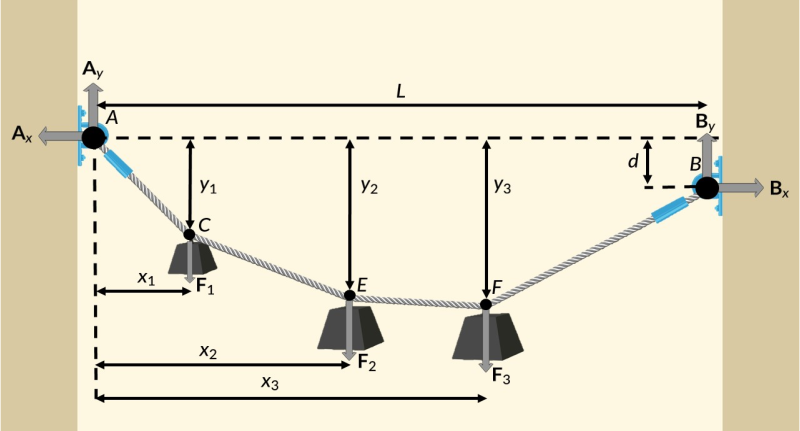
柔性电缆在多种应用中用于支撑和传递载荷。
考虑一根两端固定的缆索 AB ,承受多个竖向集中荷载。
已知载荷与支座之间的水平距离,确定缆索的形状以及缆索各段中的张力。
在分析中,假设该缆绳具有柔性、不可伸长,且重量可忽略不计。
该电缆由若干直线段组成,每一段均受到恒定的拉力作用。
绘制缆索的受力分析图,以确定支座处的反作用力。此处,未知反力分量的数目超过了平衡方程的数量。
考虑缆索上距离已知的点 D,并绘制出线段 AD 的受力分析图。通过在点 D 处应用力矩平衡方程,可得到一个附加方程。
通过回顾平衡方程并利用反作用力,可求得支座 A 到各个集中荷载的垂直距离。
类似地,可求得每一段中的张力,当该段的倾角最大时,张力达到最大值。
View the full transcript and gain access to JoVE Core videos
Q1: What assumptions are made when analyzing a cable subjected to concentrated loads?
Cables are assumed to be flexible, allowing them to change shape under applied loads, and inextensible, meaning their length does not change under tension. Additionally, the cable's weight is assumed negligible, so it does not significantly impact the cable's behavior during analysis of concentrated loads.
Q2: Why is a free-body diagram of a cable segment necessary for solving concentrated load problems?
A free-body diagram of the entire cable often yields more unknown reaction components than available equilibrium equations. By isolating a segment at a known distance and applying the moment equilibrium equation at that point, an additional equation is obtained, allowing the system to be solved for reaction forces and tensions.
Q3: How does the shape of a cable change when subjected to multiple concentrated loads?
A cable subjected to concentrated loads forms several straight-line segments between load points and supports. Each segment maintains constant tensile force and connects at the load application points, creating a polygonal shape that reflects the distribution and magnitude of the applied vertical loads.
Q4: What is the relationship between cable segment inclination and tension magnitude?
Tension in a cable segment is maximum when the segment has the largest inclination angle relative to the horizontal. Segments with steeper angles experience greater tensile forces because they must support larger vertical load components while maintaining static equilibrium across the cable system.
Q5: How are vertical distances from support to load points determined in cable analysis?
Once reaction forces are known from equilibrium equations, vertical distances from support A to each concentrated load are determined by recalling the equilibrium equation that states the sum of vertical forces acting on the cable must equal zero. This allows calculation of the cable's vertical geometry.
Q6: What information is needed to determine tension in each cable segment?
To calculate tension in each cable segment, you need the reaction forces at supports, the horizontal distances between loads, and the vertical distances from support to each load point. With these values, the tension in each segment can be computed, with maximum tension occurring in segments with the largest inclination angle.
Q7: How does the moment equilibrium equation help solve indeterminate cable systems?
When the number of unknown reaction components exceeds available equilibrium equations, applying the moment equilibrium equation at a point on the cable segment provides an additional independent equation. This transforms the indeterminate system into a determinate one, enabling complete solution for all reaction forces and segment tensions.