8.15
带肩轴承在设计各种用于支撑旋转轴向载荷的机器中都是必不可少的。根据其具体的应用和要求,可以找到带有单个或多个轴承中的带肩轴承。
假设有一个受到轴向载荷作用的单个带肩轴承。轴承的总接触区域是衬套外半径和内半径之间的区域。假设轴承能够提供均匀的支持时,可以通过将施加在衬套上的力与总的轴承接触面积进行相除…
轴套轴承是一种用于机器中支撑旋转轴上轴向载荷的轴承,可具有单个或多个轴套。
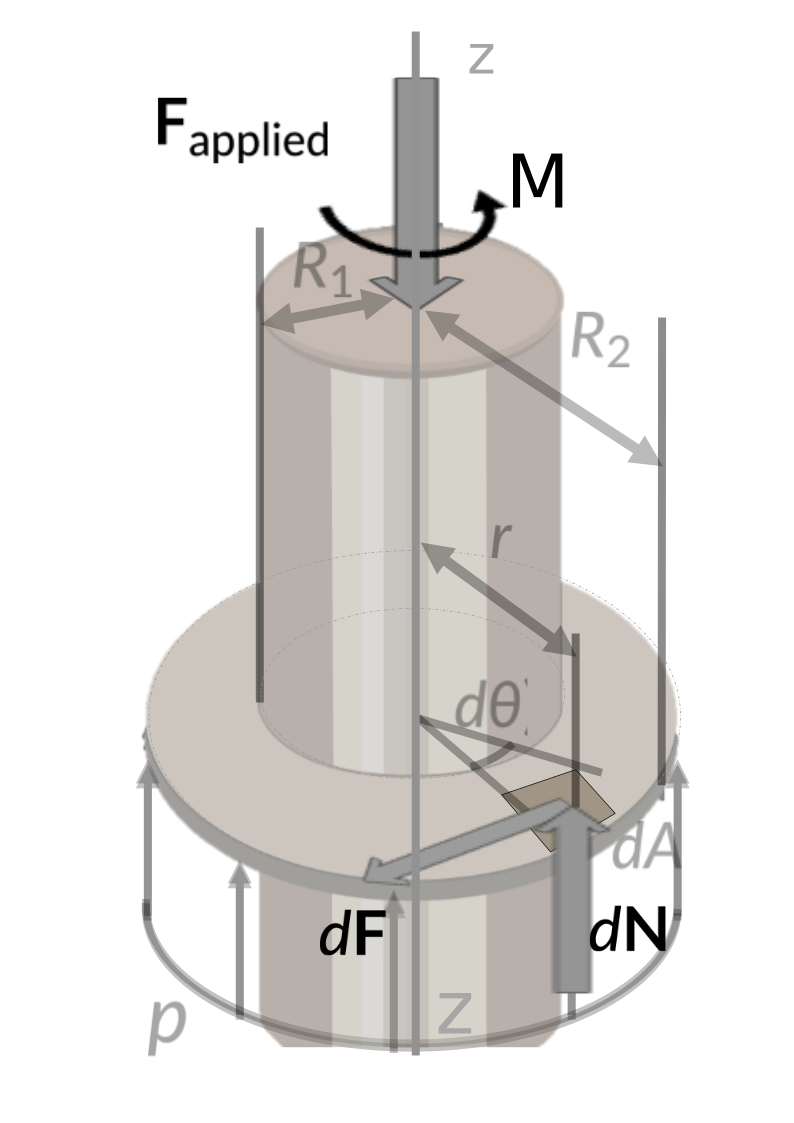
考虑一个承受轴向载荷的单个止推轴瓦。轴瓦外半径与内半径之间的区域即为总轴承接触面积。
假设轴承受力均匀,则均匀法向压强可表示为作用力与轴承面积之比。
考虑轴承上的一个无穷小面积微元。作用在该微元面积上的力可以表示为摩擦系数、压力与微元面积的乘积。
通过绕旋转轴的力矩平衡方程,确定使轴开始转动所需的力矩。
接下来,通过积分计算克服所有摩擦力所需的施加力矩。
最后,代入微分力和微分面积的值,并在整个轴承面积上对公式进行积分,即可估算出轴的力矩。
View the full transcript and gain access to JoVE Core videos
Q1: What is the bearing contact area in a collar bearing?
The bearing contact area is the region between the external and internal radius of the collar. This annular surface is where the collar makes contact with the shaft. Understanding this area is essential for calculating uniform normal pressure, which equals the applied axial force divided by the total bearing contact area.
Q2: How is uniform normal pressure calculated in a collar bearing?
Uniform normal pressure is calculated by dividing the applied axial force by the total bearing contact area. This assumes even support across the collar surface. The resulting pressure value represents the average force distribution per unit area acting on the bearing surface during shaft loading.
Q3: What factors determine the frictional force on a differential area element?
The frictional force on a differential area element is determined by three factors: the friction coefficient, the uniform normal pressure, and the differential area itself. These variables are multiplied together to express the force acting on any infinitesimal element of the bearing surface.
Q4: How is the moment required for shaft rotation determined?
The moment required for shaft rotation is determined using moment equilibrium equations about the rotational axis. Integration is applied to sum all frictional forces acting across the total bearing area. By substituting differential force and area values into the integrated equation, the applied moment needed to overcome all frictional resistance can be estimated.
Q5: Can collar bearings support loads with multiple collars?
Yes, collar bearings can be designed with either single or multiple collars depending on application requirements. Multiple collars increase the total bearing contact area and load-carrying capacity. This design flexibility allows engineers to optimize collar bearings for various machine applications supporting axial loads on rotating shafts.
Q6: Why is integration necessary in collar bearing analysis?
Integration is necessary because frictional forces vary across the bearing surface due to changing radius values. By integrating the differential force equation over the entire bearing area, engineers can accurately calculate the total moment required for impending rotation. This mathematical approach accounts for all frictional contributions across the collar surface.
Q7: What role does the friction coefficient play in collar bearing performance?
The friction coefficient is a key variable in calculating frictional forces on the bearing surface. It is multiplied by pressure and differential area to determine force on each element. The friction coefficient directly influences the moment required to initiate shaft rotation and is essential for predicting bearing performance under axial loading conditions.