2.13
使用 del算子的一阶算子包括梯度、散度和旋度。 某些组合的一阶算子在标量或向量函数上产生二阶表达式。 二阶表达式在数学和物理学中起着非常重要的作用。 一些二阶表达式包括梯度函数的散度和旋度、旋度函数的散度和旋度以及散度函数的梯度。
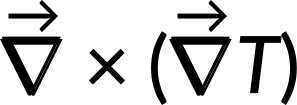
假设一个标量函数。 其梯度的旋度可以写成如下:
对于向量函数,旋度…
使用倒三角算符的一阶算符包括梯度、散度和旋度。
标量函数或向量函数上某些一阶算子的组合可产生二阶表达式。
二阶导数包括:梯度函数的散度和旋度、旋度函数的散度和旋度,以及散度函数的梯度。
梯度函数的旋度以及旋度函数的散度恒等于零。
标量函数梯度的散度称为标量拉普拉斯算子,或简称拉普拉斯算子。拉普拉斯算子类似于标量量的二阶导数。
当标量函数的梯度以柱面坐标和球面坐标表示时,可得到该函数在柱面坐标和球面坐标系中的拉普拉斯算符。
散度函数的梯度与旋度函数的旋度是两种数学构造。拉格朗日矢量叉积恒等式将二者与矢量拉普拉斯算子联系起来。
矢量拉普拉斯算子是通过对矢量的每个标量分量直接应用标量拉普拉斯算子得到的。
View the full transcript and gain access to JoVE Core videos
Q1: What is the Laplacian operator and how does it relate to second derivatives?
The Laplacian is the divergence of the gradient of a scalar function, representing a second-order derivative analogous to classical second-order differentiation. It describes physical phenomena like electric potentials and diffusion equations for heat flow. The scalar Laplacian is fundamental in mathematics and physics for modeling these processes.
Q2: Why are the curl of a gradient and divergence of a curl always zero?
These combinations of first-order operators always yield zero due to mathematical properties of the del operator. The curl of a gradient function and the divergence of a curl function are identically zero regardless of the input function. This is a fundamental identity in vector calculus with important physical implications.
Q3: How is the vector Laplacian different from the scalar Laplacian?
The vector Laplacian is obtained by directly applying the scalar Laplacian to each scalar component of a vector function. While the scalar Laplacian operates on single scalar quantities, the vector version extends this operation component-wise. Lagrange's vector cross-product identity formula relates the vector Laplacian to other second-order expressions.
Q4: What second-order expressions result from combining first-order del operators?
Combining first-order operators like gradient, divergence, and curl yields second-order expressions including the divergence and curl of a gradient function, the divergence and curl of a curl function, and the gradient of a divergence function. These combinations play a crucial role in mathematics and physics for modeling complex phenomena.
Q5: How do you express the Laplacian in cylindrical and spherical coordinates?
When the gradient of a scalar function is expressed in cylindrical and spherical coordinates, the corresponding Laplacian is obtained in those coordinate systems. The form of the Laplacian changes depending on the coordinate system used, requiring different mathematical expressions for polar and cylindrical coordinates versus spherical coordinates.
Q6: What role do second-order derivatives play in physical applications?
Second-order derivatives, particularly the Laplacian, describe fundamental physical phenomena including electric potentials and diffusion equations for heat flow. These expressions model how quantities change spatially and temporally in physical systems. Understanding second-order operators is essential for solving differential equations in physics and engineering.
Q7: What is Lagrange's vector cross-product identity formula?
Lagrange's vector cross-product identity formula is a mathematical construct that relates the gradient of a divergence and the curl of a curl to the vector Laplacian. This identity provides a fundamental relationship between different combinations of first-order operators and the vector Laplacian, enabling simplification of complex vector expressions.