9.15
假设一个包含多个点质量的系统。 该系统的质心坐标可以表示为每个质量与其位置向量的乘积之和除以总质量:
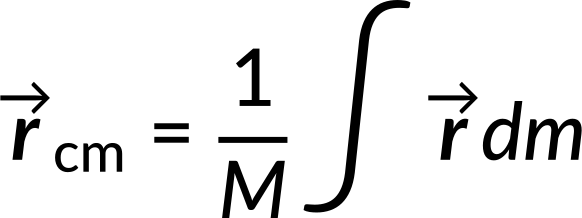
假设点质量被替换为具有均匀分布质量的扩展物体。 将点质量替换为微分质量元,并与质心方程中的积分求和,即可得到该物体的质心坐标:
假设一个具有均匀质量分布M和半径R的环。 圆形对称性确保质心位于环的几…
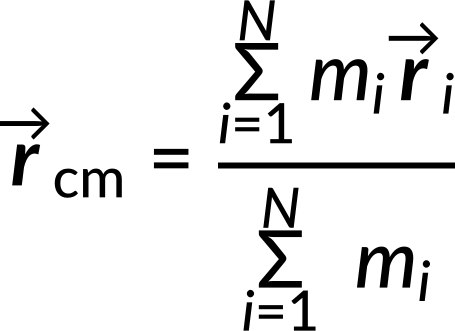
对于一组质点,质心的位置矢量可表示为各质点质量与其位置矢量乘积之和除以所有质点的总质量。
对于质量分布均匀的扩展物体,质点被替换为微分质量元,并将求和替换为积分,以得到质心坐标。
考虑一个在重力作用下沿 y 轴作匀加速自由下落的扩展物体。该物体的总势能等于各个质量元所产生的势能之和。
代入质心的表达式后,总势能等于总质量、重力加速度与质心 y 坐标的乘积。
这意味着,可以通过将任意扩展物体的全部质量视为集中在其质心处,来估算该物体的重力势能。
View the full transcript and gain access to JoVE Core videos
Q1: How do you calculate the center of mass for an extended object?
For extended objects with uniform mass distribution, replace point masses with differential mass elements and replace summation with integration. The center of mass coordinates are obtained by integrating the product of each differential mass element and its position vector, then dividing by the total mass. This mathematical approach extends the point-mass formula to continuous objects.
Q2: Why can gravitational potential energy of extended objects be found using the center of mass?
The total gravitational potential energy of an extended object equals the sum of potential energy contributions from all mass elements. When substituting the center of mass expression, this sum simplifies to the product of total mass, gravitational acceleration, and the center of mass y-coordinate. Therefore, the entire object's mass can be treated as concentrated at its center of mass for potential energy calculations.
Q3: What is the relationship between differential mass elements and linear mass density?
For objects with uniform mass distribution, the differential mass element equals the product of linear mass density and the differential length element. Linear mass density is constant throughout the object and equals total mass divided by total length. This relationship allows integration of mass distribution across the object's geometry.
Q4: Where is the center of mass located for a ring with uniform mass distribution?
For a ring with uniform mass distribution, the center of mass is located at the ring's geometric center. Circular symmetry ensures that when integrating the position vectors of all mass elements around the ring from θ = 0 to θ = 2π, the x and y components both equal zero, placing the center of mass at the origin.
Q5: How does converting from summation to integration change the center of mass calculation?
Converting from point masses to extended objects replaces discrete summation with continuous integration. Point masses become differential mass elements, and position vectors are integrated across the object's geometry. This transformation allows precise center of mass determination for objects with continuous mass distributions rather than discrete point masses.
Q6: What role does circular symmetry play in determining a ring's center of mass?
Circular symmetry ensures that mass is distributed equally in all radial directions from the geometric center. When integrating position vectors around the complete ring circumference, symmetric contributions from opposite sides cancel out. This symmetry guarantees that the center of mass coincides with the ring's geometric center.
Q7: How does the significance of center of mass apply to gravitational potential energy calculations?
The significance of center of mass lies in simplifying complex calculations for extended objects. By treating all mass as concentrated at the center of mass, gravitational potential energy calculations become straightforward, using the same formula as for point masses. This principle applies universally to any extended object with uniform mass distribution.