3.3
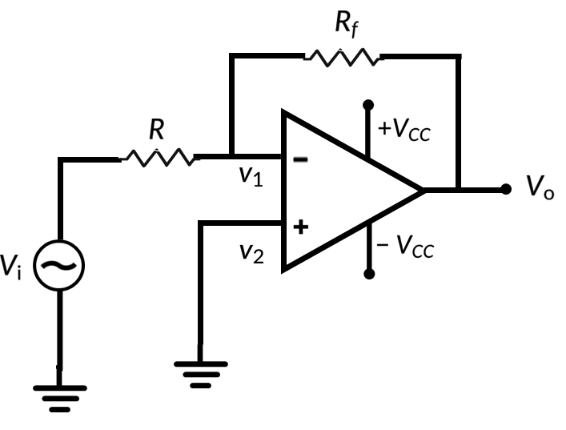
在反相放大器中,输入电压能够通过电阻器连接到反相端子。同时其中的同相端接地,反相端和输出端之间建立起反馈电阻,如图1所示。
图1:反相放大器
其目的是辨别输入电压 (vi) 和输出电压 (vo) 之间的关系。在应用基尔霍夫电流定律 (KCL) 的同时假设其运算放大器是理想的,则可以得出其中的增益表达…
反相放大器通过一个电阻将输入电压连接到反相输入端,将同相输入端接地,并在反相输入端与输出端之间连接一个反馈电阻。
通过应用基尔霍夫电流定律(KCL)并假设运算放大器为理想状态,可确定增益的表达式。
反相放大器在放大输入信号的同时会反转其极性,因此可用于噪声消除。
麦克风选择输入的噪声信号,并在消噪电路中将该信号反相,以消除噪声。
反相运算放大器在音频处理中具有信号放大、转换和滤波的应用。
同相放大器将输入电压直接施加到同相端,在反相端与地之间连接一个电阻,并使用一个电阻实现负反馈。
在反相输入端应用基尔霍夫电流定律(KCL),并代入电压值,可得到电压增益的表达式。
如果反馈电阻被短路或输入电阻处于开路状态,则增益变为1,从而形成一个电压跟随器。
它们将高阻抗输入转换为低阻抗输出,从而实现向低阻抗负载的高效信号传输。
View the full transcript and gain access to JoVE Core videos
Q1: How does an inverting amplifier circuit configuration work?
An inverting amplifier connects the input voltage through a resistor to the inverting terminal, grounds the non-inverting terminal, and uses a feedback resistor between the inverting and output terminals. By applying Kirchhoff's Current Law and assuming an ideal operational amplifier, the voltage gain expression is derived. The gain depends solely on the external resistors: feedback resistance divided by input resistance.
Q2: What is the primary function of an inverting amplifier in signal processing?
Inverting amplifiers reverse the input signal's polarity while simultaneously amplifying it. This capability makes them valuable for noise cancellation applications, where the inverted signal eliminates unwanted noise in audio processing. They are also used for signal amplification, conversion, and filtering in various audio systems.
Q3: How does a non-inverting amplifier differ from an inverting amplifier?
A non-inverting amplifier applies input voltage directly to the non-inverting terminal, with a resistor connecting the inverting terminal to ground and a feedback resistor for negative feedback. Unlike inverting amplifiers, non-inverting amplifiers maintain signal polarity while amplifying. Applying KCL at the inverting terminal yields the voltage gain expression, which again depends on the feedback and input resistances.
Q4: What is a voltage follower and when is it used?
A voltage follower, or unity gain amplifier, forms when the feedback resistor is short-circuited or the input resistor is open-circuited in a non-inverting amplifier, resulting in a gain of one. It possesses high input impedance and functions as a buffer amplifier to segregate one circuit from another. This configuration efficiently converts high-impedance inputs to low-impedance outputs for signal transfer to low-impedance loads.
Q5: Why is input impedance important in non-inverting amplifier applications?
Non-inverting amplifiers have high input impedance, making them ideal intermediate-stage buffer amplifiers. This high impedance allows efficient signal transfer to low-impedance loads while minimizing loading effects on source circuits. The voltage follower configuration particularly leverages this characteristic to isolate circuit stages and preserve signal integrity across cascaded systems.
Q6: How does gain calculation differ between inverting and non-inverting amplifiers?
Both inverting and non-inverting amplifiers calculate gain using external resistor values through KCL analysis. For inverting amplifiers, gain equals negative feedback resistance divided by input resistance. For non-inverting amplifiers, gain equals one plus feedback resistance divided by input resistance. In both cases, the operational amplifier's characteristics of practical op amps determine the circuit's overall performance and accuracy.
Q7: What role does negative feedback play in op-amp amplifier circuits?
Negative feedback, established through the feedback resistor in both inverting and non-inverting configurations, stabilizes the amplifier gain and determines the amplification factor. The feedback path allows KCL analysis to derive predictable gain expressions independent of the op-amp's internal characteristics. This feedback mechanism ensures that gain depends solely on external resistor values, making amplifier performance reliable and controllable.