9.6
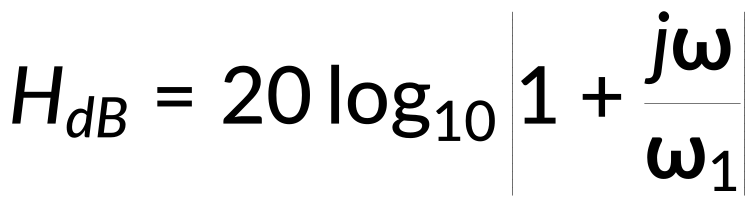
在标准形式中,传递函数以恒定增益、原点处的极点/零点、简单极点/零点和二次极点/零点表示;每个极点/零点都对系统的整体响应产生独特的影响。术语表示简单零点的幅度:
波德幅度图在低频(接近 0 dB)时是保持平坦的,并且还会在特定频率(称为转折频率或断点频率)ω_1 之后以 20 dB/decade…
考虑以标准形式表示的传递函数,包含极点和零点
对于具有简单零点的传递函数,在低频区域,幅值增益是一条斜率为零的直线,且相位趋近于零。
在转角频率处,渐近幅值偏离零斜率线,相位趋近于45度。
在较高频率下,幅值图呈现为一条+20 dB/十倍频程的直线,相位为90度。
一个一阶极点是一阶零点的倒数。这意味着基于极点的伯德图会以水平轴为对称轴,将一阶零点的图形进行镜像反射。
考虑一个二次极点传递函数。
在较低频率下,增益和相位角趋近于零。
在转角频率处,渐近幅值偏差取决于阻尼因子,且相位角接近 -90 度。
在较高频率下,幅值图呈现一条斜率为 -40 dB/十倍频程、相位为 -180 度的直线。
对于多个二次极点,直线的斜率和相位偏移均乘以极点的数量。
View the full transcript and gain access to JoVE Core videos
Q1: What happens to the magnitude and phase of a simple zero at the corner frequency?
At the corner frequency, the asymptotic magnitude deviates from the zero-slope line, and the phase approaches 45 degrees. Below this frequency, the magnitude plot remains flat with zero slope and phase near zero. Above the corner frequency, the magnitude increases at 20 dB/decade with phase approaching 90 degrees.
Q2: How does a simple pole Bode plot differ from a simple zero plot?
A simple pole is the reciprocal of a simple zero, meaning pole-based Bode plots mirror the simple zero plot reflected about the horizontal axis. Where zeros show positive magnitude slopes and phase increases, poles display negative magnitude slopes and phase decreases by the same magnitude.
Q3: What is the slope and phase response of a quadratic pole at higher frequencies?
At higher frequencies, a quadratic pole magnitude plot forms a straight line with a slope of -40 dB/decade and a phase of -180 degrees. This response is twice as steep as a simple pole because quadratic poles have two poles contributing to the overall system response.
Q4: How does the damping factor affect the quadratic pole response near the natural frequency?
The damping factor influences the peak amplitude and phase transition of a quadratic pole near the natural frequency. The actual plot's peak varies with the damping factor, and the phase plot slope is affected by this factor as it transitions from zero to -180 degrees across the frequency range.
Q5: What is the -3 dB point and why is it significant in Bode plots?
The -3 dB point occurs at the corner frequency where the magnitude plot's slope changes and the actual response begins to deviate from the straight-line approximation. This deviation quantifies where the system's gain transitions from flat response to the ascending or descending slope characteristic of poles or zeros.
Q6: How do multiple quadratic poles affect the overall Bode plot slope and phase shift?
For more than one quadratic pole, the slope of the magnitude line and phase shift are multiplied by the number of poles. This means two quadratic poles produce a -80 dB/decade slope and -360 degrees phase shift at high frequencies, compared to -40 dB/decade and -180 degrees for a single quadratic pole.
Q7: Why does the phase angle of a simple zero approach 90 degrees at high frequencies?
At high frequencies, the jω term in the transfer function dominates, making the simple zero behave like a pure differentiator. This causes the phase to approach 90 degrees asymptotically, representing the maximum phase lead that a simple zero can contribute to the system's frequency response.