13.3
考虑一个体重为 70 公斤的人坐在椅子上,该椅子通过杆件 BC 连接到销支撑件。 如果该人保持直立位置,则任务是确定当该成员与水平面成 45° 角时椅子对该人的水平和垂直反作用力。 此时,该男子的速度为 5 m/s,并以 1 m/s^2 的速度增加。
当人沿着曲线路径移动时,切向加速度为 1 m/s…
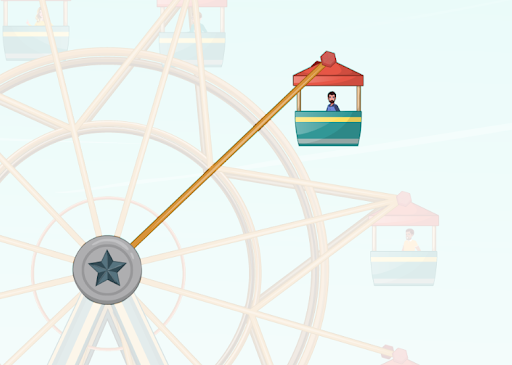
考虑一个质量为70 kg的男子坐在椅子上。椅子通过长度为10 m的构件BC与一个销钉支座相连。
若该人始终直坐在椅子上,当构件与水平方向成 45° 角时,求椅子对该人施加的水平和竖直方向的反作用力。在此瞬间,该人的速度为 5 m/s,且正以 1 m/s2 的加速度增加。
此处,此人沿曲线路径运动,其切向加速度为 1 m/s2。 该人的法向加速度可通过切向速度和曲率半径计算得出。
接下来,绘制该人的受力分析图,并写出切向和法向分量的运动方程。
代入已知数值,并假设重力加速度为 10 m/s2,可建立两个包含所需反作用力的方程。
联立求解可得到水平和竖直方向上反作用力的大小。
View the full transcript and gain access to JoVE Core videos
Q1: How do you calculate normal acceleration for an object moving along a curvilinear path?
Normal acceleration is calculated using the tangential speed and the radius of curvature. The formula relates the square of the velocity to the radius of the curved path. In the chair problem, with a speed of 5 m/s and a member length of 10 m acting as the radius, normal acceleration can be determined. This component is perpendicular to the direction of motion and points toward the center of the curved path.
Q2: What is the difference between tangential and normal acceleration in curvilinear motion?
Tangential acceleration changes the speed of an object along its path, while normal acceleration changes the direction of motion. In the problem, tangential acceleration is 1 m/s², indicating the speed increases at this rate. Normal acceleration acts perpendicular to velocity, directed toward the center of curvature. Both components are essential for analyzing motion on curved paths and must be considered separately in equations of motion.
Q3: Why is a free-body diagram necessary when solving curvilinear motion problems?
A free-body diagram isolates the object and shows all forces acting on it, enabling systematic analysis of motion. For the seated man, the diagram displays weight, normal force, and reaction forces from the chair. This visual representation clarifies force directions and magnitudes, making it easier to write accurate equations of motion for tangential and normal components. Without it, force relationships become unclear and errors in problem-solving increase.
Q4: How do you set up equations of motion for normal and tangential components?
Equations of motion are derived by applying Newton's second law separately to tangential and normal directions. For the tangential direction, sum forces parallel to velocity and set equal to mass times tangential acceleration. For the normal direction, sum forces perpendicular to velocity and set equal to mass times normal acceleration. Substituting known values like mass (70 kg), accelerations, and gravity (10 m/s²) yields two equations with unknown reaction forces that can be solved simultaneously.
Q5: What role does the member angle play in determining reaction forces on the chair?
The member angle of 45° determines the orientation of the support structure and affects how forces distribute between horizontal and vertical directions. At this angle, the geometry influences both the normal and tangential components of acceleration relative to the chair's support. The angle directly impacts the direction of reaction forces the chair exerts on the man, requiring careful geometric analysis when decomposing forces into horizontal and vertical components for solving the problem.
Q6: How does increasing speed affect the normal acceleration in this curvilinear motion problem?
Normal acceleration depends on the square of the tangential speed and the radius of curvature. As speed increases from 5 m/s at a rate of 1 m/s², the normal acceleration increases proportionally to the square of the new speed. With a fixed radius of 10 m, higher speeds produce greater normal acceleration, requiring larger normal forces from the chair to maintain the curved path. This relationship demonstrates why faster motion on curves demands greater support forces.
Q7: What assumptions are made when solving for reaction forces in this chair problem?
Key assumptions include the man remaining upright throughout motion, the member BC maintaining constant length of 10 m, and gravity acting at 10 m/s². The man is treated as a point mass, and the chair provides only normal and tangential reaction forces. The curvilinear path is assumed to have a constant radius equal to the member length. These simplifications allow the problem to be solved using standard equations of motion without accounting for body rotation or deformation.