19.3
假设有这样一种情况:圆轴所承受的扭矩能够保持在胡克定律的范围之内,以此来避免圆轴出现任何永久性的变形。因此,需要对剪切应变的公式进行重新整理。将该公式与刚性模量进行相乘,然后将其应用到剪切应力和应变的胡克定律中。最终便可以推导出圆轴中剪切应力的方程。
此外,需要记住作用在圆轴中任何横截面上基本力的力…
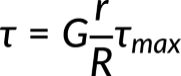
考虑一种情况,当施加在圆轴上的扭矩处于胡克定律极限范围内时,不会发生永久变形。
现在,回顾一下切应变的表达式。将其乘以剪切模量,并结合剪切应力与应变的胡克定律,即可确定轴中剪切应力的表达式。
请记住,作用在轴的任意横截面上的初等力的力矩之和必须等于作用在该轴上的扭矩的大小。
代入剪切应力并重新整理各项后,可得到一个包含积分项的表达式,该积分项表示横截面相对于其中心的极惯性矩。
经过进一步的重新排列和代入,得到刚性均匀圆轴切应力的弹性扭转公式,用于计算最大切应力。
然而,对于内径和外径分别为 r1 和 r2 的空心轴,其极惯性矩表示为两个半径的四次方之差。
View the full transcript and gain access to JoVE Core videos
Q1: What is the elastic torsion formula for shearing stress in a circular shaft?
The elastic torsion formula determines shearing stress in a rigid uniform circular shaft by combining Hooke's Law with the polar moment of inertia. It derives from multiplying shearing strain by the modulus of rigidity, then ensuring the sum of moments on any cross-section equals the applied torque. This formula applies when torque remains within Hooke's law limit, preventing permanent deformation.
Q2: How does the polar moment of inertia differ between solid and hollow circular shafts?
For a solid circular shaft, the polar moment of inertia is calculated from the fourth power of the radius. For a hollow shaft with inner radius r1 and outer radius r2, the polar moment of inertia is expressed as the difference in the fourth power of both radii. This difference accounts for the removed material in the hollow center.
Q3: Why is the modulus of rigidity important in deriving shaft stress equations?
The modulus of rigidity relates shearing stress to shearing strain through Hooke's Law. When multiplied by the shearing strain expression, it enables derivation of the shearing stress equation for the shaft. This material property is essential for connecting elastic deformation behavior to the applied torque.
Q4: What role does the sum of moments play in the elastic torsion formula?
The sum of moments of elementary forces exerted on any cross-section of the shaft must equal the magnitude of the applied torque. This equilibrium condition is fundamental to deriving the elastic torsion formula. Substituting this relationship into the stress equation produces the integral term representing polar moment of inertia.
Q5: When can the elastic torsion formula be applied to a circular shaft?
The elastic torsion formula applies when torque remains within Hooke's law limit, ensuring no permanent deformation occurs. Under these conditions, the shaft exhibits linear elastic behavior, and shearing stress is directly proportional to shearing strain. This linear range assumption is critical for formula validity.
Q6: How does maximum shearing stress relate to the polar moment of inertia in torsion?
Maximum shearing stress is inversely proportional to the polar moment of inertia. After substituting for maximum shearing stress in the equilibrium equation, the polar moment of inertia emerges as a key geometric property. Larger polar moments of inertia reduce maximum stress for the same applied torque, which is why hollow shafts are often preferred in design of transmission shafts.
Q7: What assumptions must be satisfied for the elastic torsion formula to hold?
The shaft must be rigid and uniform with constant cross-section. Torque must remain within Hooke's law limit to prevent plastic deformation. The formula assumes linear elastic material behavior where shearing stress is proportional to shearing strain. These conditions ensure the derived relationships between torque, stress, and geometric properties remain valid.