11.8
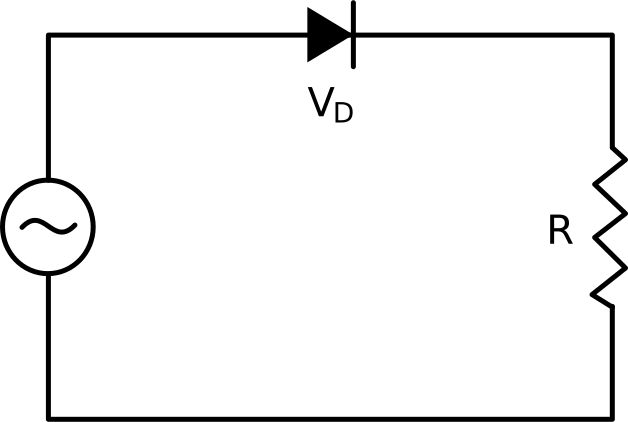
半波整流器是电子学中的基本电路,旨在将交流 (AC) 电压转换为单向电压。它采用最简单的二极管整流形式,电路由单个二极管与负载电阻和交流电源串联组成。
半波整流器的工作原理是二极管只允许电流朝一个方向流动。在交流输入的正半周期内,当输入电压超过二极管的阈值时,二极管正向偏置。因此,电流流过电路,并在…
二极管整流电路利用半波或全波配置,将交流电压转换为单向直流电压。
考虑一个半波整流电路,该电路由一个二极管、一个电阻器和一个输入正弦信号串联组成。
在输入信号的正半周期,当电压超过或等于二极管的压降时,二极管变为正向偏置,允许电流通过。
然后通过从输入电压中减去二极管的压降来确定输出电压。
相反,在负半周期间,输入电压低于二极管的压降,二极管保持不导通状态,从而产生零输出电压。
尽管输入电压的极性发生变化且平均值为零,但由于整流作用,输出仍保持单向性,并具有稳定的平均值。
峰值反向电压表示二极管在不损坏的情况下所能承受的最大反向电压。
在半波整流器中,当输入电压在负方向达到峰值时,负半周期间会发生这种情况。
因此,峰值反向电压等于输入电压的峰值,但极性相反。
View the full transcript and gain access to JoVE Core videos
Q1: How does a half-wave rectifier convert AC voltage to DC?
A half-wave rectifier uses a single diode to convert alternating current into unidirectional voltage. During positive half-cycles, the diode becomes forward-biased when input voltage exceeds its threshold, allowing current flow and producing output voltage. During negative half-cycles, the diode remains reverse-biased and non-conductive, resulting in zero output. This creates a pulsating DC that flows only during positive input cycles.
Q2: What is the relationship between input and output voltage in a half-wave rectifier?
The output voltage in a half-wave rectifier equals the input voltage minus the diode's forward voltage drop during conduction. When the diode conducts during positive half-cycles, this voltage difference appears across the load resistor. During negative half-cycles, the output voltage drops to zero because the diode blocks current flow, resulting in no voltage across the load.
Q3: What is peak inverse voltage and why does it matter in rectifier circuits?
Peak inverse voltage (PIV) is the maximum reverse voltage a diode can withstand without breakdown. In a half-wave rectifier, PIV occurs during negative half-cycles when input voltage reaches its peak in the negative direction, equaling the input voltage peak with reversed polarity. Selecting a diode with adequate PIV rating prevents damage and ensures circuit longevity and reliability.
Q4: Why does the diode conduct during positive half-cycles but not negative ones?
During positive half-cycles, input voltage exceeds the diode's threshold voltage, creating forward-bias conditions that allow current flow. During negative half-cycles, input voltage falls below the diode's potential barrier, establishing reverse-bias conditions where the diode becomes non-conductive. This directional behavior is fundamental to how diodes rectify AC signals into unidirectional current.
Q5: What circuit components are required for a basic half-wave rectifier?
A basic half-wave rectifier requires three essential components: a diode, a load resistor, and an AC power source connected in series. The diode controls current direction, the resistor provides the load path, and the AC source supplies the alternating input signal. This simple configuration forms the foundation of rectification circuits used in power supply applications.
Q6: How does a half-wave rectifier produce a consistent average DC value from a zero-average AC signal?
Although the input AC signal has an average value of zero due to equal positive and negative cycles, the half-wave rectifier blocks negative half-cycles entirely. This asymmetry produces a pulsating DC output that flows only during positive input cycles, resulting in a consistent positive average value. The rectification process effectively removes the negative portion of the waveform.
Q7: How does a half-wave rectifier compare to a full-wave rectifier in terms of output?
A half-wave rectifier conducts during only positive half-cycles, producing output pulses at half the input frequency with lower average DC value. A full-wave rectifier utilizes both positive and negative half-cycles, delivering output pulses at twice the frequency with higher average DC value and smoother waveform. Full-wave configurations provide more efficient power conversion and reduced ripple.