11.9
全波整流器是一种将交流电 (AC) 转换为直流电 (DC) 的设备,比半波整流器更高效。它通常包括一个中心抽头变压器、两个二极管和一个负载电阻。变压器的次级绕组被分割以提供两个极性相反的相等电压,这是全波整流的关键要素。
全波整流器的工作原理是让每个二极管在交流输入的交替半周期内导通,利用交流波形的…
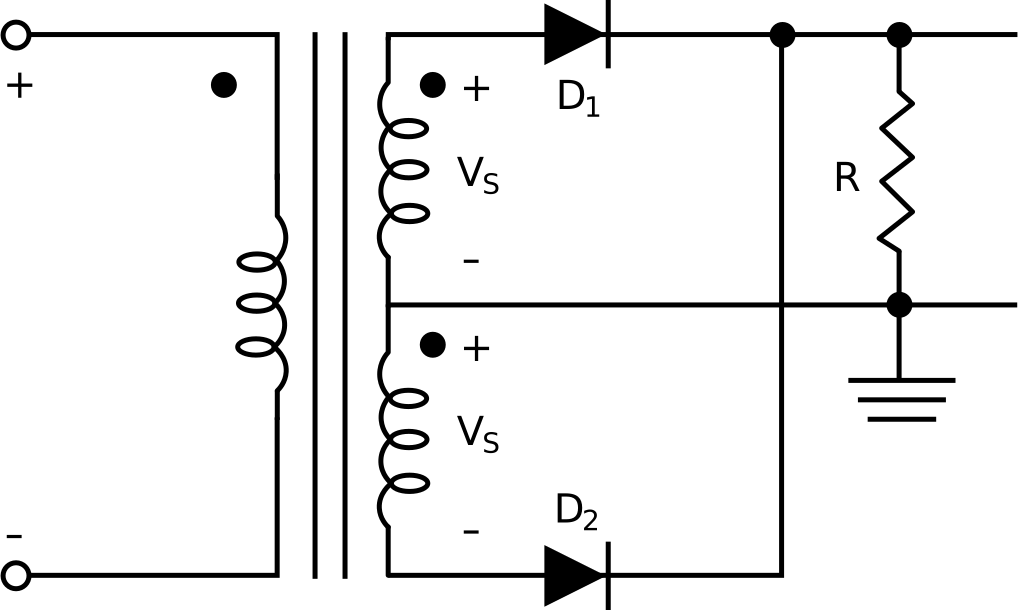
考虑一个全波整流电路,该电路包含一个中心抽头变压器、两个以中心抽头方式连接的二极管以及一个负载电阻。
变压器的次级绕组在次级绕组的两半部分上提供两个幅值相等、极性相反的输入电压。
在输入信号的正半周期,当电压超过或等于二极管的正向导通压降时,二极管 D1 导通,而 D2 处于反向偏置状态。输出波形类似于半波整流器的波形。
相反,在负半周期间,当输入电压低于二极管的正向导通压降时,二极管 D1 截止,而 D2 导通。此时输出波形仍与半波整流器的波形相同。
通过电阻的电流始终沿同一方向流动,从而产生单极性输出。
全波整流器更高的整流效率使其可用于电源、电池充电器、音频放大器和信号处理。
峰值反向电压是峰值输入电压的两倍减去二极管的正向压降,大约是半波整流情况下的两倍。
View the full transcript and gain access to JoVE Core videos
Q1: How does a full-wave rectifier convert AC to DC?
A full-wave rectifier converts alternating current to direct current by using a center-tapped transformer and two diodes that conduct on alternate half-cycles. During the positive half-cycle, diode D1 becomes forward-biased and conducts while D2 is reverse-biased. During the negative half-cycle, D1 is reverse-biased and D2 conducts, flipping the negative voltage to positive. This ensures unidirectional current through the load resistor, producing a unipolar DC output.
Q2: What is the role of the center-tapped transformer in a full-wave rectifier?
The center-tapped transformer is the pivotal element of full-wave rectification. Its secondary winding is divided to provide two equal voltages of opposite polarities across the two halves. This dual-voltage configuration allows each diode to conduct during alternate half-cycles of the AC input, enabling the circuit to utilize the full cycle of the AC waveform rather than just half of it.
Q3: Why is a full-wave rectifier more efficient than a half-wave rectifier?
A full-wave rectifier has higher rectification efficiency because it utilizes both the positive and negative half-cycles of the AC input signal, whereas a half-wave rectifier uses only one half-cycle. Additionally, the full-wave rectifier produces lower ripple voltage at double the ripple frequency, yielding smoother DC output with less filtering requirement compared to a half-wave rectifier.
Q4: What is peak inverse voltage in a full-wave rectifier?
Peak inverse voltage (PIV) is the maximum reverse voltage a diode must withstand in the circuit. In a full-wave rectifier, the PIV equals twice the maximum input AC voltage minus the diodes' forward voltage drop. This PIV is approximately double that encountered in a half-wave rectifier, requiring diodes that can sustain higher reverse voltages to ensure safe operation.
Q5: What are the main applications of full-wave rectifiers?
Full-wave rectifiers are extensively used in power supply units, battery chargers, audio amplifiers, and signal-processing applications. Their increased rectification efficiency and smoother DC output make them ideal for these applications where stable, continuous direct current is required. The reduced ripple voltage and higher ripple frequency minimize the need for additional filtering components.
Q6: How does the output waveform differ between the two diodes in a full-wave rectifier?
Each diode in a full-wave rectifier produces an output waveform resembling that of a half-wave rectifier during its respective conduction period. When D1 conducts during positive half-cycles, it generates a positive output. When D2 conducts during negative half-cycles, it flips the negative voltage to positive. Combined, these alternating outputs create a continuous unipolar waveform with current flowing consistently in the same direction through the load resistor.
Q7: What determines when each diode conducts in a full-wave rectifier?
Diode conduction is determined by the input signal polarity and the diode's forward voltage drop threshold. During positive half-cycles, when voltage exceeds the diode's forward voltage drop, D1 conducts while D2 is reverse-biased. During negative half-cycles, when input voltage is lower than the forward voltage drop, D1 is cut off while D2 conducts. This alternating conduction pattern ensures full-wave rectification of the AC signal.