13.9
基本信号操作包括时间反转、时间缩放、时间移位和振幅变换。这些操作是信号处理和分析的基础。
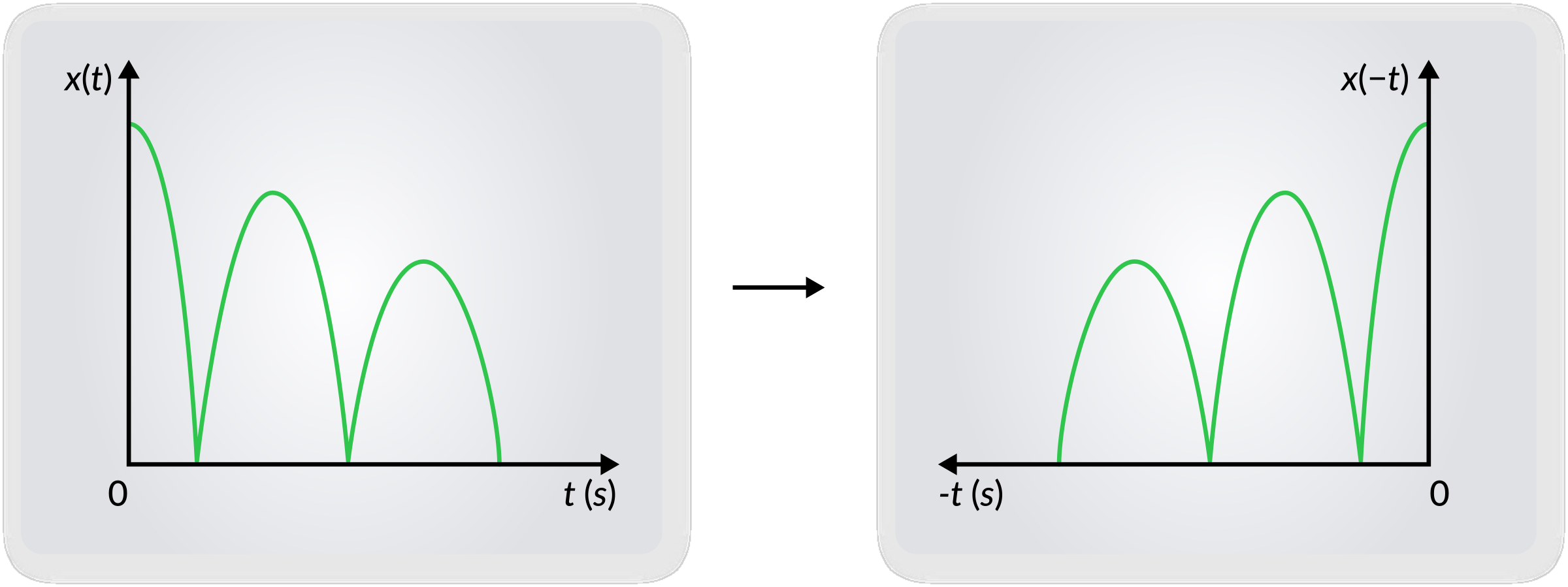
时间反转在 t=0 处将连续时间信号镜像到垂直轴。这是通过将 t 替换为 −t 来实现的。例如,如果考虑信号 x(t),则时间反转信号为 x(−t)。此操作可以图形表示,显示镜像信号。
时间缩放通过将 t 替换…
基本信号运算包括时间反转、尺度变换、移位和幅度变换。
时间反转是将连续时间信号关于时间零点处的垂直轴进行镜像,通过将“t”替换为负的“t”来实现。对于所考虑的信号,其结果以图形方式展示。
时间缩放通过将“t”替换为“at”来实现信号在时间上的压缩或扩展,其中“a”为常数。若该常数的绝对值大于1,则信号被压缩;若小于1,则信号被扩展。
该常数的负值会同时引起时间反转以及压缩或扩展。这可以通过所考虑的信号进行图形化表示。
连续时间信号的时间平移通过将“t”替换为“t − t0”来实现,其中“t0”为常数。当该常数为正时,信号将被延迟并向右平移;当该常数为负时,信号将被提前并向左平移。
连续时间信号的幅度变换具有如下一般形式,其中“A”和“B”为常数。图中显示了一个示例信号的幅度变换。
View the full transcript and gain access to JoVE Core videos
Q1: What does time reversal do to a continuous-time signal?
Time reversal mirrors a continuous-time signal about the vertical axis at t=0 by substituting t with −t. For a signal x(t), the time-reversed signal becomes x(−t). This operation graphically flips the signal, reversing its temporal progression while preserving amplitude values at mirrored time positions.
Q2: How does time scaling compress or expand a signal?
Time scaling replaces t with at, where a is a constant. If the magnitude of a is greater than 1, the signal compresses in time; if less than 1, it expands. A negative value of a causes both time reversal and compression or expansion simultaneously, creating combined temporal and directional transformations.
Q3: What is the difference between positive and negative time shifting?
Time shifting replaces t with t−t0, where t0 is a constant. A positive t0 delays the signal and shifts it right from the origin, while a negative t0 advances the signal and shifts it left. The magnitude of t0 determines how far the signal moves along the time axis.
Q4: How do amplitude transformations modify a continuous-time signal?
Amplitude transformations take the form Ax(t)+B, where A and B are constants. The constant A scales the signal's amplitude vertically, while B shifts it vertically. Together, these constants allow independent control of signal magnitude and vertical position, enabling precise amplitude adjustments in signal processing applications.
Q5: What happens when a negative constant is used in time scaling?
A negative constant in time scaling induces both time reversal and compression or expansion simultaneously. The signal is mirrored about the vertical axis while also being compressed or expanded depending on the magnitude of the constant. This combined operation creates a transformed signal that is both reversed and temporally scaled.
Q6: Why are basic signal operations important in signal processing?
Basic signal operations—time reversal, scaling, shifting, and amplitude transformations—are essential tools for manipulating and analyzing signals. These operations enable various adjustments and modifications necessary for signal processing applications, allowing engineers to transform signals to meet specific requirements and analyze signal behavior under different conditions.
Q7: Can you apply multiple signal operations to the same signal?
Yes, multiple basic signal operations can be combined and applied sequentially to a signal. For example, you can apply time scaling followed by time shifting, or combine amplitude transformations with time reversal. These composite operations create more complex signal transformations useful in advanced signal processing and analysis of basic continuous time signals.