22.2
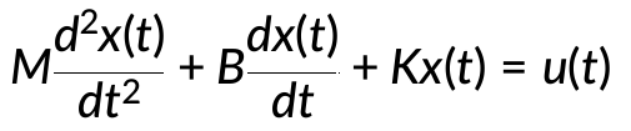
在弹簧-质量-阻尼器系统中,二阶微分方程描述了系统的动态行为。当在零初始条件下变换到拉普拉斯域时,可以有效地分析和处理该方程。变换到拉普拉斯域将微分方程转换为代数方程,从而简化了隔离输出的过程。
将拉普拉斯变换应用于弹簧-质量-阻尼器系统的标准微分方程,可得出以下输出:
在构建框图时,可以将右侧的信…
考虑弹簧-质量-阻尼系统的二阶微分方程。在零初始条件下,该系统被变换到拉普拉斯域中。
然后重新整理该方程以分离输出,可将其解释为进入具有特定传递函数的模块的信号。
通过相应地进行两次积分或后乘运算即可获得输出结果。
简而言之,右侧的信号相互连接,从而得到该系统的最终框图表示。
通过从内部反馈回路中提取公因式,可进一步简化,从而得到一个等效的替代框图。
该框图模型还可以包含表示加速度和速度的内部变量。
由于1/s对应于拉普拉斯域中的积分,因此首先对加速度进行积分以获得速度,随后对速度进行积分以得到位移信号。
通过将输入和反馈信号处的模块移至比较器的右侧,并简化内部反馈回路,可得到系统的传递函数。最终得到的方程即为该系统的传递函数。
View the full transcript and gain access to JoVE Core videos
Q1: How do you convert a second-order differential equation into a block diagram?
Transform the differential equation into the Laplace domain under zero initial conditions to convert it into an algebraic form. Rearrange to isolate the output, then interpret signals as entering blocks with specific transfer functions. Connect signals on the right-hand side and represent each operation as a block, creating a visual representation of the system's dynamic behavior.
Q2: What role does the 1/s operator play in block diagram representation?
In the Laplace domain, 1/s represents integration. Acceleration is first integrated using a 1/s block to obtain velocity, then velocity is integrated again to yield displacement. This cascading integration structure allows block diagrams to represent the relationships between acceleration, velocity, and displacement signals in dynamic systems.
Q3: How is a transfer function derived from a block diagram?
Move the block representing input and feedback signals to the right-hand side of the comparator. Simplify the internal feedback loop by factoring terms and algebraically manipulating the resulting equation. The final simplified equation yields the transfer function, which characterizes the system's input-output relationship and is essential for analyzing system behavior.
Q4: Why is block diagram simplification important for spring-mass-damper systems?
Simplification reduces complex representations into manageable forms by factoring internal feedback loops and combining blocks. This process clarifies the system's structure, making it easier to identify key relationships between variables like acceleration, velocity, and displacement. Simplified diagrams also facilitate transfer function derivation and control system design.
Q5: What internal variables are typically represented in a spring-mass-damper block diagram?
Block diagrams incorporate acceleration, velocity, and displacement as internal variables. These variables are interconnected through integration operations: acceleration integrates to velocity, and velocity integrates to displacement. Representing these variables explicitly shows the hierarchical signal flow and helps visualize how different system states relate to one another.
Q6: How does the Laplace transform simplify differential equation analysis?
The Laplace transform converts differential equations into algebraic equations under zero initial conditions, eliminating the need for calculus-based solutions. This transformation allows engineers to manipulate equations algebraically, isolate outputs more easily, and construct block diagrams that represent system dynamics. The resulting algebraic form is more suitable for block diagram representation and transfer function derivation.
Q7: How do block diagrams relate to the overall system transfer function?
Block diagrams visually represent the mathematical relationships described by differential equations and transfer functions. By manipulating the block diagram structure through simplification and rearrangement, engineers derive the overall transfer function. This function predicts system response to various inputs and enables design of control strategies for achieving desired performance in mechanical and electrical systems.
