2.2
在微积分中,乘积法则提供了一种对两个函数乘积进行求导的方法。该法则指出,两个可微函数乘积的导数等于第一个函数乘以第二个函数的导数,再加上第二个函数乘以第一个函数的导数。
该法则确保乘积的变化率能够充分反映两个函数同时发生变化的情形。
理解乘积法则的一种直观而有力的方法,是借助几何类比:考虑一个宽度和高度…
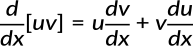
乘积法则用于对由两个函数乘积构成的函数进行求导。
它指出,两个函数 u 和 v 的导数等于 u 乘以 v 的导数加上 v 乘以 u 的导数。
要理解其中原因,可以想象在屏幕上调整一个矩形窗口的大小。其面积等于宽度乘以高度。
由于宽度和高度随时间变化,总面积也随之改变。这种变化可以通过在边缘和角落处新增像素块来直观表示。
总面积表达式包含三个部分:来自宽度的部分、来自高度的部分以及来自角部的部分。为了求出变化率,需将总面积的变化量除以时间间隔。
当时间间隔趋近于零时,第一部分变为高度乘以宽度的变化率,第二部分变为宽度乘以高度的变化率。
角部区域表示宽度的微小变化与高度的微小变化的乘积。当极限趋近于零时,依赖于时间的角部区域趋近于零。
结果符合乘积法则,即每个函数乘以另一个函数的导数。
View the full transcript and gain access to JoVE Core videos
Q1: What does the Product Rule state about differentiating products of functions?
The Product Rule states that the derivative of a product of two functions equals the first function times the derivative of the second, plus the second function times the derivative of the first. Mathematically, if u and v are differentiable functions, then d/dx(uv) = u(dv/dx) + v(du/dx). This ensures the rate of change accounts for simultaneous variation of both functions.
Q2: How does the rectangular window analogy explain the Product Rule?
Imagine a rectangular window with changing width and height over time. The area equals width times height. As both dimensions change, the total area change consists of three parts: a strip along the width, a strip along the height, and a small corner square. The corner term vanishes as the time interval approaches zero, leaving only the two linear contributions that match the Product Rule formula.
Q3: Why does the corner term disappear when applying the Product Rule?
The corner term represents the product of tiny changes in both width and height simultaneously. As the time interval approaches zero in the limit, this corner term becomes infinitesimally small relative to the linear contributions and vanishes. This is why the final Product Rule formula contains only the two linear terms, not the corner component.
Q4: What are the three components of area change in the geometric model?
The three components are: a strip along the width representing change from increasing width alone, a strip along the height representing change from increasing height alone, and a small square at the corner representing combined increase in both dimensions. When divided by the time interval and taking the limit, only the first two strips contribute to the final derivative.
Q5: How does the Product Rule relate to rates of change?
The Product Rule captures how the rate of change of a product depends on both individual rates of change. Each function contributes to the overall rate through its own derivative multiplied by the other function's value. This relationship ensures that application of rates of change accounts for both functions' simultaneous variation in the product.
Q6: What happens to the limit as the time interval approaches zero in the Product Rule derivation?
As the time interval approaches zero, the first part becomes height times the rate of change of width, and the second becomes width times the rate of change of height. The corner part, which depends on the product of infinitesimal changes, becomes negligible and vanishes. This limiting process yields the complete Product Rule formula.
Q7: Why is the Product Rule necessary instead of differentiating each function separately?
The Product Rule is necessary because the derivative of a product is not simply the product of the derivatives. The rule accounts for how both functions change simultaneously and their interaction. Without it, you would miss the cross-terms that arise from the simultaneous variation of both u and v in the product uv.