1.3
指数提供了一种简洁且高效的方式,用以表示重复乘法。这一概念是代数及更广泛数学领域(包括科学计算、尺度定律与量纲分析)的基础。
指数的规律与性质
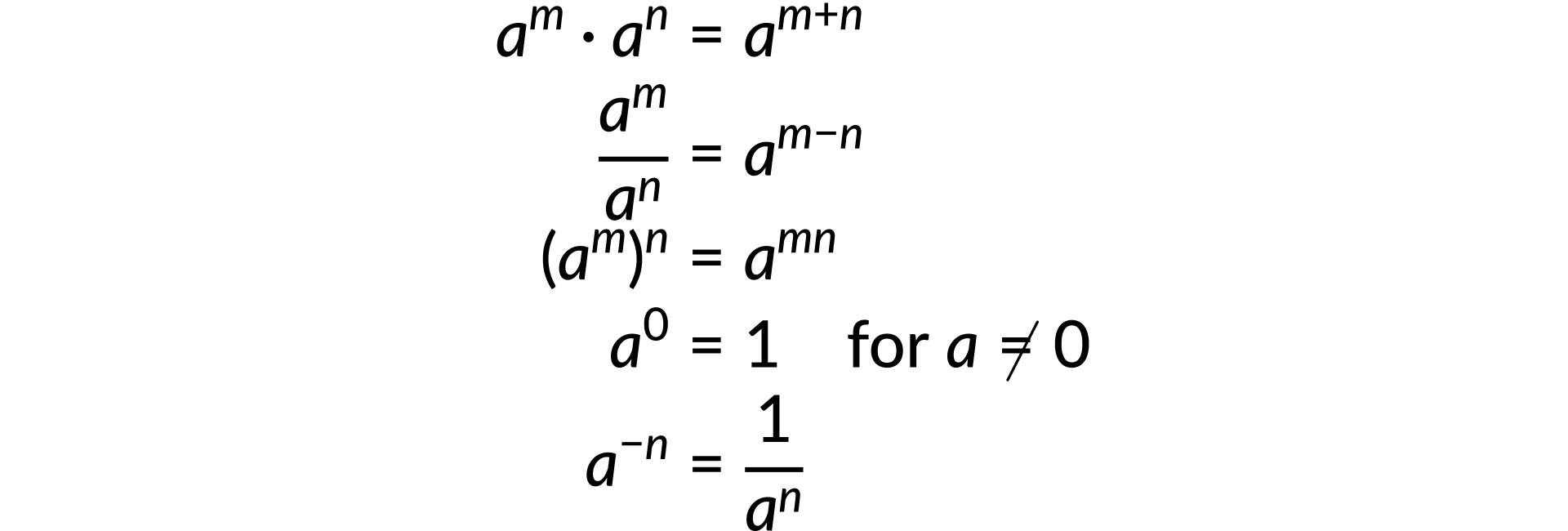
指数记号用于表达一个数自身的重复相乘。对于任意非零实数 a 和整数 n,a^n 表示 a 与自身相乘 n 次。主要性质包括:
这些性质有助于在符号运算与数值运算的…
一个边长为1米的立方体,其体积为1立方米,即1的3次方。
将边长扩大到2米,体积增加至8立方米。
被乘的数称为底数,指数则表示该底数乘以自身的次数。
将两个相同的2米立方体堆叠在一起会使体积加倍。总体积等于原始立方体的体积——即2乘以2乘以2立方米——再乘以第二个立方体的倍数2,即2的3次方乘以2的1次方。
当底数相同的幂相乘时,指数相加。这得到 2 的 4 次方,结果为 16 立方米。
当一个立方体沿一个维度被均匀分割时,其体积减半。新的体积等于原始立方体体积除以二,即二的三次方除以二的一次方。
当同底数幂相除时,指数相减。结果为 2 的 2 次方,即 4 立方米。
这些遵循指数运算法则:相乘时,指数相加;相除时,指数相减。
使用10的幂次方表示的指数可用于科学记数法,以表达地球直径或红细胞大小等数值。
View the full transcript and gain access to JoVE Core videos
Q1: What is the relationship between a base and an exponent?
The base is the number being multiplied, while the exponent indicates how many times the base multiplies by itself. For example, in 2³, the base is 2 and the exponent is 3, meaning 2 × 2 × 2 equals 8. This exponential notation provides a compact way to express repeated multiplication.
Q2: How do you multiply powers with the same base?
When multiplying powers with the same base, add the exponents together. For instance, 2³ × 2¹ equals 2⁴ because 3 + 1 = 4. This rule simplifies calculations and is fundamental to working with algebraic expressions involving repeated multiplication and exponential operations.
Q3: What happens when you divide powers with the same base?
When dividing powers with the same base, subtract the exponents. For example, 2³ ÷ 2¹ equals 2² because 3 − 1 = 2, resulting in 4. This rule allows efficient simplification of exponential expressions in both symbolic and numerical contexts.
Q4: How does scaling affect volume in three-dimensional objects?
Scaling edge length by a factor raises volume by that factor cubed. A 1-meter cube has 1 cubic meter volume; scaling to 2 meters produces 2³ or 8 cubic meters. This demonstrates how exponents describe dimensional relationships in geometric scaling.
Q5: What is scientific notation and why is it useful?
Scientific notation expresses numbers as a × 10ⁿ, where 1 ≤ a < 10 and n is an integer. It simplifies operations on extremely large or small quantities, such as Earth's diameter or red blood cell size. This format maintains precision and readability in quantitative work across scientific fields.
Q6: How do exponent rules apply to scientific notation calculations?
Scientific notation uses the same exponent rules for multiplication and division. When multiplying, add the powers of ten; when dividing, subtract them. This allows efficient computation by operating on coefficients and adjusting powers of ten accordingly, making complex calculations manageable.
Q7: Why are exponents fundamental to algebra and mathematics?
Exponents provide compact representation of repeated multiplication and enable simplification of complex expressions. They are essential for algebraic manipulation, scientific computation, scaling laws, and dimensional analysis. Understanding exponent rules forms the foundation for advanced mathematical problem solving and quantitative analysis.