11.8
在微积分中,极限定律是分析函数当自变量趋近特定值时其行为的基础性工具。其中,涉及商、幂与根的定律在化简复杂的极限表达式时尤为重要。
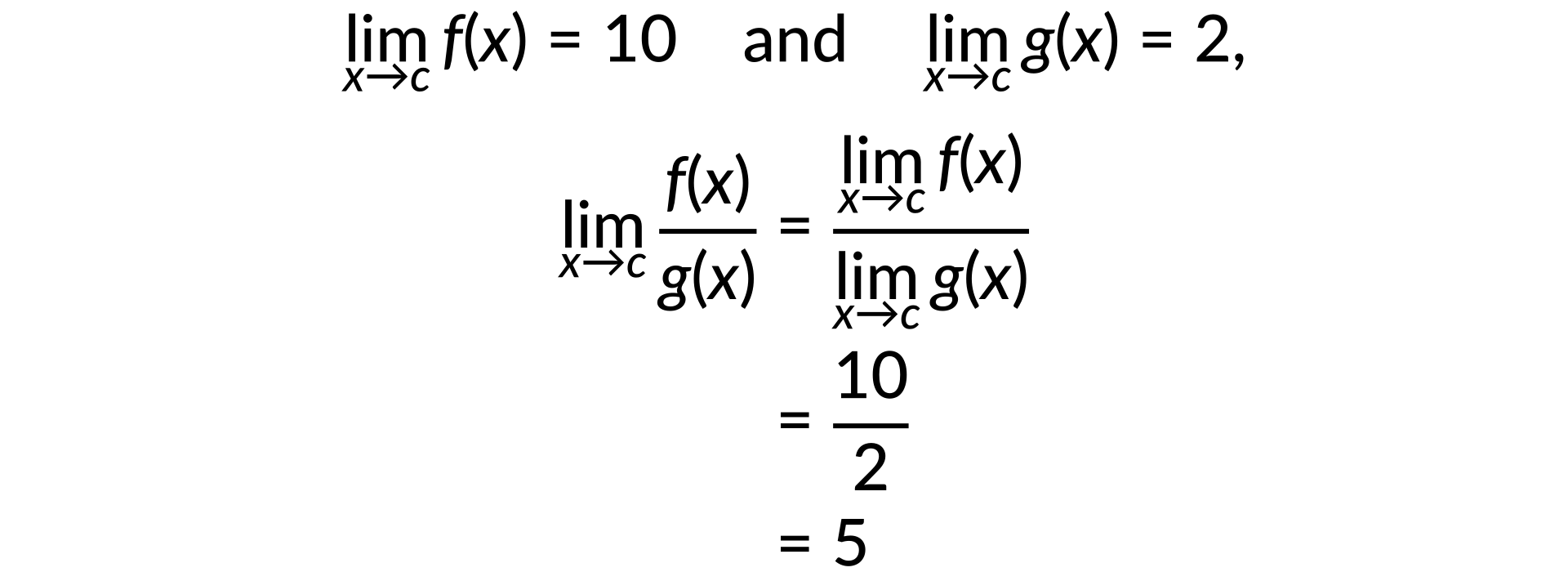
商定律指出,若分子与分母的极限均存在且分母的极限不为零,则两个函数相除的极限等于它们各自极限的商。即:
幂定律说明,当一个函数被取正整数次幂时,其极限等于该函数极限的同次幂…
当变量趋近于特定值时,涉及商、幂和根的基本极限法则有助于简化复杂表达式。
商法则指出,当分母的极限存在且不为零时,商的极限等于极限的商。
幂定律指出,如果一个函数被提升到一个正整数次幂,其极限等于该函数极限的相同次幂。
根法则指出,当函数的极限存在且在 n 为偶数时非负的情况下,该函数的 n 次方根趋近于其极限的 n 次方根。
这些定律适用于现实世界中的场景,例如不断发展的城市中的人口密度,人口密度定义为人口数量与土地面积的比值。由于这两个量随时间变化,它们的极限可用于模拟长期行为。
当面积的极限不为零时,商法则通过种群数量和面积的极限来求得密度的极限。
如果基础设施需求随密度的平方增长,幂定律将给出其极限值。
如果每个人的能源需求取决于需求限制值的平方根,则在该值为非负数时,适用平方根定律。
View the full transcript and gain access to JoVE Core videos
Q1: What does the Quotient Law state about limits of fractions?
The Quotient Law states that the limit of a quotient equals the quotient of the limits, provided the denominator's limit exists and is not zero. This allows you to evaluate complex fractions by finding the limits of the numerator and denominator separately, then dividing them. For example, population density modeled as population divided by land area uses this law to find long-term density behavior.
Q2: How does the Power Law simplify limits of exponential expressions?
The Power Law states that if a function is raised to a positive integer power, its limit equals the limit of the base function raised to that same power. This eliminates the need to expand complex expressions before evaluating limits. For instance, if infrastructure demand grows with the square of density, the Power Law directly gives the limiting value without expanding the squared term.
Q3: When can you apply the Root Law to find limits?
The Root Law applies when evaluating the nth root of a function. The limit of the nth root equals the nth root of the function's limit, provided the limit exists and is non-negative when n is even. This restriction prevents undefined results from negative numbers under even roots. Per-person energy needs depending on the square root of demand illustrate this law's real-world application.
Q4: Why must the denominator's limit be non-zero in the Quotient Law?
Division by zero is undefined in mathematics, so the Quotient Law requires the denominator's limit to exist and be non-zero. If the denominator approaches zero while the numerator approaches a non-zero value, the quotient diverges to infinity rather than converging to a finite limit. This condition ensures the law produces valid, meaningful results for limit evaluation.
Q5: How do limit laws help break down complex expressions?
Limit laws streamline limit evaluation by reducing complex expressions into simpler components. The Quotient, Power, and Root Laws allow you to evaluate limits of individual parts separately, then combine results using the laws. This systematic approach transforms difficult problems into manageable steps, making it easier to analyze function behavior as variables approach specific values.
Q6: What real-world scenario demonstrates the Quotient Law in action?
Population density in a growing city demonstrates the Quotient Law, defined as the ratio of population to land area. As both quantities change over time, their limits model long-term density behavior. The Quotient Law finds the limiting density by dividing the limit of population by the limit of area, provided the area's limit is not zero.
Q7: What restriction applies to the Root Law with even roots?
The Root Law requires that the limit be non-negative when n is even. This restriction exists because even roots of negative numbers are undefined in real mathematics. For example, the square root of a negative number has no real solution, so the Root Law cannot apply if the function's limit is negative and you are taking an even root.