All procedures involving animal models have been reviewed by the local institutional animal care committee and the JoVE veterinary review board.
1. Generation of a pleural dissemination model
- Prepare luciferase-expressing target cells and suspend 1.0 × 10⁶ target cells in 100 µL of phosphate-buffered saline (PBS)
NOTE: Intrathoracic cancer cells such as lung cancer and MPM are suitable as target cells. Luciferase-expressing cells were prepared via luciferase gene transfection, and high expression of luciferase was confirmed after > 10 cell passages. Cells were cultured in a medium supplemented with 10% fetal bovine serum penicillin (100 IU/mL) and streptomycin (100 mg/mL). The number of cells was adjusted according to the tumor growth rate and the time course of treatment (1.0. × 105-6.0 × 10⁶ cells/body weight).
- Prepare 8-12-week-old female homozygote athymic nude mice, with a preferable body weight of 19-21 g.
- Anesthetize mice during the procedure with isoflurane (introduction: 4-5%, maintenance 2-3%); press the tail with tweezers to confirm that there is no reaction.
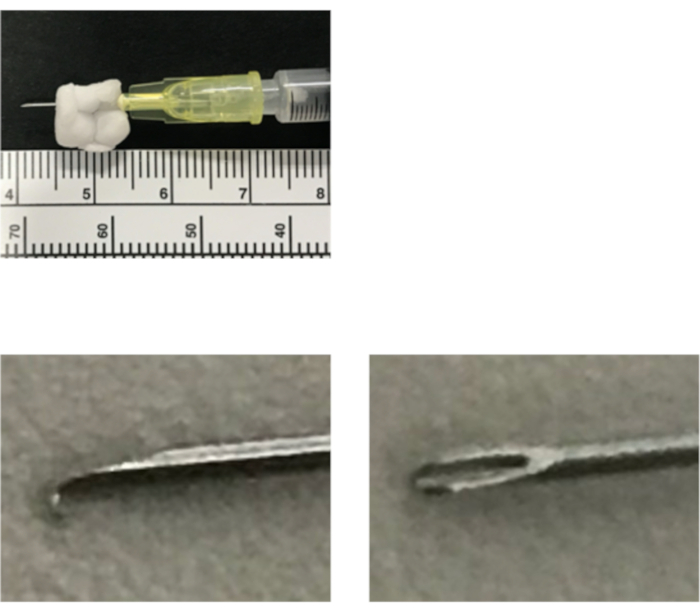
- Make a stopper with polystyrene foam and attach the stopper to the 30 G needle so that the tip remains at 5 mm to prevent lung injury. Bend the needle tip with clean forceps or by pressing it against a hard object cleaned with 70% EtOH to avoid pneumothorax (Figure 1).
CAUTION: Be careful not to pierce oneself. Use forceps to bend the needle. Do not hold the stopper when attaching it to the needle. It is safer to stick the stopper before filling the cells into the syringe.
- Fill a syringe (1 mL) with target cells and attach a 30G needle with a stopper.
- Disinfect the chest of the animal with 70% EtOH before the procedure.
- Pierce a needle into the chest of the mouse through the intercostal space. Owing to the resistance while hitting against the ribs at that time, the needle tip moved up and down. After passing through the intercostal space, press the syringe against the mouse and inject 100 µL of target cells (Figure 2).
NOTE: The mouse breaths deeply when the needle properly enters the chest cavity. With the bending of the needle tip, pneumothorax and inappropriate injection of cells into the lung could be avoided.
NOTE: Right chest wall puncture is recommended to avoid the risk of cardiac wall puncture.
- Roll the mouse 2-3 times to spread the cells throughout the thoracic cavity.
- Return the mouse to a clean and warm cage and monitor until ambulatory. After the procedure, the mouse will wake up from anesthesia and behave normally.