A subscription to JoVE is required to view this content. Sign in or start your free trial.

Method Article

Performing Injection into Palpebral Portion of the Superior Lacrimal Gland: A Technique for Inducing Dry Eye Disease in Rabbit Model

2.9K views

⸱

July 8th, 2025

In This Article

Abstract

Source: Honkanen, R. A., et al. A Rabbit Model of Aqueous-Deficient Dry Eye Disease Induced by Concanavalin A Injection into the Lacrimal Glands: Application to Drug Efficacy Studies. J. Vis. Exp. (2020).

In this video, we show a procedure to induce aqueous-deficient dry eye disease in a rabbit model by injecting the palpebral portion of the superior lacrimal gland with Concanavalin A. This model is useful for pharmacokinetic and biodistribution assays of drugs for treating dry eye disease.
Protocol

All procedures involving animal models have been reviewed by the local institutional animal care committee and the JoVE veterinary review board.

1. Animals and housing

  1. Acquire New Zealand White (NZW) rabbits weighing 2-3 kg.
  2. House the rabbits singly in cages with strict temperature (65 ± 5 °F) and humidity (45 ± 5%) control. Lighting should have a 12 h on/off cycle.
  3. Provide unlimited access to water and standard rabbit chow. Eliminate dietary enrichments as they may contain vitamin A that affects the eye.
  4. Acclimate the animals for at least 2 weeks prior to baseline measures or inducti....

Access restricted. Please log in or start a trial to view this content.

Results

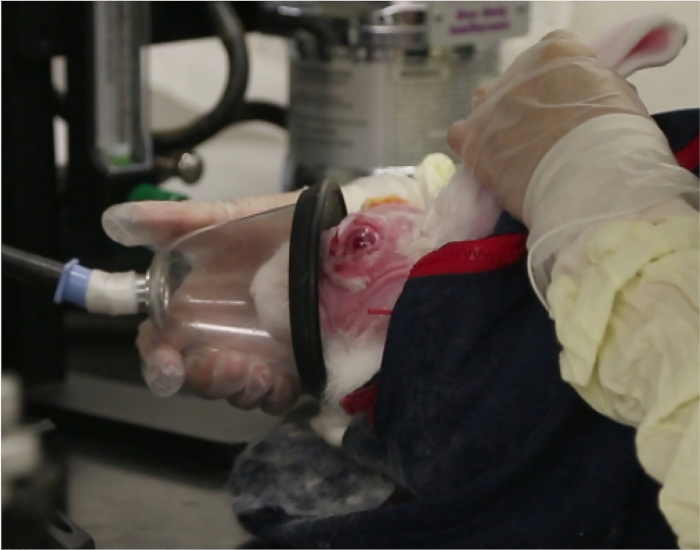
Surgical procedure on anesthetized animal, laboratory setup, anesthesia workflow, medical research.
Figure 1: Gas mask sedation. This photograph shows the gas mask providing brief moderate sedation with isoflurane.

Access restricted. Please log in or start a trial to view this content.

Disclosures

No conflicts of interest declared.

Materials

List of materials used in this article
NameCompanyCatalog NumberComments
27 gauge needles (5/8)Becton Dickinson and Company, Franklin Lakes, NJ305921Needles for injecting ConA into the lacrimal glands
Aceproinj (acepromazine)Henry Schein Animal Health, Dublin, OHNDC11695-0079-80.1ml/kg subcutaneously injection for rabbit sedation
Anesthesia vaporizerVetEquip, Pleasanton, CAItem #911103
Bishop Harmon ForcepsBausch and Lomb (Storz), Bridgewater, NJE1500-CTissue forceps
Concanavalin ASigma, St. Louis, MOC2010Make 5mg/ml in PBS for injection into rabbit lacrimal glands
fluoresceinAKRON, Lake Forest, ILNDC17478-253Dilute to 0.2% with PBS to measure TBUT
IsofluraneHenry Schein, Melville, NY29405
lidocaineSigma, St. Louis, MOL56471% in PBS for anesthesia agent
PBS (phosphate buffered saline)Mediatech, Inc. Manassas, VA21-031-CV
Rabbit, New Zealand White or Dutch Belted (as described in text)Charles River Labs, Waltham, MA2-3 kgResearch animals
Surgical Loupes +1.50Designs for Vision, Bohemia, NYSpecialty itemProvide magnificantion of ocular surface while observing tear break up and performing Concanavalin A injections.

Explore More Articles

Lacrimal Gland InjectionConcanavalin APalpebral GlandTransconjunctival ApproachAqueous DeficiencyOcular SurfaceTear ProductionDrug Efficacy