כאן, אנו מתארים פרוטוקול סטנדרטי למיפוי מוטורי באמצעות nTMS בשילוב עם שחזור טנסורי דיפוזיה (DTI) של מסלול הקורטיקוספינל (CST). הפרוטוקול ניתן לשחזור, ישים קלינית וניתן לשילוב בקלות בתהליכים קליניים שגרתיים, ומספק מסגרת חזקה וחשובה להערכת מסלולים מוטוריים, מחקר נוירופלסטיות ותכנון שיקום.
מאמר שיטה
פרוטוקול סטנדרטי למיפוי מוטורי פונקציונלי באמצעות גירוי מגנטי טרנס-גולגולתי מנווט
במאמר זה
סיכום
תקציר
גירוי מגנטי טרנס-גולגולתי מנווט (nTMS) מבוסס על שילוב נתוני הדמיית מוח בודדים לקביעת המיקום המדויק של סליל הגירוי, ובכך לאפשר גירוי מונחה אנטומית של מטרות קורטיקליות. העניין של מערכות ניווט עצבי מוכר היטב באופטימיזציה של מיקום סליל במהלך טיפולים חזרתיים של TMS (rTMS). יתרה מזאת, nTMS מיושם יותר ויותר למיפוי פונקציונלי של אזורי מוח ביישומים שונים, כגון זיהוי והגדרת אזורים מוטוריים ושפתיים רהוטים לפני כריתת גידול. מלבד השימושיות שלו באופטימיזציה של הליכים נוירוכירורגיים, מיפוי nTMS יכול לשמש גם כלי למעקב אחר פלסטיות קורטיקלית וכימות שלמות המערכת המוטורית במחלות נוירולוגיות שונות. מאמר מתודולוגי זה מציג פרוטוקול סטנדרטי למיפוי מוטורי באמצעות nTMS, בשילוב עם שחזור מבוסס דיפוזיה טנזורית (DTI) של מסלול הקורטיקוספינל (CST). גישה זו מאפשרת לזהות במדויק אזורים מוטוריים קליפתיים רהוטים וההקרטות התת-קורטיקליות שלהם, וכן זיהוי ארגוני תפקוד מחדש אצל מטופלים עם נגעים סמוכים. כאשר משולבת בתכנון טרום-ניתוחי, שיטה זו מספקת הנחיות לאסטרטגיות ניתוח מותאמות אישית שמטרתן למקסם כריתת נגעים תוך שמירה על תפקוד מוטורי. הפרוטוקול המוצג כאן ניתן לשכפול, ישים קלינית ומתאים לשילוב בתהליכי עבודה שגרתיים. הוא מהווה כלי מבטיח למחקר נוירופלסטיות ותכנון שיקום.
מבוא
מקסום היקף הכריתה בגידולי מוח מוטוריים ומדויקים תוך הפחתת ליקויים מוטוריים לאחר ניתוח נותר אתגר מרכזי בנוירוכירורגיה. מיפוי גירוי חשמלי ישיר תוך ניתוחי (DES) הוא טכניקת "התקן הזהב" לספק מידע אנטומו-פונקציונלי אמין בנוגע לייצוג הקורטקסי והתת-קורטיקלי של מסלולי תנועה 1,2,3,4,5. עם זאת, לתכנון טרום-ניתוח, סיווג סיכונים וייעוץ מיטבי למטופלים, חשוב להגדיר את האנטומיה התפקודית האישית לפני הניתוח. הקשר בין אנטומיה לתפקוד באזורים מוטוריים קורטיקליים אינו ניתן להסקה מדימות תהודה מגנטית מוחית קונבנציונלית (MRI), שכן גידולים במוח עלולים לגרום לעיוות אנטומי משמעותי או לארגון מחדש פלסטי של רשתות מוטוריות.
גירוי מגנטי טרנס-גולגולתי (TMS) הוכנס לשיטה לא פולשנית לחקירת קליפת המוטורי6, ולאחר מכן הותאמה למיפוי פונקציונלי של קליפת המוטורי 7,8, כולל בניסויים טרום-ניתוחיים על ידי רישום פוטנציאלים מוטוריים (MEPs) משרירים שונים עם אלקטרומיוגרפיהשטחית 9,10,11. פרוטוקולי TMS מוקדמים שאינם מנווטים היו תובעניים טכנית וחסרו דיוק אנטומי. שילוב מאוחר יותר עם נתוני MRI בודדים וניווט מבוסס שדה חשמלי אפשר הכוונה מדויקת של אתרי גירוי, שיפר את הדיוק האנטומי-פונקציונלי 12,13,14 ואת השחזוריות 15,16. על ידי השגת MEPs ישירות, TMS מנווט (nTMS) מספק רזולוציה זמנית בקנה מידה מילישניות ומיקום מרחבי תת-סנטימטרי של פלט קורטיקוספינלי בהתאמה טובה עם DES 17,18,19 תוך ניתוח. nTMS מונחה תמונה בטוח, נסבל היטב20,21, ומאושר על ידי מנהל המזון והתרופות (FDA) למיפוי תפקודי טרום-ניתוחי של הקורטקס המוטורי במשך יותר מ-15שנים.
במיפוי מוטורי, ייצוגים קורטיקליים מוגדרים על ידי דגימת אמפליטודות MEP בין אתרי גירוי ממוקדים לבניית מפות מוטוריות ספציפיות למטופל23. בהשוואה ל-MRI פונקציונלי מבוסס משימה (fMRI), nTMS מראה התאמה מרחבית קרובה יותר ל-DES 24,25,26 תוך ניתוח. בעוד שהחלטות תוך ניתוח תלויות בסופו של דבר ב-DES כאשר נגעים מתקרבים או פולשים לאזורים המוטוריים, nTMS לפני הניתוח מספק מידע משלים יקר ערך על ידי ייצוא אתרים חיוביים לגירוי כזרעים להדמיית טנסור דיפוזיה (DTI) של מסלול הקורטיקוספינל (CST). גישה זו שימושית במיוחד להערכת שלמות הקורטיקוספינל כאשר גידולים משפיעים בעיקר על המסלולים המוטוריים בחומר הלבן התת-קורטיקלי27,28. יתרה מזאת, מיפוי מוטורי של nTMS לפני ניתוח הראה ערך חיזוי חיובי טוב29,30 וערך חיזוי שלילי גבוה 29,30,31, עם תוצאות ניתוח משופרות 17,18,19,32. לאחרונה הוכח גם ככלי יעיל להערכת תפקוד מוטורי לאחר ניתוח 31,33. מסיבות אלו, מיפוי מוטורי של nTMS משמש יותר ויותר הן להערכה טרום-ניתוחית והן למעקב לאחר הניתוח בנוירוכירורגיה. המלצות מתודולוגיות למיפוי קורטיקלי עם nTMS פורסמו בשנת 2017,34. לאור המחקרים האחרונים הללו ושילוב טכניקות הדמיה מודרניות, ניתן כעת לשפר את המתודולוגיה הזו כדי לספק הנחיות מדויקות יותר לפרקטיקה קלינית ומחקרית.
במאמר זה אנו מציגים פרוטוקול סטנדרטי לביצוע מיפוי מוטורי באמצעות nTMS, המשלב טכניקות שונות להערכת ייצוגים קורטיקליים ותת-קורטיקליים של מסלולים מוטוריים לתכנון כריתת גידול בתנאים קליניים אמיתיים.
פרוטוקול
מחקר זה נערך בהתאם להנחיות אתיות לאומיות ובינלאומיות למחקר אנושי. ניתוח רטרוספקטיבי של נתוני מטופלים אנונימיים שנאספו במהלך טיפול שגרתי בוצע בהסכמה מדעת שהתקבלה בזמן הטיפול, בהתאם לתקנות הצרפתיות. נתוני הדגמה של נבדקים בריאים, שהם שותפים לכתיבת המאמר, נכללו עם הסכמה מדעת בכתב להשתתפות ולפרסום נתונים ותמונות. זהו הפרוטוקול הנוכחי המשמש בבית החולים אנרי מונדור (קרטיי, צרפת) ובבית החולים האוניברסיטאי ארהוס (דנמרק) לתכנון טרום-ניתוחי גידולי מוח.
1. רכישת נתוני דימות מוחי לניווט עצבי
- אמת היעדר התוויות נגד ל-nTMS ו-MRI באמצעות רשומות רפואיות וראיונות מטופלים, כולל מכשיר פרומגנטי תוך-גולגולתי, אפילפסיה לא מבוקרת, קוצב לב, הריון או הנקה35.
- לרכוש תמונת מוח אנטומית ברזולוציה גבוהה הכוללת גם את האוזניים וגם את קודקוד הגולגולת (ללא קפלים או עיוותים מאוזניות MRI) כדי לאפשר שחזור מוחי מדויק על ידי מערכת הניווט העצבי.
- השתמש בהמלצה הבאה לרצף ה-MRI:
הדהוד אנטומי משוקלל T1 (T1w) תלת-ממדי
ווקסלים איזוטרופיים בקוטר 1 מ"מ (או פחות)
≥מערכת MRI של 1.5-טסלה (3 טון מועדף). - חלופה נוספת היא להשתמש ברצפים המקובלים הבאים:
3D-FLAIR
T1w תלת-ממדי משופר בניגודיות
- השתמש בהמלצה הבאה לרצף ה-MRI:
- רכוש הדמיה משוקללת דיפוזיה (DWI) לפני הזרקת חומר ניגוד לצורך הדמיית טנזור דיפוזיה (DTI) מאוחר יותר,36.
- השתמש בפרמטרים המינימליים הבאיםלרכישה 37:
ווקסלים איזוטרופיים בקוטר 2 מ"מ
כיווני קידוד דיפוזיה: ≥ 25
ערך B: ≈ 800 שניות/מ"מ²
תמונות ללא משקל דיפוזיה: ≥ 3 נפחים b0 (b = 0 s/mm²) - השתמש בפרמטרים המומלצים הבאים (לשיפור הערכת טנזורים וטרקוגרפיה):
כיווני קידוד דיפוזיה: ≥ 64
ערך B: 1000 שניות/מ"מ 2
רזולוציה מרחבית גבוהה יותר (≤ איזוטרופי של 2 מ"מ)
- השתמש בפרמטרים המינימליים הבאיםלרכישה 37:
2. הכינו את הנושא
- ייבא את תמונת ה-MRI האנטומית של הנבדק למערכת הניווט העצבי כדי ליצור שחזור מוחי תלת-ממדי.
- סמן את הנקודות האנטומיות המרכזיות ב-MRI בתוך תוכנת הניווט העצבי (נסיון, אוזן ימין, אוזן שמאל).
- השתמש בשורש של ה-crus hellicis לדיוק גבוה יותר.
- חלופה נוספת היא להשתמש בטרגוס, אך פני השטח הגדולים יותר שלו עלולים להגדיל את חוסר ההתאמה ברישום משותף.
הערה: כדי לקצר את מיפוי המנועים, ניתן לבצע את השלבים ההכנתיים הללו לפני התקנת הנושא בחדר.
- מקם את הנבדק על כורסה נוחה, עם נטייה קלה (20-30°) להפחתת מתח בגב38°. כוון את משענת הראש לתמוך בראש ובצוואר באיניון (inion).
- בדקו חפצים מתכתיים באזור הראש והצוואר (למשל, עגילים, סיכות שיער, פירסינגים) והסירו אותם לפני תחילת ההליך.
- הכינו את העור על המצח למיקום מעקב ראש.
- נקה את העור עם כריות אלכוהול או ג'ל שוחק עדין.
- ודא שהעור יבש לחלוטין לפני שמניחים את המעקב.
- הנח את מעקב הראש על המצח כדי שיישאר יציב לאורך כל סשן הגירוי.
- מקם אותו מעל הגבות ומתחת לקו השיער.
- שים אותו או באמצע או מעט לרוחב.
- תקבע את המעקב באמצעות משטח הדביק או עם רצועת גומי.
- רשמו יחד את הנקודות האנטומיות המרכזיות של המטופל עם התמונה המיובאת בתוכנת הניווט העצבי (ראו איור 1).
- השתמשו בעט הדיגיטציה כדי לסמן את נקודות הציון האנטומיות.
- ודאו שתנוכי האוזניים פתוחות מהמשענת כדי למנוע הזזת סימני האוזניים39.
- אם אנטומיית האוזן נראית מעוותת ב-MRI (למשל, פינה מקופלת של האוזן), יש להגדיר מחדש את הנקודה המתאימה בתמונה לפני הדיגיטציה.
- לאחר השלמה, התוכנה מאמתת את שלוש נקודות הפידוציאלית אם שגיאת חוסר ההתאמה מתחת ל-3 מ"מ. אם שגיאת חוסר ההתאמה גדולה מדי, נסו את הצעדים הבאים לפי הסדר:
- לדגיטל את הנקודות האנטומיות המרכזיות של המטופל בפעם השנייה.
- הגדר מחדש את נקודות האנטומיה של האוזן השמאלית והימנית ב-MRI.
- עשה דיגיטציה תוך לחיצה עדינה על הסליל של תנוך האוזן, כי ייתכן שאוזניות MRI הזיזו את האוזן בכמה מילימטרים.
- לחדד את הרישום על ידי דיגיטציה של נקודות קרקפת נוספות (התאמת קרקפת למשטח).
- אימות ההרשמה המשותפת, עם שגיאת רישום משותף מתחת ל-3 מ"מ (2 מ"מ מועדף). אם חוסר ההתאמה עולה על 3 מ"מ, חזור על צעדים 2.7-2.9.
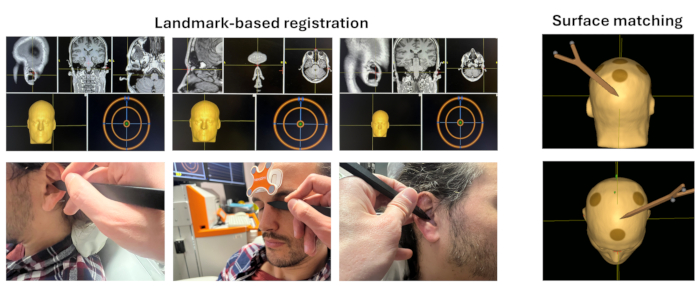
איור 1: רישום משותף של ראש המטופל עם ה-MRI האנטומי. צד שמאל: רישום מבוסס אתר ציון. פאנלים עליונים: זיהוי נקודות הציון האנטומיות ב-MRI (אוזן שמאל, נזיון, אוזן ימין) בתוך תוכנת הניווט העצבי. פאנלים תחתונים: דיגיטציה של נקודות הציון על המטופל באמצעות עט דיגיטציה. צד ימין: שיפור התאמת משטח באמצעות נקודות קרקפת נוספות. אנא לחצו כאן כדי לצפות בגרסה מוגדלת של הדמות הזו.
3. הכנת שרירים ממופים
- תנו אטמי אוזניים לנבדק ולבשו אוזניות מגן בזמן הגירוי.
- הכינו את העור מעל השריר היעד על ידי גירוד עדין של העור עם כריות אלכוהול ו/או כריות כותנה עם ג'ל שוחק עדין.
- הניחו אלקטרודות שטחיות על השרירים המעניינים במונטאז' גיד הבטן, בדומה ל-MEP קליני שגרתיים. ניתן למפות עד שישה שרירים שונים בו-זמנית.
- הנח את אלקטרודת הקרקה על אתר ניטרלי, כמו גדם הכתף, משטח היד הגבית או משטח השוקה המדיאלית.
- חבר את כל האלקטרודות למגבר ה-EMG.
- התחל ברכישת EMG כדי להציג EMG רציף של כל הערוצים ולוודא שהשרירים במנוחה.
- בדוק שערוצי ה-EMG נקיים מרעש מופרז של 50/60 הרץ (< 50 מיקרו-וולט). אם הזמזום החשמלי מופרז, נסו את השלבים הבאים לפי הסדר:
- ודאו שהאלקטרודות מחוברות היטב לעור, ללא ניתוק.
- מקם מחדש את כבלי האלקטרודה בתוך הכיסא כדי להימנע ממגע עם חלקים מתכתיים או עם הרצפה.
- הזז את החלק הדיסטלי של המובילים האלקטרודה הרחק ממערכת הניווט העצבי וממקורות הכוח של חילופין חילופין.
- החלף את האלקטרודות והחלו אותן מחדש בכיוון כבלים שונה (ראו שלבים 3.7.2 ו-3.7.3).
- נתק את הכיסא מהספק הכוח.
- הנח את אלקטרודת הארקה על אותו איבר כמו השרירים הממופים.
- חזור על השלבים לפי הסדר עד שהרעש יורד מתחת לסף.
- ברגע שרעש ה-50/60Hz מצטמצם, הפעל מחדש את הקלטת ה-EMG כדי לאפס את קו הבסיס.
- לאחר ששלבי ההכנה הללו עברו, יש לבצע מיפוי גס של השרירים הנבחרים.
הערה: מפגש מיפוי סטנדרטי צריך לכלול לפחות שריר אחד לכל מקטע של הגפה העליונה ושני שרירי גפה תחתונה. טבלה 1 מפרטת את השרירים הנפוצים, שיש להתאים אותם בהתאם למיקום הנגע ולהצגה הקלינית של המטופל34.
| איבר | שרירים | חלופות(ות) |
| יד | הגב הבין-עצמי הראשון (FDI) | אבדוקטור פוליסיס ברוויס (APB) |
| אבדוקטור דיגיטי מינימי (ADM) | ||
| אמה | פלקסור קרפי רדיאליס (FCR) | אקסטנסור קרפי רדיאליס (ECR) |
| זרוע / כתף | בייספס | - |
| דלטואיד | ||
| רגל | טיביאלית קדמית (TA) | סולאוס (סול) |
| רגל | הזיית חוטף (AH) | כף הרגל המדיאלי (MP) |
| פנים | אורביקולאריס אוריס | נזליס |
טבלה 1: שרירים מומלצים למיפוי מוטורי.
4. מיפוי גס לזיהוי נקודת החום וקביעת סף המנוע המנוחה (RMT)
- בנפח המוח המוצג בתוכנה, כוון את עומק הקילופים בין 15-25 מ"מ לעומק הקרקפת, מקרה אחר מקרה, כדי לחשוף בצורה הטובה ביותר את האנטומיה הקורטיקלית. המטרה היא להמחיש את הג'ירי הפרה-מרכזי והפוסט-מרכזי, את הסולקוס המרכזי, ואת הסולקי המצחי העליון והתחתון.
הערה: זיהוי הג'יירוס הפרה-מרכזי קל יותר כאשר הנבדק מציג ידית יד בצורת "אומגה"40,41. עם זאת, ציון דרך זה אינו קבוע 42,43. במקרים כאלה, מומלץ מספר שיטות לזיהוי הגירוס הפרה-מרכזי 43,44,45. - הפעל את יחידת הממריץ.
- מקם את סליל הגירוי (איור שמונה) במשיקים לקרקפת (ראו איור 2).
- יייצב את הסליל ביד אחת על הידית וביד השנייה על הסליל כדי לשמור על מגע יציב עם הקרקפת בזמן השינוי בתנוחה.
- השתמש בסיוע הניווט העצבי (זווית סליל, מרחק סליל לראש, מדדי הטיה) כדי להבטיח מיקום מדויק של הסליל בכל אתר גירוי.
- לשמור על שדה חשמלי מושרה יציב (EF, V/m) על ידי הימנעות מהטיית סליל.
- אמצו יציבה נוחה כי הסליל יכול להיות כבד. השתמש בזרוע החזקת כבל כדי להפחית את מתיחות הכבל תוך שמירה על תנועה חופשית של הסליל.
- גירוי בעוצמה מותאמת לעורר תגובות בטווח המשרעת של 100-500 מיקרו-וולט (שיא-עד שיא)46.
הערה: זה מושג בדרך כלל בין 35% ל-45% מהתפוקה המקסימלית של הממריץ (MSO) לגפיים העליונות ובין 50% ל-80% מה-MSO בגפיים התחתונות. עם זאת, טווח ערכים זה חל על נבדקים בריאים ויכול להיות גבוה יותר כאשר הגידול חודר לאזורים המוטוריים. - יש לשים לב שכיוון הסליל עבור המיפוי הגס (כמו גם המיפוי העדין) תלוי בזירה הממופה (ראו איור 3):
- עבור הגפה העליונה והפנים: שמרו על כיוון סליל בניצב לסולקוס המרכזי (מיושר לסולקוס), כדי לשמור על זרם חשמלי מושרה בכיוון אחורי לקדמי47.
- לגבי הגפה העליונה: התחל לגרות מעל החלק העליון (כתף) או החלק האמצעי (שרירי האמה והיד) של הקיר האחורי של כפתור היד, הפונה לסולקוס הקדמי העליון.
- לפנים: התחל לגרות מעל הקיר האחורי של הג'ירוס הפרה-מרכזי הפונה לסולקוס המצחי התחתון. בדוק את זמני התגובה כדי לוודא שהם מגיעים מהמסלולים הקורטיקובולבריים. ל-MEPs פנים יש השהיה של 7-13 מילישניות, בעוד שתגובת שריר ישירה (תנועת לסת) הנגרמת על ידי nTMS היא עם השהיה של כ-3-4 מילישניות.
- לגפה התחתונה: שמרו על כיוון סליל בניצב לקו האמצע הסגיטלית, עם זרם חשמלי מושרה בכיוון אמצע-לטרלי34. כיווני סליל חלופיים כוללים מקביל לקו האמצע הסגיטלי 48,49,50 ו/או בניצב לקפלים של הלובלה הפרה-מרכזית ולגירוס הפרה-מרכזי.
- עבור הגפה העליונה והפנים: שמרו על כיוון סליל בניצב לסולקוס המרכזי (מיושר לסולקוס), כדי לשמור על זרם חשמלי מושרה בכיוון אחורי לקדמי47.
- בצע גירויים מעל הג'יירוס הפרה-מרכזי.
- נקודות גירוי במרחב במרחק של 2-5 מ"מ זה מזה, בין אם חזותי או באמצעות רשת גירוי.
- כאשר מבצעים זאת בצורה ויזואלית, דגמו שלושה קווים מקבילים על פני הג'ירוס. זה בדרך כלל מספיק.
- מרחק כל גירוי לפחות ב-1.5 שניות, רצוי עם מרווח גירוי אקראי.
- אם לא מתקבלות תגובות, הגדילו את עוצמת הגירוי ב-10% יחסית לערך ההתחלתי וחזרו על הפעולה כפי שהיה קודם.
- עצור את המיפוי הגס ברגע שנרשמו 20-30 תגובות לכל שריר.
- בדקו את כל חברי הפרלמנט האירופי כדי להוציא הקלטות מזוהמות.
- זהה את ה"נקודת החם" לכל שריר. "נקודת החם" היא נקודת הגירוי שמפעילה את ה-MEP בעל המשרעת הגדולה ביותר. כדי להבטיח הגדרה אמינה של נקודת חום51
- הצג את ההקלטות של כל שריר באמצעות סולם צבע מנורמל.
- אתר את האזור שבו נמצאים MEPs בעוצמה הגבוהה ביותר.
- מיין את חברי הפרלמנט האירופי לפי אמפליטודה, מהגבוה ביותר לנמוך ביותר.
- בחר את ה-MEP בעל המשרעת הגבוהה ביותר באזור זה, תוך הימנעות מתגובות בודדות גבוהות באופן חריג (בדרך כלל שני ה-MEPs הראשונים).
- לכל שריר, בחרו את נקודת החום כדי לקבוע את סף התנועה במנוחה (RMT). זה ישמור על מיקום וכיוון הסליל לאורך כל תהליך קביעת ה-RMT, ויבטיח מדידהאמינה 52.
- קבעו את עוצמת הגירוי הנמוכה ביותר לכל שריר בנפרד, בין אם באמצעות טכניקת ציד סף53 או על ידי זיהוי עוצמת הגירוי הנמוכה ביותר (% MSO) שמעוררת MEPs ≥ 50μV ב-5 מתוך 10 ניסויים רצופים (שיטת רוסיני-רות'וול)54. השתמש ב-RMT של כל שריר כנקודת ייחוס לקביעת עוצמת הגירוי במהלך המיפוי המדויק.
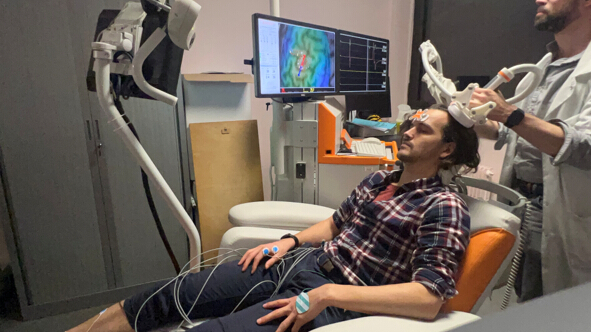
איור 2: הגדרת nTMS ניסיונית. הנבדק יושב עם שכיבה קלה ותמיכה בזרוע, עם אלקטרודות EMG מונחות על שרירי המטרה. המפעיל מחזיק את הסליל בצורת שמונה ומייצב אותו כדי לשמור על מגע משני הקרקפת, תוך ניטור השדה החשמלי המושר (חצים: כיוון, עיגול: עוצמה) וה-MEPים המושרים. אנא לחצו כאן כדי לצפות בגרסה מוגדלת של הדמות הזו.
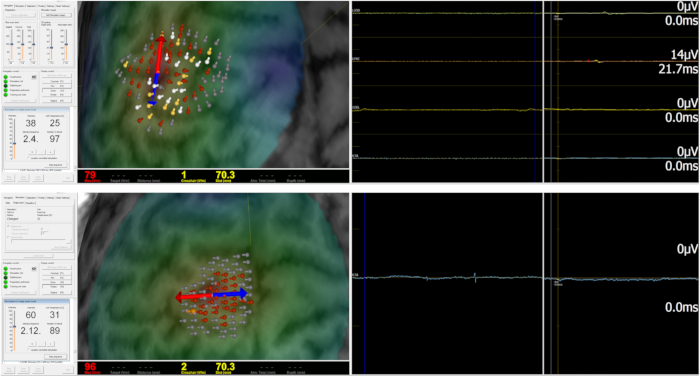
איור 3: ממשק ניווט עצבי במהלך המיפוי. משוב בזמן אמת על מיקום הסליל (חיבור החצים הכחול והאדום), הטיית הסליל, כיוון השדה החשמלי (חץ כחול לאדום) ועוצמת השדה (טבעת צבעונית סביבה) מבטיח גירוי מדויק בכל אתר קורטיקלי. לוח עליון: מיפוי גס של הגפה העליונה, כאשר הסליל ממוקם בניצב לחריץ המרכזי. לוח תחתון: מיפוי עדין של טיביאלית קדמית, כאשר הסליל ממוקם בניצב לקו האמצע הסגיטלית. אנא לחצו כאן כדי לצפות בגרסה מוגדלת של הדמות הזו.
5. מיפוי מדויק
- ודא שהנבדק רפוי לחלוטין, ללא התכווצות שרירים בלתי רצונית.
- עבור כל שריר, בצע את הגירוי ב-105-110% מה-RMT שלו.
- השתמש באותו כיוון סליל כמו במיפוי גס (ראו שלבים 4.5 ו-4.6).
- הקטן את המרחק בין נקודות הגירוי (4-6 קווים מקבילים לכל ג'יירוס).
- שמור על מרווח בין-גירוי ≥ 1.5 שניות, רצוי אקראי.
- הגדר מפות מוטוריות פונקציונליות כאזורים קורטיקליים שבהם nTMS מייצר MEPs ≥ 50 מיקרו-וולט (שיא לשיא).
הערה: למיפוי גפיים תחתונים, חלופה היא להתחיל ב-110% מה-RMT של הגפה העליונה, ולכוונן את ה-EF בשלבים של ± 10 V/m עד לקבלת MEPsעקביים של 34. - בצע את הגירוי עד שמפות המנוע מוקפות בשורה או שתיים רצופות של אתרים שליליים שאינם מעוררים MEPs.
- אם לא מתקבל גבול שלילי ברור, האריך את הדגימה, תוך שמירה על אותו ריווח, עד שהתגובות ייעלמו באופן אמין.
- אם התגובות החיוביות מתרחבות באזורים לא רגילים, בדוק והתאים את זווית הסליל, EF ו-RMT.
הערה: מספר הנקודות לשריר יכול להשתנות (30 עד 100 פולסים) בהתאם לייצוג הקורטקס של השריר ולמידת ההזזה המוחית הנגרמת מהגידול.
- הימנעו מכיווני סליל שמייצרים מיקומי MEP או אמפליטודות חריגים. בפרט, כיוון של 45° (ביחס לקו האמצע) יכול ליצור MEPs בגפה העליונה מאוד קדמית ואינו מייצג ייצוג מוטורי קורטיקלימדויק 47.
- ודא שמפות המנוע אליפטיות, עם כמה אתרים שליליים בפנים. לנקודות גירוי שליליות במפת המוטור, יש לבצע גירויים נוספים ברגעים שונים במהלך ההערכה כדי לשלוט בשינויים חולפים בהתעוררות הקורטקס המוטורי.
- אם מתרחשות תגובות שליליות רבות (<50 מיקרו-וולט) במהלך המיפוי, נסו את השלבים הבאים בסדר:
- בקש מהנבדק להישאר ער, שכן זה לעיתים משקף ירידה במצב הערנות.
- בדוק שעוצמת הגירוי לא ירדה.
- שקול לחזור על ה-RMT, שכן הערך ההתחלתי עשוי להיות מושפע ממצב היפר-אקסיטבליות חולף.
- אם מופיעים MEPs רבים בעלי משרעת גבוהה באופן חריג (> 1000 מיקרו-וולט) והמפה מתרחבת יתר על המידה, נסו את השלבים הבאים בסדר:
- בקש מהנבדק להרפות את הגפה, אפילו על ידי הצגת פעילות שרירים מתמשכת במידת הצורך (משוב אותות).
- אם פעילות השרירים נשארת, בקש מהנבדק לנער את הגפה או להזיז אותה במצב רגוע יותר. אם יש צורך, יש לבצע תנועה פסיבית קונצנטרית על השריר שנבדק (למשל עם חפץ לשרירי היד ולהזיית החוטף, או עם תמיכה בכף הרגל לשריר השוקה הקדמי).
- שקול לחזור על ה-RMT, שכן הערך ההתחלתי עשוי להיות מושפע ממצב מעבר של היפו-אקסיביליות לקורטקס המוטורי.
6. ניתוח לאחר עיבוד של נתוני MEP וייצוא
- בדוק והתאם את ה-MEP לכל שריר.
- פתח את פאנל הסקירה של MEP או את צופה האותות בתוכנת הניווט העצבני.
- בדוק כל MEP מוקלט כדי לתקן את המשרעת וההשהיה ולהתאים את הסימנים במידת הצורך.
- להוציא נקודות גירוי ארטפקטיות או חריגות.
- פתח את רשימת הגירויים או את מרחב העבודה המיפוי בתוכנה.
- הסר ניסויי גירוי המכילים ארטיפקטים או מיקומים שגויים של סלילים (ראו איור 4).
- הצג את מפת המוטורי של כל שריר בפורמט בינארי (חיובי/שלילי; מעל/מתחת ל-50 מיקרו-וולט).
- ייצוא את נקודות הגירוי החיובי בפורמט DICOM משולב בעומק 15, 20 ו-25 מ"מ. השתמש בקבצים אלו למעקב סיבים לשחזור ה-CST, תוך שימוש בנקודות הגירוי החיוביות כזרעים לטרקוגרפיה.
- כדי למדוד פרמטרים אחרים במפות קורטיקליות (מרכז כובד, צפיפות מפה, גודל מפת מנוע), ייצא את הנתונים בעומק קילוף הגירוי או בעומק קילוף סטנדרטי של 20 מ"מ (עומק קילוף סטנדרטי) 25,55,56,57,58.
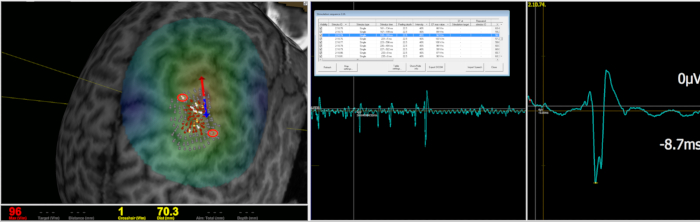
איור 4: ניתוח לאחר עיבוד נתוני MEP. עקבות MEP נבדקים כדי לתקן את סמני המשרעת וההשהיה ולהוציא מחקרים ארטיפקטואליים (פאנל ימין: דוגמה לניסוי שזוהם מפעילות EMG מתמשכת). שני הגירויים (עיגולים אדומים) ממחישים "תגובות חריגות" המתרחשות באזור השלילי, ככל הנראה קשורות להשפעות כיוון סליל. אנא לחצו כאן כדי לצפות בגרסה מוגדלת של הדמות הזו.
7. ניתוח עיבוד לאחר מיפוי מנוע
- ייבא את ה-DICOM של מפות המוטוריות לתוכנת ניתוח תמונה המתאימה לניווט נוירוכירורגי להסרת גידולי מוח.
- רשמו את התמונה האנטומית (T1w) עם מפות המנוע, DICOMs ו-DWI. ייבא ורשם תמונות נוספות במידת הצורך (למשל, FLAIRw, SWI, T1w-gadolinum enhanced).
- ליצור אובייקטים מ-DICOM של מפת המנוע ולהגדיל אותם ב-2-3 מ"מ כדי לשפר את הרגישות59.
- חתכו את מפות המנוע כדי להסיר את האוזניים והנזיון ולמנוע שחזור סיב לא תקין במהלך מעקב הסיבים.
- צייר ROI סוף ידנית ברמת הפונטין התחתונה, באותו צד לחצי הכדור הממוף.
- בצע מעקב סיבים, תוך שימוש ב-ROIs של מפת המנוע כזרעים, וב-ROI הפונטיני כנקודת הסיום. אלגוריתמים נפוצים של טרקטוגרפיה כוללים מעקב דטרמיניסטי עם קו זרימה או טרקטוגרפיה הסתברותית, בהתאם לשאלה הקלינית ולתוצאות מעקב הסיבים.
הערה: בעת שימוש בתוכנת דיפוזיה בקוד פתוח, נדרשים מספר שלבי קדם-עיבוד לפני הטרקטוגרפיה (דה-אינואיזציה, תיקון ארטיפקטים של גיבס, תיקון תנועה ועיוות, תיקון שדה הטיה B1, התאמת טנזורים ויצירת מפת FA). - כוון את פרמטרי מעקב הסיבים בניתוח מקרה לגופו. הפרמטרים המומלצים הם אורך מינימלי של 110-120 מ"מ, זווית מקסימלית של 30°, ו-FA מוגדר ב-75% מסף ה-FA (FAT, התואם ל-FA שבו סיבי CST הראשונים נראים לעין)60,61.
- חלקו את הגידול במוח בתמונות אחרות (למשל FLAIR, gadolinium T1w) וצרו אובייקט מתאים.
- הצג את ה-CST עבור כל חלק של איבר (בצבעים שונים) או עבור כל מיפוי המנוע.
- שלבו את כל הנתונים (זרעי קורטיקל, CST, אובייקט גידול במוח) בתוכנת הניווט של חדר ניתוח לנוירוכירורגיה.
תוצאות
אנו מציגים שלבים מייצגים ותוצאות מיפוי מוטורי שהושגו במטופלים בריאים שונים ובמטופלים שעברו מיפוי מוטורי בסביבה קלינית, באמצעות מערכת ה-TMS המנווטת שלנו. שחזור CST בוצע באמצעות תוכנת עיבוד הדמיה המתאימה לתכנון נוירוכירורגיה, המסוגלת לרשום תמונה רב-מודלית וטרקטוגרפיה מבוססת DTI. מערכת הניווט העצבי משלבת סליל בצורת שמונה מנווט, מצלמה סטריאוטקסית, מגבר EMG, ומספקת ויזואליזציה בזמן אמת של השדה החשמלי המושר בשחזור המוח התלת-ממדי באמצעות מודל ראש רב-כדורי אישי.
איור 5 מציג את קביעת ה-RMT בנקודה החמה שנקבעה מהמיפוי הגס. מיקום הסליל וכיוונם נשמרים בדיוק באותו מיקום לאורך כל ההליך בעזרת מטרה נוירוניוטיבית. איור6 מציג מיפוי מוטורי של נבדק בריא. הגפה התחתונה השמאלית (ירך, רגל, כף רגל), הגפה העליונה (כתף, אמה, יד) והפנים מופו. אתרי גירוי חיוביים (מקודדים בצבעים על ידי משרעת MEP) ואתרים שליליים (אפורים) מגדירים את הייצוג המוטורי הקורטקיאלי. איור7 מציג מיפוי מוטורי ושחזור CST בחולה עם גרורות סרטן ריאות באזור הפרה-מוטורי, שנחשף על ידי ליקוי מוטורי בגפה העליונה.
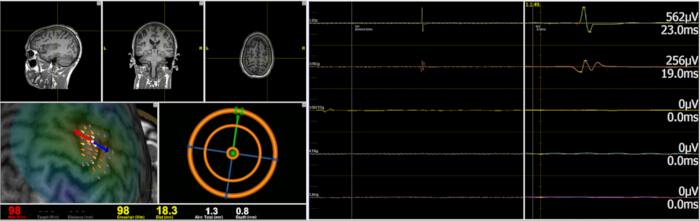
איור 5: מיפוי גס וקביעת RMT בנקודת החום (First Interosseus dorsalis) בנבדק בריא, באמצעות TMS מנווט עצב. נקודת החם, שזוהתה באמצעות מיפוי גס (פאנל שמאלי תחתון), נבחרת כמטרה לקביעת ה-RMT. מיקום הסליל וכיוונם נשמרים בדיוק באותו מיקום לאורך כל ההליך, בעזרת מטרה נוירוניווטית (הפאנל הימני התחתון). פוטנציאלים ממוטוריים (MEPs) נרכשים באמצעות עקבות EMG רציפים ותגובות אפוק. אנא לחצו כאן כדי לצפות בגרסה מוגדלת של הדמות הזו.
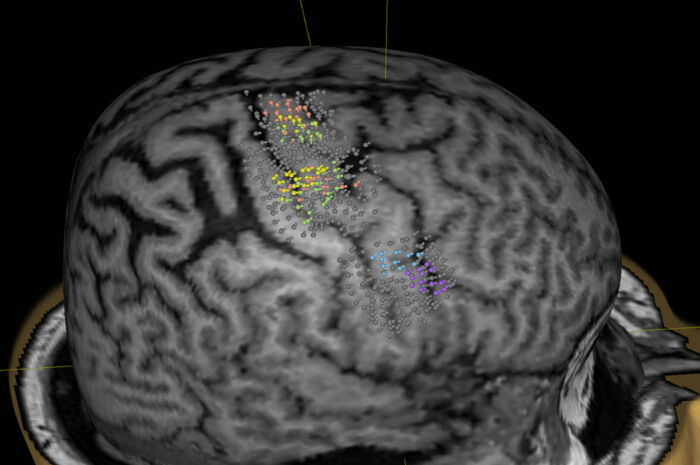
איור 6: מיפוי קורטקס מוטורי של שרירי הגפה התחתונה, הגפה העליונה והפנים באמצעות TMS מנווט על ידי נוירו-ניווט . שרירים שנרשמו בגפיים התחתונות: ארבע ראשי עצם הירך (ירוק), טיבאליס קדמי (כתום), הזיית אבדוקטור (צהוב). שרירים שנרשמו בגפיים העליונות: אבדוקטור דיגיסטי מינימי (ירוק), כופף קרפי רדיאליס (כתום), דלטואיד (צהוב). שרירים שנרשמו בפנים: Nasalis (כחול), Triangularis (סגול). אנא לחצו כאן כדי לצפות בגרסה מוגדלת של הדמות הזו.
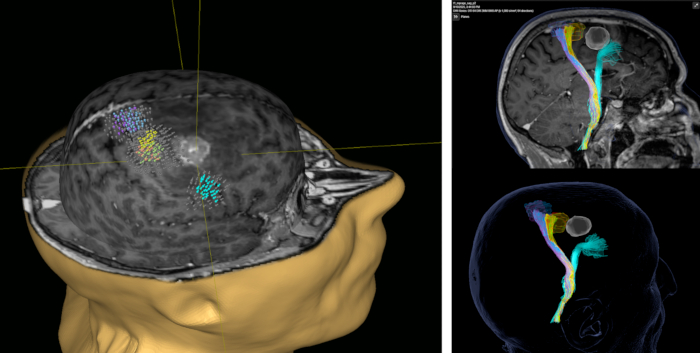
איור 7: מיפוי מוטורי קורטיקלי ושחזור CST לתכנון נוירוכירורגיה. nTMS-מיפוי מוטורי (פאנל שמאל) ושחזור מונחה nTMS של מסלולי הקורטיקוספינל (הפאנל הימני) בחולה עם גרורות מוחיות (לבנה) מסרטן ריאות. שרירים שנרשמו: הלוציס אבדוקטור (סגול), טיביאליס קדמי (כחול), דלתואיד (צהוב), כפוף קרפי רדיאליס (אדום), ראשון אינטראוסאוס דורסליס (ירוק), אורביקולאריס (תכלת). אנא לחצו כאן כדי לצפות בגרסה מוגדלת של הדמות הזו.
דיון
במאמר זה אנו מציגים פרוטוקול סטנדרטי וניתן לשחזור למיפוי מוטורי קורטיקלי פונקציונלי עם nTMS הרלוונטי ישירות לתכנון הכירורגי לפני הניתוח. על ידי שילוב ניוווט עצבי עם שחזור מוח אנטומי של הנבדק, פרוטוקול סטנדרטי זה מאפשר לזהות ולזהות אזורים קורטיקליים מוטוריים-רהוטים במהלך בדיקה שנמשכת פחות מ-90 דקות, בהתאם למספר השרירים שנבדקו. גישה זו רלוונטית במיוחד אצל מטופלים עם גידולים מוטורי-רהוטים, שבהם שחזור אנטומי של ה-CST מוגבל לעיתים קרובות על ידי שני גורמים: (i) הזזת אנטומית עקב אפקט מסה ו/או בצקת ו-(ii) ארגון מחדש תפקודי של ייצוגים מוטוריים. לפיכך, טרקטוגרפיית זריעה אנטומית המבוססת על סימני אנטומיה קבועים עלולה להטעות באיתור מקור הקורטקס ובהפצת שגיאות לאורך מעקב הסיבים. מיפוי מוטורי קורטיקלי פונקציונלי פותר בעיה זו באמצעות שימוש באתרים חיוביים ל-nTMS כזרעים קורטיקליים, ובכך מחבר את הטרקטוגרפיה למפת המוטוריקה הנוכחית של המטופל שמניעה את תפוקת הקורטיקוספינל. במהלך ניתוח לאחר העיבוד, יש להגדיל את תשאי ה-ROI הקורטיקלי הנגזרים ממפות המנוע ב-2-3 מ"מ כדי לצמצם את חוסר ההתאמה הקשור להיתוך ולתקן את נפח התשואה (0.9 ± 0.1 ס"מ 3), מה שמפחית את השונות בין המפעילים ובין הנבדקים ומשפר את השוואת ה-CST59. בהשוואה לטרקוגרפיה מבוססת ציוני דרך, טרקטוגרפיה שזרעה ב-nTMS מניבה שחזורי CST סבירים ועקביים יותר סומטוטופית, עם פחות קווי זרם חריגים ושונות בין-מדרגת נמוכה יותר 27,61,62. בהשוואה לזריעה מבוססת fMRI, טרקטוגרפיה מבוססת nTMS גם מפיקה שחזורים סבירים יותר ועקביות אינטרטר גבוהה יותר בחולים עם גידולים סמוכים ל-CST25. הוא גם מאפשר חילוץ של מספר מדדים ממיפוי nTMS-מוטורי ומה-CST שנוצר ב-nTMS, שעשויים לשמש כגורם חיזוי לתוצאה מוטורית לאחר הניתוח. ברמת הקורטקס, נוכחות אתרים המגיבים ל-nTMS בתוך הגידול נקשרה לסיכון מוגבר לליקוי מוטורי, עם ערך חיזוי חיובי הנע בין 50% ל-90% 30,63,64,65. לעומת זאת, כריתת אתרים שליליים ל-nTMS נחשבת לבטוחה, עם ערך חיזוי שלילי גבוה הנע בין 90%ל-100%30,31,65. ברמה התת-קורטיקלית, זוהה מרחק גידול למסלול <8-12 מ"מ כסף קריטי הקשור לסיכון מוגבר לחסר לאחר הניתוח, כל עוד הגידול אינו פולש לגירוס הפרה-מרכזי 66,67,68,69,70,71 . בנוסף, שינויים מיקרוסטרוקטוריאליים ב-CST שנוצר ב-nTMS (ירידה באניזוטרופיה חלקית עם דיפוזיות ממוצעת מוגברת) הוצעו גם הם כגורמי סיכון נוספים לגירעון70 לאחר ניתוח. לבסוף, השימוש בטרקטוגרפיה מבוססת nTMS נקשר להיקף גדול יותר של כריתה והישרדות ממושכת תוך שמירה על תפקוד מוטורי, מה שתומך בשילובם בתכנון טרום-ניתוחי72.
במהלך מיפוי מוטורי, פרמטר מרכזי שמשפיע מאוד על התפלגות המרחבית של MEPs ועל יכולת הפרשנות של מפות מוטוריות הוא עוצמת הגירוי (SI). SI גבוה מעלה את הסתברות התגובה ואת הפיזור המרחבי (סיכון לתגובות חיוביות שגויות), בעוד SI לא מספק מעלה את הסיכון לתגובות שליליות שגויות. כדי למזער הטיה זו, יש להגדיל את ה-SI ביחס ל-RMT וכאשר ניתן, להתאים אותו לשמירה על EF יעד יציב. בפועל, SI קרוב לסף מאזן בין רגישות לספציפיות ומספק מפות שמרניות הקרובות למיפוי גירוי חשמלי ישיר. מצד שני, בחירת SI מעל סף (למשל, 120% RMT) יכולה להיות מוצדקת כאשר הבטיחות הקלינית נותנת עדיפות לרגישות בשולי המפה, תוך הכרה בכך ש-SI גבוה מרחיב באופן שיטתי את מפת המוטור73. בהקשר של מיפוי שרירים מרובים, שימוש בשריר SI יחיד עשוי להטות את המיפוי לשריר בעל הסף הנמוך ביותר, שכן שרירים סמוכים עשויים להיות בעלי פרופילי התעוררות שונים. בהתאם לכך, יש להעריך RMT עבור כל שריר74. מצד שני, שינויים משמעותיים בהתרגשות הקורטיקה, המשתקפים בשינויים בלתי צפויים באמפליטודות ה-MEP, עשויים להתרחש במהלך מפגש מיפוי מוטורי, ולדרוש הערכה מחודשת של RMT והתאמת ה-SI.
השימוש ברשתות גירוי במהלך מיפוי מנוע מסייע לסטנדרטיזציה של המרווחים ומקל על כימות המפה (כלומר, על ידי ספירת ריבועים פעילים). עם זאת, גודל הרשת משפיע ישירות על התוצאות: ריבועים גדולים עלולים להעריך יותר מדי את גודל המפה, בעוד שריבועים קטנים מגבירים את הסיכון לדגימה נמוכה. עדויות עדכניות מצביעות על כך שמיפוי nTMS ניתן לבצע ללא רשתות, באמצעות גישה מונחית אנטומיה עם גירויים צפופים יותר בקרבת נקודות הציון האנטומיות וקצוות המפה75.
ניתן לגזור מספר פרמטרים כמותיים ממיפוי מנועים, כגון מרכז הכובד (CoG), שטח מפת המנוע ונפח. ה-CoG מוגדר כמיקום משוקלל לפי אמפליטודה בקואורדינטות שמייצג את מרכז הייצוג המוטורי58. בדיקות סדרתיות הראו שינויים ב-CoG אצל חולי גידול מוח 76,77,78, ולוכדים עדויות לארגון מחדש תפקודי לאורך זמן בקורטקס המוטורי. שטח ונפח מפת המנוע מייצגים את ההיקף המרחבי של ייצוג המוטורי. שטח נגזר בדרך כלל על ידי ספירת הריבועים הפעילים על רשת גירוי או באמצעות אינטרפולציה של ספליין בגירוי ללא רשת, שמחברת את נקודות הגירוי החיובי עם עקומות פולינומיות חלקות ליצירת משטח רציף או נפח56. מדדים אלו ניתנים למעקב לאורך זמן (מחקר מעקב או הערכת התערבות) או להשוואה להמיספרה הנגדית כדי לחקור פלסטיות מוטורית קורטיקלית 79,80,81,82. מדדי מיפוי מוטורי כמותיים עשויים להתרחב מעבר לנוירו-אונקולוגיה, ולספק סמנים ביולוגיים לשלמות מערכת המוטוריקה ולפלסטיות הקשורה למחלות נוירולוגיות55,83.
למרות ש-nTMS מבוססת היטב למיפוי מוטורי לפני ניתוח, יש להכיר במספר מגבלות. ראשית, דיוק הרישום המשותף ומיפוי הקורטיקה נשאר תלוי חלקית במפעילים. נדרשים הכשרה נכונה בטיפול בסלילים, יציבות הראש-עוקב והתאמה מהירה של הגירוי כדי להבטיח אמינות ושחזוריות של הטכניקה, אם כי מחקרים קודמים הראו כי nTMS מספק טופוגרפיה מנועית אמינה עם הסכמה טובה בין בוחנים מומחים למתחילים84. מגבלה שנייה נוגעת להשפעת בצקת פרילסיונלית והשפעת המסה על הטרקטוגרפיה. בצקת פרילזיונית מופרזת עלולה להפחית את הדיוק של שחזור CST מבוסס nTMS, במיוחד בווקסלים הסמוכים לנגע85. באופן דומה, עשויות להיווצר פערים בין מערכי הנתונים לפני הניתוח לבין האנטומיה האמיתית בתוך הניתוח בשל הזזת מוח תוך ניתוחית86,87. מכיוון שלא ניתן למנוע לחלוטין הזזת מוח - במיוחד בגידולים בעלי השפעה מסה משמעותית - הדיוק של האזורים המוטוריים שמקורם ב-nTMS (הן הקורטיקה והן התת-קורטיקלית) עשוי לרדת בשלבים המאוחרים של הכריתה. מספר אסטרטגיות יכולות להפחית אי-דיוקים אלו, כולל הגבלת חשיפה מיותרת לקורטיקה, בדיקה חוזרת של סימני אנטומיה שטחיים88, ושימוש בהדמיה תוך ניתוחית כגון MRI, אולטרסאונד או CT, בשילוב עם תיקון עיוות מוחי 89,90,91,92. לבסוף, מבחינת בטיחות, nTMS הוכיח פרופיל בטיחות חיובי אצל חולים עם אפילפסיה הקשורה לגידולים. בסדרות גדולות, פרכוסים שנגרמו על ידי גירוי נדירים או נעדרים במהלך מיפוי93 לפני הניתוח, מה שתומך בבטיחות הטכניקה כאשר ננקטים אמצעי זהירות מתאימים.
בסך הכל, nTMS מספק מידע פונקציונלי קליני שימושי לתכנון ניתוחי ופותח את הדרך למחקרים אורך של פלסטיות במערכת המוטורית במחלות נוירולוגיות או פסיכיאטריות שונות.
גילויים
למחברים אין מה לחשוף.
תודות
עבודה זו נתמכה על ידי קרן המחקר העצמאית של דנמרק (מספר מענק: 3165-00230B), קרן Aage & Johanne Louis-Hansens (מספר מענק: 25-1-17926), ו-Muskelsvindfonden (מספר מענק: 2025-0010)
חומרים
| שם | חברה | מספר קטלוג | הערות |
|---|---|---|---|
| תוכנת אלמנטים | BrainLAB AG, מינכן, גרמניה | תוכנות לעיבוד תמונה ותוכנות ניווט עצבי לניתוח | |
| מערכת TMS נוירוניווט | נקסטים, הלסינקי, פינלנד | מערכת NBS 5.1 | מערכת TMS מנווטת עם סליל בצורת שמונה ומגבר EMG |
| אלקטרודות שטח להקלטת EMG | נאטוס, מידלטון, ויסקונסין, ארה"ב | 9013L0453 | להקלטת EMG |
מקורות
- Berger, M. S., Ojemann, G. A., Lettich, E. Neurophysiological monitoring during astrocytoma surgery. Neurosurg Clin N Am. 1 (1), 65-80 (1990).
- Kombos, T., Suess, O., Funk, T., Kern, B. C., Brock, M. Intra-operative mapping of the motor cortex during surgery in and around the motor cortex. Acta Neurochir. 142 (3), 263-268 (2000).
- Keles, G. E., Lundin, D. A., Lamborn, K. R., Chang, E. F., Ojemann, G., Berger, M. S. Intraoperative subcortical stimulation mapping for hemispherical perirolandic gliomas located within or adjacent to the descending motor pathways: evaluation of morbidity and assessment of functional outcome in 294 patients. J Neurosurg. 100 (3), 369-375 (2004).
- Duffau, H., et al. Contribution of intraoperative electrical stimulations in surgery of low grade gliomas: a comparative study between two series without (1985-96) and with (1996-2003) functional mapping in the same institution. J Neurol Neurosurg Psychiatry. 76 (6), 845-851 (2005).
- De Witt Hamer, P. C., Robles, S. G., Zwinderman, A. H., Duffau, H., Berger, M. S. Impact of intraoperative stimulation brain mapping on glioma surgery outcome: a meta-analysis. J Clin Oncol. 30 (20), 2559-2565 (2012).
- Barker, A. T., Jalinous, R., Freeston, I. L. Non-invasive magnetic stimulation of human motor cortex. Lancet. 1 (8437), 1106-1107 (1985).
- Cohen, L. G., Bandinelli, S., Topka, H. R., Fuhr, P., Roth, B. J., Hallett, M. Topographic maps of human motor cortex in normal and pathological conditions: mirror movements, amputations and spinal cord injuries. Electroencephalogr Clin Neurophysiol Suppl. 43 (1), 36-50 (1991).
- Levy, W. J., Amassian, V. E., Schmid, U. D., Jungreis, C. Mapping of motor cortex gyral sites non-invasively by transcranial magnetic stimulation in normal subjects and patients. Electroencephalogr Clin Neurophysiol Suppl. 43 (1), 51-75 (1991).
- Asakura, T., Tokimura, H., Hirahara, K., Baba, K. Identification of the cerebral motor cortex by focal magnetic stimulation: clinical application to neurosurgical patients. Stereotact Funct Neurosurg. 63 (1-4), 177-181 (1994).
- Krings, T., et al. Functional magnetic resonance imaging and transcranial magnetic stimulation: complementary approaches in the evaluation of cortical motor function. Neurology. 48 (5), 1406-1416 (1997).
- Krings, T., et al. Stereotactic transcranial magnetic stimulation: correlation with direct electrical cortical stimulation. Neurosurgery. 41 (6), 1319-1325 (1997).
- Krings, T., Chiappa, K. H., Foltys, H., Reinges, M. H., Cosgrove, G. R., Thron, A. Introducing navigated transcranial magnetic stimulation as a refined brain mapping methodology. Neurosurg Rev. 24 (4), 171-179 (2001).
- Lefaucheur, J. -P. Why image-guided navigation becomes essential in the practice of transcranial magnetic stimulation. Neurophysiol Clin. 40 (1), 1-5 (2010).
- Ruohonen, J., Karhu, J. Navigated transcranial magnetic stimulation. Neurophysiol Clin. 40 (1), 7-17 (2010).
- Gugino, L. D., et al. Transcranial magnetic stimulation coregistered with MRI: a comparison of a guided versus blind stimulation technique and its effect on evoked compound muscle action potentials. Clin Neurophysiol. 112 (10), 1781-1792 (2001).
- Cavaleri, R., Schabrun, S. M., Chipchase, L. S. The reliability and validity of rapid transcranial magnetic stimulation mapping. Brain Stimul. 11 (6), 1291-1295 (2018).
- Frey, D., et al. Navigated transcranial magnetic stimulation improves the treatment outcome in patients with brain tumors in motor eloquent locations. Neuro Oncol. 16 (10), 1365-1372 (2014).
- Krieg, S. M., et al. Utility of presurgical navigated transcranial magnetic brain stimulation for the resection of tumors in eloquent motor areas. J Neurosurg. 116 (5), 994-1001 (2012).
- Picht, T., et al. Preoperative functional mapping for rolandic brain tumor surgery: comparison of navigated transcranial magnetic stimulation to direct cortical stimulation. Neurosurgery. 69 (3), 581-588 (2011).
- Tarapore, P. E., et al. Safety and tolerability of navigated TMS in healthy volunteers. Clin Neurophysiol. 127 (3), 1916-1918 (2016).
- Rossi, S., et al. Safety and recommendations for TMS use in healthy subjects and patient populations, with updates on training, ethical and regulatory issues: Expert Guidelines. Clin Neurophysiol. 132 (1), 269-306 (2021).
- Cohen, S. L., Bikson, M., Badran, B. W., George, M. S. A visual and narrative timeline of US FDA milestones for transcranial magnetic stimulation (TMS) devices. Brain Stimul. 15 (1), 73-75 (2022).
- Nahas, Z. Handbook of Transcranial Magnetic Stimulation. J Psychiatry Neurosci. 28 (5), 373-375 (2003).
- Mangraviti, A., et al. Practical assessment of preoperative functional mapping techniques: navigated transcranial magnetic stimulation and functional magnetic resonance imaging. Neurol Sci. 34 (9), 1551-1557 (2013).
- Weiss Lucas, C., et al. Functional MRI vs. navigated TMS to optimize M1 seed volume delineation for DTI tractography. A prospective study in patients with brain tumours adjacent to the corticospinal tract. Neuroimage Clin. 13, 297-309 (2017).
- Weiss Lucas, C., et al. Invasive versus non-invasive mapping of the motor cortex. Hum Brain Mapp. 41 (14), 3970-3983 (2020).
- Krieg, S. M., Buchmann, N. H., Gempt, J., Shiban, E., Meyer, B., Ringel, F. Diffusion tensor imaging fiber tracking using navigated brain stimulation-a feasibility study. Acta Neurochir. 154 (3), 555-563 (2012).
- Picht, T., Frey, D., Thieme, S., Kliesch, S., Vajkoczy, P. Presurgical navigated TMS motor cortex mapping improves outcome in glioblastoma surgery: a controlled observational study. J Neurooncol. 126 (3), 535-543 (2016).
- Raffa, G., et al. Multimodal surgical treatment of high-grade gliomas in the motor area: the impact of the combination of navigated transcranial magnetic stimulation and fluorescein-guided resection. World Neurosurg. 128, e378-e390 (2019).
- Eibl, T., et al. Significance of navigated transcranial magnetic stimulation and tractography to preserve motor function in patients undergoing surgery for motor eloquent gliomas. Heliyon. 10 (6), e28115(2024).
- Seidel, K., et al. Postoperative navigated transcranial magnetic stimulation to predict motor recovery after surgery of tumors in motor eloquent areas. Clin Neurophysiol. 130 (6), 952-959 (2019).
- Picht, T., Schulz, J., Hanna, M., Schmidt, S., Suess, O., Vajkoczy, P. Assessment of the influence of navigated transcranial magnetic stimulation on surgical planning for tumors in or near the motor cortex. Neurosurgery. 70 (5), 1248-1256 (2012).
- Eibl, T., Liebert, A., Ritter, L., Schebesch, K. -M. Evaluating postoperative motor function using postoperative navigated transcranial magnetic stimulation motor mapping. Neurophysiol Clin. 55 (4), 103072(2025).
- Krieg, S. M., et al. Protocol for motor and language mapping by navigated TMS in patients and healthy volunteers; workshop report. Acta Neurochir. 159 (7), 1187-1195 (2017).
- Rossi, S., Hallett, M., Rossini, P. M., Pascual-Leone, A. Safety of TMS Consensus Group. Safety, ethical considerations, and application guidelines for the use of transcranial magnetic stimulation in clinical practice and research. Clin Neurophysiol. 120 (12), 2008-2039 (2009).
- Zolal, A., et al. The effect of a gadolinium-based contrast agent on diffusion tensor imaging. Eur J Radiol. 81 (8), 1877-1882 (2012).
- Sanvito, F., Kaufmann, T. J., Cloughesy, T. F., Wen, P. Y., Ellingson, B. M. Standardized brain tumor imaging protocols for clinical trials: current recommendations and tips for integration. Front Radiol. 3, (2023).
- Stinson, M. D., Porter-Armstrong, A., Eakin, P. Seat-interface pressure: a pilot study of the relationship to gender, body mass index, and seating position. Arch Phys Med Rehabil. 84 (3), 405-409 (2003).
- Nieminen, A. E., et al. Accuracy and precision of navigated transcranial magnetic stimulation. J Neural Eng. 19 (6), 066037(2022).
- Yousry, T. A., et al. Localization of the motor hand area to a knob on the precentral gyrus. A new landmark. Brain. 120 (1), 141-157 (1997).
- Caulo, M., et al. New morphologic variants of the hand motor cortex as seen with MR imaging in a large study population. AJNR Am J Neuroradiol. 28 (8), 1480-1485 (2007).
- Wu, R., et al. The new morphologic classification of the hand motor cortex with magnetic resonance imaging in glioma patients. Heliyon. 10 (7), e28548(2024).
- Berger, M. S., Cohen, W. A., Ojemann, G. A. Correlation of motor cortex brain mapping data with magnetic resonance imaging. J Neurosurg. 72 (3), 383-387 (1990).
- Boling, W., Olivier, A., Bittar, R. G., Reutens, D. Localization of hand motor activation in Broca's pli de passage moyen. J Neurosurg. 91 (6), 903-910 (1999).
- Kido, D. K., LeMay, M., Levinson, A. W., Benson, W. E. Computed tomographic localization of the precentral gyrus. Radiology. 135 (2), 373-377 (1980).
- Sartori, L., et al. Selective stimulus intensity during hotspot search ensures faster and more accurate preoperative motor mapping with nTMS. Brain Sci. 13 (2), 285(2023).
- Raffin, E., Pellegrino, G., Di Lazzaro, V., Thielscher, A., Siebner, H. R. Bringing transcranial mapping into shape: sulcus-aligned mapping captures motor somatotopy in human primary motor hand area. Neuroimage. 120, 164-175 (2015).
- Cacchio, A., Cimini, N., Alosi, P., Santilli, V., Marrelli, A. Reliability of transcranial magnetic stimulation-related measurements of tibialis anterior muscle in healthy subjects. Clin Neurophysiol. 120 (2), 414-419 (2009).
- Cacchio, A., et al. Reliability of TMS-related measures of tibialis anterior muscle in patients with chronic stroke and healthy subjects. J Neurol Sci. 303 (1), 90-94 (2011).
- Sondergaard, R. E., Martino, D., Kiss, Z. H. T., Condliffe, E. G. TMS motor mapping methodology and reliability: a structured review. Front Neurosci. 15, (2021).
- Reijonen, J., Pitkänen, M., Kallioniemi, E., Mohammadi, A., Ilmoniemi, R. J., Julkunen, P. Spatial extent of cortical motor hotspot in navigated transcranial magnetic stimulation. J Neurosci Methods. 346, 108893(2020).
- Julkunen, P., et al. Comparison of navigated and non-navigated transcranial magnetic stimulation for motor cortex mapping, motor threshold and motor evoked potentials. Neuroimage. 44 (3), 790-795 (2009).
- Awiszus, F. TMS and threshold hunting. Suppl Clin Neurophysiol. 56, 13-23 (2003).
- Rossini, P. M., et al. Non-invasive electrical and magnetic stimulation of the brain, spinal cord, roots and peripheral nerves: basic principles and procedures for routine clinical and research application. An updated report from an I.F.C.N. committee. Clin Neurophysiol. 126 (6), 1071-1107 (2015).
- Bardel, B., et al. Motor function in multiple sclerosis assessed by navigated transcranial magnetic stimulation mapping. J Neurol. 271 (7), 4513-4528 (2024).
- Julkunen, P. Methods for estimating cortical motor representation size and location in navigated transcranial magnetic stimulation. J Neurosci Methods. 232, 125-133 (2014).
- Sinitsyn, D. O., Chernyavskiy, A. Y., Poydasheva, A. G., Bakulin, I. S., Suponeva, N. A., Piradov, M. A. Optimization of the navigated TMS mapping algorithm for accurate estimation of cortical muscle representation characteristics. Brain Sci. 9 (4), 88(2019).
- Sollmann, N., Krieg, S. M., Säisänen, L., Julkunen, P. Mapping of motor function with neuronavigated transcranial magnetic stimulation: a review on clinical application in brain tumors and methods for ensuring feasible accuracy. Brain Sci. 11 (7), 897(2021).
- Weiss, C., et al. Improved nTMS- and DTI-derived CST tractography through anatomical ROI seeding on anterior pontine level compared to internal capsule. Neuroimage Clin. 7, 424-437 (2015).
- Frey, D., Strack, V., Wiener, E., Jussen, D., Vajkoczy, P., Picht, T. A new approach for corticospinal tract reconstruction based on navigated transcranial stimulation and standardized fractional anisotropy values. Neuroimage. 62 (3), 1600-1609 (2012).
- Ivren, M., et al. Comparison of anatomical-based vs. nTMS-based risk stratification model for predicting postoperative motor outcome and extent of resection in brain tumor surgery. Neuroimage Clin. 38, 103436(2023).
- Rosenstock, T., et al. Specific DTI seeding and diffusivity-analysis improve the quality and prognostic value of TMS-based deterministic DTI of the pyramidal tract. Neuroimage Clin. 16, 276-285 (2017).
- Muir, M., et al. TMS seeded diffusion tensor imaging tractography predicts permanent neurological deficits. Cancers. 14 (2), 340(2022).
- Moser, T., et al. Resection of navigated transcranial magnetic stimulation-positive prerolandic motor areas causes permanent impairment of motor function. Neurosurgery. 81 (1), 99-110 (2017).
- Raffa, G., et al. The role of navigated transcranial magnetic stimulation for surgery of motor-eloquent brain tumors: a systematic review and meta-analysis. Clin Neurol Neurosurg. 180, 7-17 (2019).
- Eibl, T., et al. Tumor-specific alterations in motor cortex excitability and tractography of the corticospinal tract-a navigated transcranial magnetic stimulation study. J Integr Neurosci. 23 (7), 132(2024).
- Ivren, M., et al. Comparison of anatomical-based vs. nTMS-based risk stratification model for predicting postoperative motor outcome and extent of resection in brain tumor surgery. Neuroimage Clin. 38, 103436(2023).
- Rosenstock, T., Tuncer, M. S., Münch, M. R., Vajkoczy, P., Picht, T., Faust, K. Preoperative nTMS and intraoperative neurophysiology-a comparative analysis in patients with motor-eloquent glioma. Front Oncol. 11, 676626(2021).
- Rosenstock, T., et al. Risk stratification in motor area-related glioma surgery based on navigated transcranial magnetic stimulation data. J Neurosurg. 126 (4), 1227-1237 (2017).
- Rosenstock, T., et al. Bicentric validation of the navigated transcranial magnetic stimulation motor risk stratification model. J Neurosurg. 136 (4), 1194-1206 (2022).
- Sollmann, N., et al. Associations between clinical outcome and navigated transcranial magnetic stimulation characteristics in patients with motor-eloquent brain lesions: a combined navigated transcranial magnetic stimulation-diffusion tensor imaging fiber tracking approach. J Neurosurg. 128 (3), 800-810 (2018).
- Weiss Lucas, C., et al. Surgery of motor eloquent glioblastoma guided by TMS-informed tractography: driving resection completeness towards prolonged survival. Front Oncol. 12, (2022).
- Kallioniemi, E., Julkunen, P. Alternative stimulation intensities for mapping cortical motor area with navigated TMS. Brain Topogr. 29 (3), 395-404 (2016).
- Nazarova, M., Novikov, P., Ivanina, E., Kozlova, K., Dobrynina, L., Nikulin, V. V. Mapping of multiple muscles with transcranial magnetic stimulation: absolute and relative test-retest reliability. Hum Brain Mapp. 42 (8), 2508-2528 (2021).
- Pitkänen, M., Kallioniemi, E., Julkunen, P. Extent and location of the excitatory and inhibitory cortical hand representation maps: a navigated transcranial magnetic stimulation study. Brain Topogr. 28 (5), 657-665 (2015).
- Bulubas, L., Sollmann, N., Tanigawa, N., Zimmer, C., Meyer, B., Krieg, S. M. Reorganization of motor representations in patients with brain lesions: a navigated transcranial magnetic stimulation study. Brain Topogr. 31 (2), 288-299 (2018).
- Conway, N., et al. Cortical plasticity of motor-eloquent areas measured by navigated transcranial magnetic stimulation in patients with glioma. J Neurosurg. 127 (5), 981-991 (2017).
- Forster, M. -T., Senft, C., Hattingen, E., Lorei, M., Seifert, V., Szelényi, A. Motor cortex evaluation by nTMS after surgery of central region tumors: a feasibility study. Acta Neurochir. 154 (8), 1351-1359 (2012).
- Cirillo, S., Caulo, M., Pieri, V., Falini, A., Castellano, A. Role of functional imaging techniques to assess motor and language cortical plasticity in glioma patients: a systematic review. Neural Plast. 2019, 4056436(2019).
- de Almeida, C. C., et al. Quantification of tumor induced motor cortical plasticity using navigated transcranial magnetic stimulation in patients with adult-type diffuse gliomas. Front Neurosci. 17, 1143072(2023).
- Moser, I., et al. Analysis of neuronal excitability profiles for motor-eloquent brain tumor entities using nTMS in 800 patients. Cancers. 17 (6), 935(2025).
- Onyiriuka, L., et al. Identifying functional cortical plasticity after spinal tumour resection using navigated transcranial magnetic stimulation. Ann R Coll Surg Engl. 107 (6), 446-450 (2025).
- Durner, G., et al. Mapping motor neuroplasticity after successful surgical brachial plexus reconstruction using navigated transcranial magnetic stimulation (nTMS). Neurol Int. 16 (1), 239-252 (2024).
- Zdunczyk, A., Fleischmann, R., Schulz, J., Vajkoczy, P., Picht, T. The reliability of topographic measurements from navigated transcranial magnetic stimulation in healthy volunteers and tumor patients. Acta Neurochir. 155 (7), 1309-1317 (2013).
- Henderson, F., Abdullah, K. G., Verma, R., Brem, S. Tractography and the connectome in neurosurgical treatment of gliomas: the premise, the progress, and the potential. Neurosurg Focus. 48 (2), E6(2020).
- Gerard, I. J., Kersten-Oertel, M., Petrecca, K., Sirhan, D., Hall, J. A., Collins, D. L. Brain shift in neuronavigation of brain tumors: a review. Med Image Anal. 35, 403-420 (2017).
- Romano, A., et al. Pre- and intraoperative tractographic evaluation of corticospinal tract shift. Neurosurgery. 69 (3), 696-704 (2011).
- Bello, L., et al. Intraoperative use of diffusion tensor imaging fiber tractography and subcortical mapping for resection of gliomas: technical considerations. Neurosurg Focus. 28 (2), E6(2010).
- Senova, S., et al. Case report: multimodal functional and structural evaluation combining preoperative nTMS mapping and neuroimaging with intraoperative CT-scan and brain shift correction for brain tumor surgical resection. Front Hum Neurosci. 15, 646268(2021).
- Morin, F., et al. Brain-shift compensation using intraoperative ultrasound and constraint-based biomechanical simulation. Med Image Anal. 40, 133-153 (2017).
- Valencia, A., Blas, B., Ortega, J. Modeling of brain shift phenomenon for different craniotomies and solid models. J Appl Math. , (2012).
- Chowdhury, T., et al. The role of intraoperative MRI in awake neurosurgical procedures: a systematic review. Front Oncol. 8, 434(2018).
- Tarapore, P. E., et al. Safety and tolerability of navigated TMS for preoperative mapping in neurosurgical patients. Clin Neurophysiol. 127 (3), 1895-1900 (2016).
הדפסות חוזרות והרשאות
