10.6
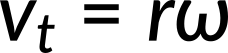
円運動の場合、回転軸からの半径における粒子の接線線速度は、次の関係によって角速度に関係します。

これは、固定軸の周りを回転する剛体上の点にも適用できます。 円運動には、均一でも不均一でも、向心加速度が存在します。 向心加速度ベクトルは、回転軸に向かって円運動を実行する粒子から内側を指します。 等速円…
物体が不均一な円運動で動いているとき、線形加速度は求心成分と接線成分で表されます。
求心性または半径状成分は、速度の方向の変化に関連付けられており、円の速度と半径で表されます。速度をオメガ×半径に置き換えると、求心加速度と角速度の関係が得られます。
接線加速度成分は瞬時速度と平行であり、速度の大きさの変化に関連付けられています。速度をオメガ×半径に置き換えると、接線加速度と角加速度の関係が得られます。
接線加速度は速度にのみ関連し、運動方向には関連しないため、角加速度は角速度が増加しているときには正になり、角速度が減少しているときには負になります。
View the full transcript and gain access to JoVE Core videos
Q1: What is the difference between centripetal and tangential acceleration in circular motion?
Centripetal acceleration is the radial component associated with changes in velocity direction, pointing inward toward the axis of rotation. Tangential acceleration is parallel to instantaneous velocity and relates to changes in speed magnitude. These two components are always perpendicular to each other and together form the total linear acceleration in nonuniform circular motion.
Q2: How do you relate centripetal acceleration to angular velocity?
Centripetal acceleration can be expressed in terms of angular velocity by replacing linear velocity with omega times radius. This relationship shows that centripetal acceleration depends on both the angular velocity and the distance from the axis of rotation. The resulting formula connects the radial acceleration component directly to rotational motion parameters.
Q3: What does tangential acceleration tell you about angular acceleration?
Tangential acceleration is associated only with changes in speed, not direction, making it directly related to angular acceleration. Angular acceleration is positive when angular velocity increases, causing positive tangential acceleration, and negative when angular velocity decreases. This relationship shows how rotational acceleration manifests as linear acceleration along the circular path.
Q4: Why does uniform circular motion have only centripetal acceleration?
In uniform circular motion, angular velocity is constant and angular acceleration is zero, so tangential acceleration is absent. The only linear acceleration present is centripetal acceleration, which continuously changes the velocity direction while maintaining constant speed. This occurs because there is no change in the magnitude of tangential velocity, only its direction.
Q5: How is total linear acceleration calculated in nonuniform circular motion?
Total linear acceleration is the vector sum of centripetal and tangential acceleration components. Since these components are perpendicular, the resultant vector points at an angle between them. This combined acceleration vector describes the complete change in velocity for a point on a rotating rigid body or particle executing nonuniform circular motion.
Q6: What is the relationship between tangential speed and angular velocity?
The linear tangential speed of a particle at a radius from the axis of rotation is related to angular velocity by the relation v equals omega times r. This relationship applies to both individual particles and points on rigid bodies rotating about a fixed axis. Replacing velocity with this expression allows conversion between linear and angular motion quantities.
Q7: How do centripetal and tangential accelerations differ in uniform versus nonuniform circular motion?
Uniform circular motion exhibits only centripetal acceleration because angular velocity remains constant. Nonuniform circular motion has both centripetal and tangential acceleration components due to angular acceleration. The presence of tangential acceleration in nonuniform motion indicates that the rotating system is speeding up or slowing down while changing direction.