16.16
熱付加環化は、反応を開始するために必要な活性化エネルギー源が熱の形で提供される反応です。 熱的に許容される付加環化の典型的な例は、[4 + 2] 付加環化であるディールスアルダー反応です。 対照的に、[2 + 2] 付加環化は熱的に禁止されています。
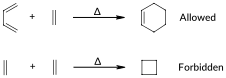
反応は、一方のπ成分の最高被占分子軌道 (HOM…
なぜ一部の環化付加反応は熱的に許可され、他の反応は禁止されているのですか?
まず、反応する成分であるHOMOとLUMOのフロンティア軌道間の相互作用を調べることから始めましょう。
熱条件下では、環化付加は基底状態のHOMOとLUMOを介して進行します。
同時結合のオーバーラップは、2つのπ成分の末端ローブが同相である場合にのみ可能です。
[4 + 2]環化付加では、反応する端は、対面の接着相互作用のための対称性が一致します。この 2 つのπコンポーネントは、両端で超対称的に相互作用すると言われており、対称性が許容される協調的なプロセスとなっています。
しかし、[2 + 2]環化付加では、対称性の不一致により、1つの結合性相互作用と1つの反結合性相互作用が生じます。
ここでは、結合形成は、一方の端で同じ面に表面的に発生し、もう一方の端では反対側の面に発生します。相互作用は対称性が許容されますが、幾何学的制約により、これは熱的に禁止されたプロセスになります。
View the full transcript and gain access to JoVE Core videos
Q1: What determines whether a cycloaddition reaction is thermally allowed or forbidden?
Thermal cycloadditions are allowed or forbidden based on frontier molecular orbital (HOMO-LUMO) symmetry. In a [4+2] cycloaddition, terminal lobes of both π components are in phase, enabling suprafacial bonding on both ends—a symmetry-allowed process. In contrast, [2+2] cycloadditions exhibit a symmetry mismatch creating one bonding and one antibonding interaction, making them thermally forbidden despite geometric constraints.
Q2: How do frontier orbitals control cycloaddition reactivity under thermal conditions?
Under thermal conditions, cycloadditions proceed through ground state HOMO and LUMO interactions between reacting π components. A simultaneous bonding overlap occurs only when terminal lobes have matching symmetries. This frontier orbital interaction determines whether the reaction proceeds as a concerted, symmetry-allowed process or remains forbidden due to orbital phase mismatches.
Q3: What is the difference between suprafacial and antarafacial bonding in cycloadditions?
Suprafacial bonding occurs on the same face of a π system, while antarafacial bonding occurs on opposite faces. In [4+2] cycloadditions, both ends interact suprafacially, allowing thermal reactivity. In [2+2] cycloadditions, one end bonds suprafacially and the other antarafacially, creating geometric constraints that make the reaction thermally forbidden despite orbital symmetry allowance.
Q4: Why is the Diels-Alder reaction a typical example of a thermally allowed cycloaddition?
The Diels-Alder reaction is a [4+2] cycloaddition where the terminal lobes of the 4π diene and 2π dienophile components are in phase. This phase matching enables suprafacial interaction on both ends, satisfying orbital symmetry requirements and making it a concerted, thermally allowed process that proceeds readily under heat activation.
Q5: What role does symmetry mismatch play in making [2+2] cycloadditions thermally forbidden?
In [2+2] cycloadditions, symmetry mismatch between the two π components creates one bonding and one antibonding orbital interaction. Although orbital overlap technically occurs, the geometric constraint requiring suprafacial bonding on one end and antarafacial on the other makes simultaneous bond formation impossible under thermal conditions, rendering the reaction forbidden.
Q6: How does heat activation relate to ground state HOMO-LUMO interactions in cycloadditions?
Heat provides activation energy that allows cycloadditions to proceed via ground state HOMO and LUMO interactions. Under thermal conditions, the reacting components access their lowest energy molecular orbitals, enabling concerted bond formation when terminal lobes are in phase. This contrasts with photochemical activation, which uses excited state orbitals.
Q7: What makes a cycloaddition concerted and symmetry-allowed?
A cycloaddition is concerted and symmetry-allowed when terminal lobes of reacting π components have matching symmetries, enabling simultaneous bonding overlap. This phase alignment allows both ends to interact suprafacially in a single step without breaking or forming intermediate bonds. The [4+2] cycloaddition exemplifies this symmetry-allowed concerted mechanism.